



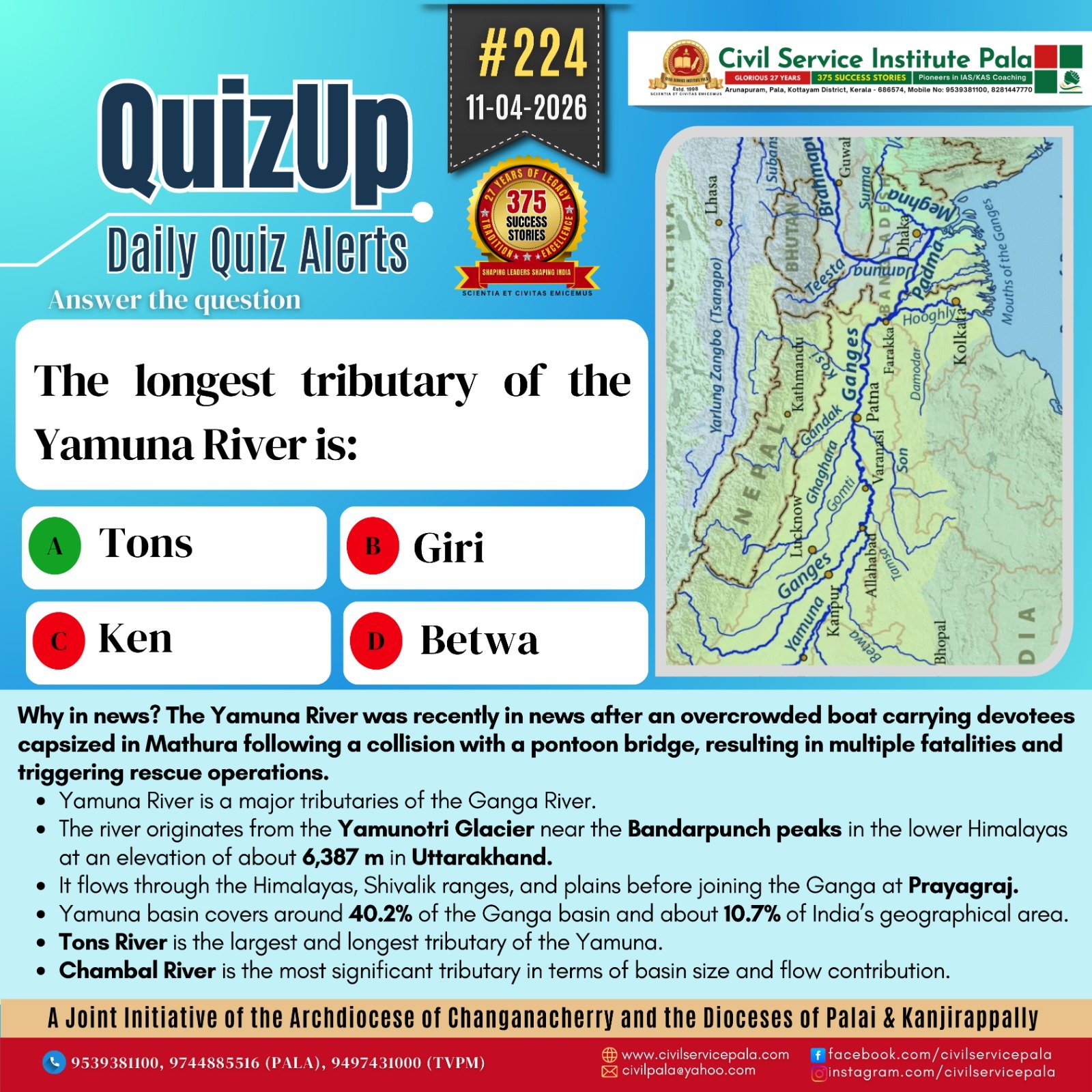
Yamuna River
Background
• Yamuna River is one of the major tributaries of the Ganga River and plays a crucial role in the Indo-Gangetic river system.
• The river originates from the Yamunotri Glacier near the Bandarpunch peaks in the lower Himalayas at an elevation of about 6,387 m in Uttarakhand.
• It flows through the Himalayas, Shivalik ranges, and plains before joining the Ganga at Prayagraj (Allahabad).
• Yamuna basin covers around 40.2% of the Ganga basin and about 10.7% of India’s geographical area.
Course of the River
• The river initially flows through steep Himalayan valleys for about 200 km before entering the plains at Dak Pathar.
• It passes through key regions including Himachal Pradesh, Uttarakhand, Haryana, Delhi, Uttar Pradesh, and Madhya Pradesh.
• Major barrages such as Wazirabad and Okhla regulate its flow for irrigation and drinking water.
• The river becomes discontinuous in the dry season due to excessive diversion and reduced environmental flow.
Segments of Yamuna
The river is divided into five segments based on hydrological characteristics.
1. Himalayan Segment extends from origin to Tajewala Barrage (~172 km).
2. Upper Segment runs from Tajewala to Wazirabad (~224 km).
3. Delhi Segment covers Wazirabad to Okhla (~22 km) and is highly polluted.
4. Eutrophicated Segment extends from Okhla to Chambal confluence (~490 km).
5. Diluted Segment runs from Chambal confluence to Ganga confluence (~468 km).
Major Tributaries
• Tons River is the largest and longest tributary of the Yamuna.
• Chambal River is the most significant tributary in terms of basin size and flow contribution.
• Other important tributaries include Hindon, Betwa, and Ken.
• The tributaries of Yamuna account for 70.9% of the catchment area.
• The basin supports diverse forests such as Sal, Khair, and Shivalik pine forests.
Challenges
• Experts highlight that excessive water diversion through canals leads to reduced downstream flow.
• Pollution levels are extremely high in the Delhi segment due to untreated sewage and industrial waste.
• Seasonal drying of the river disrupts ecological continuity and aquatic life.
• Urbanisation and agricultural pressures have degraded water quality and river health.
