



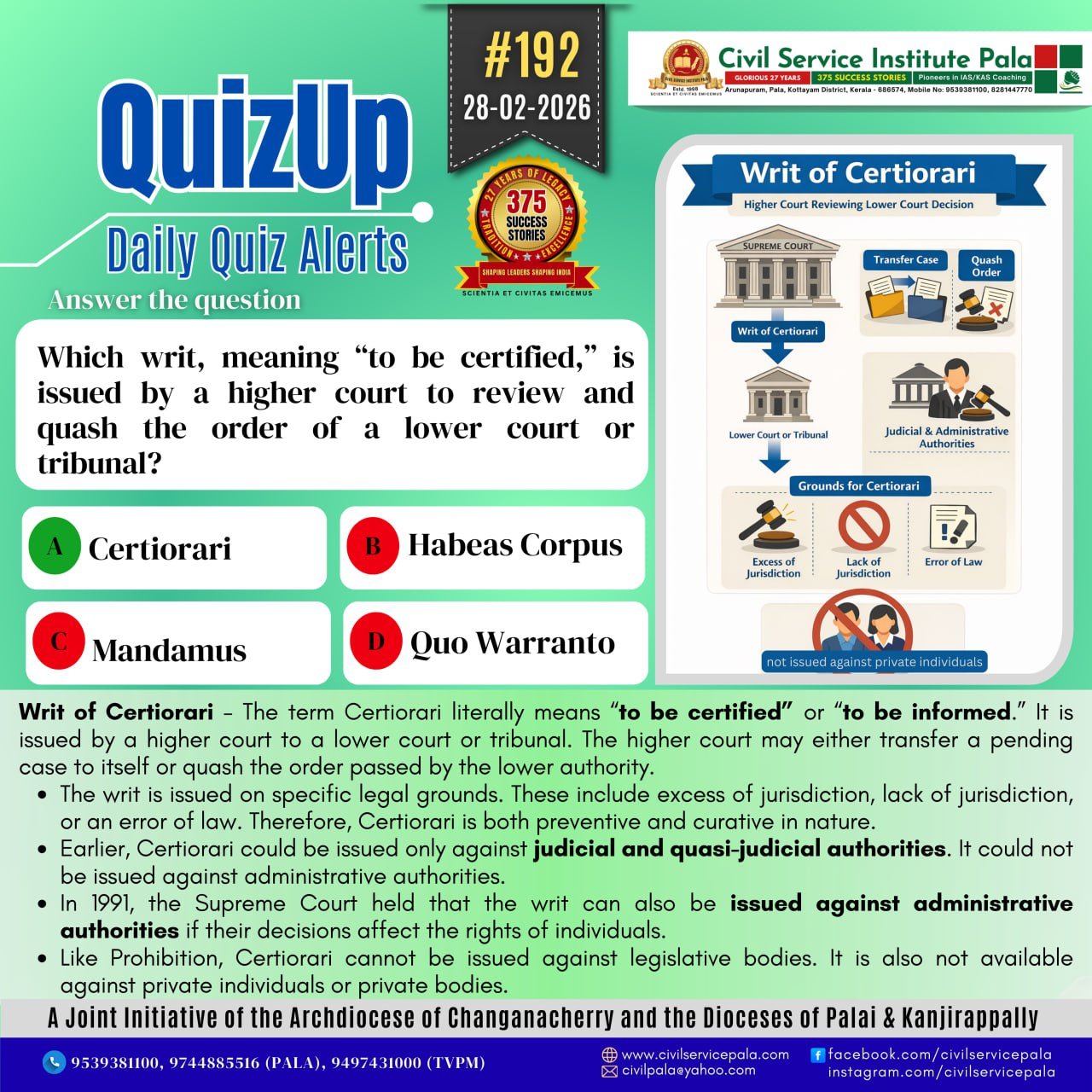
Writ of Certiorari
The term Certiorari literally means “to be certified” or “to be informed.” It is issued by a higher court to a lower court or tribunal. The higher court may either transfer a pending case to itself or quash the order passed by the lower authority.
The writ is issued on specific legal grounds. These include excess of jurisdiction, lack of jurisdiction, or an error of law. Therefore, unlike the writ of Prohibition, which is purely preventive, Certiorari is both preventive and curative in nature.
Earlier, Certiorari could be issued only against judicial and quasi-judicial authorities. It could not be issued against administrative authorities. However, in 1991, the Supreme Court held that the writ can also be issued against administrative authorities if their decisions affect the rights of individuals.
Like Prohibition, Certiorari cannot be issued against legislative bodies. It is also not available against private individuals or private bodies.
Constitutional Basis: Article 32
The Right to Constitutional Remedies is provided under Article 32 of the Indian Constitution. It is placed in Part III, which deals with Fundamental Rights.
Article 32 guarantees the right to move the Supreme Court for the enforcement of Fundamental Rights. The right to seek protection of Fundamental Rights is itself a Fundamental Right.
Dr. B.R. Ambedkar described Article 32 as the “heart and soul” of the Constitution. He stated that without this article, the Constitution would be a nullity. The Supreme Court has also recognised Article 32 as a part of the basic structure of the Constitution.
Provisions under Article 32
Article 32 contains four key provisions:
(a) It guarantees the right to move the Supreme Court for enforcement of Fundamental Rights.
(b) It empowers the Supreme Court to issue directions, orders, or writs for enforcement of these rights.
(c) It authorises Parliament to empower other courts to issue such writs.
(d) It states that the right to move the Supreme Court cannot be suspended except as provided by the Constitution.
Under Article 359, the President may suspend the right to move any court for enforcement of specified Fundamental Rights during a National Emergency.
Types of Writs
The Supreme Court under Article 32 and the High Courts under Article 226 can issue five writs:
• Habeas Corpus
• Mandamus
• Prohibition
• Certiorari
• Quo Warranto
Parliament may also empower other courts to issue these writs.
