



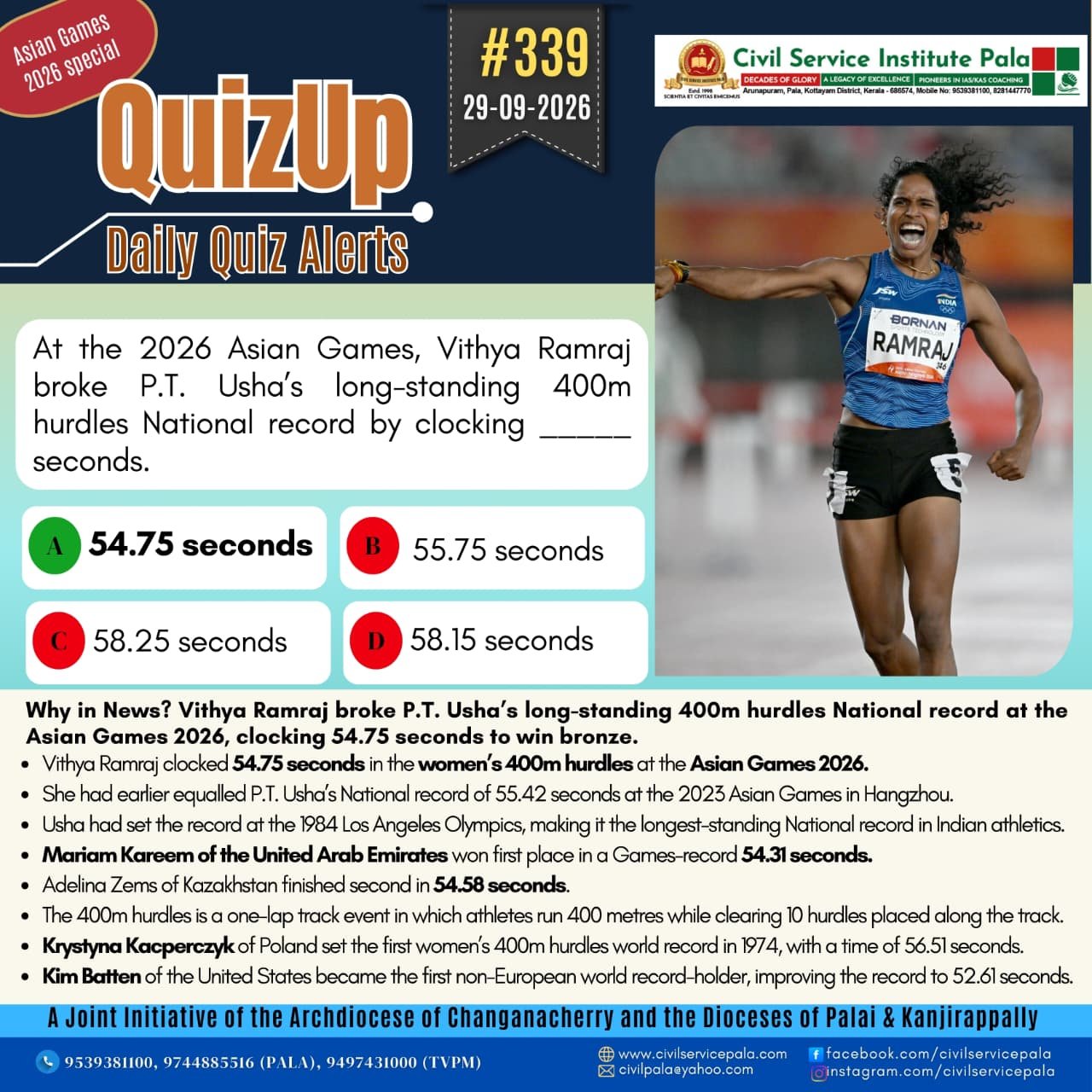
Vithya Ramraj Breaks P.T. Usha’s 400m Hurdles Record
Vithya Ramraj Breaks P.T. Usha’s 400m Hurdles Record
Why in News?
Vithya Ramraj broke P.T. Usha’s 28-year-old 400m hurdles National record at the Asian Games 2026, clocking 54.75 seconds to win bronze.
A Long-Standing Record Broken
• Vithya Ramraj clocked 54.75 seconds in the women’s 400m hurdles at the Asian Games 2026.
• She had earlier equalled P.T. Usha’s National record of 55.42 seconds at the 2023 Asian Games in Hangzhou.
• Usha had set the record at the 1984 Los Angeles Olympics, making it the longest-standing National record in Indian athletics.
• Vithya finally improved the mark by 0.67 seconds, lowering it from 55.42 to 54.75 seconds.
• She finished third in the race. Mariam Kareem of the United Arab Emirates won in a Games-record 54.31 seconds, while Adelina Zems of Kazakhstan finished second in 54.58 seconds.
Understanding the 400m Hurdles
The 400m hurdles is a one-lap track event in which athletes run 400 metres while clearing 10 hurdles placed along the track.
• The first hurdle is placed 45 metres from the starting line.
• The remaining nine hurdles are placed at intervals of 35 metres.
• The hurdle height is 91.4 cm for men and 76.2 cm for women.
• An athlete can continue the race after knocking down a hurdle.
• A false start results in immediate disqualification.
Historical Background
• The first 440-yard hurdles race was held in Oxford, England, around 1860, with competitors clearing 12 large wooden barriers.
• The men’s 400m hurdles became an Olympic event in 1900.
• The women’s 400m hurdles was introduced at the 1984 Olympic Games.
Women’s 400m Hurdles World Record
• Krystyna Kacperczyk of Poland set the first women’s 400m hurdles world record in 1974, with a time of 56.51 seconds.
• Kim Batten of the United States became the first non-European world record-holder, improving the record to 52.61 seconds.
• Yuliya Pechonkina of Russia lowered it further to 52.34 seconds in 2003.
• Since 2019, Dalilah Muhammad and Sydney McLaughlin-Levrone have repeatedly broken the world record.
• Sydney McLaughlin-Levrone’s 50.65 seconds in 2024 is the fastest time at present.
