



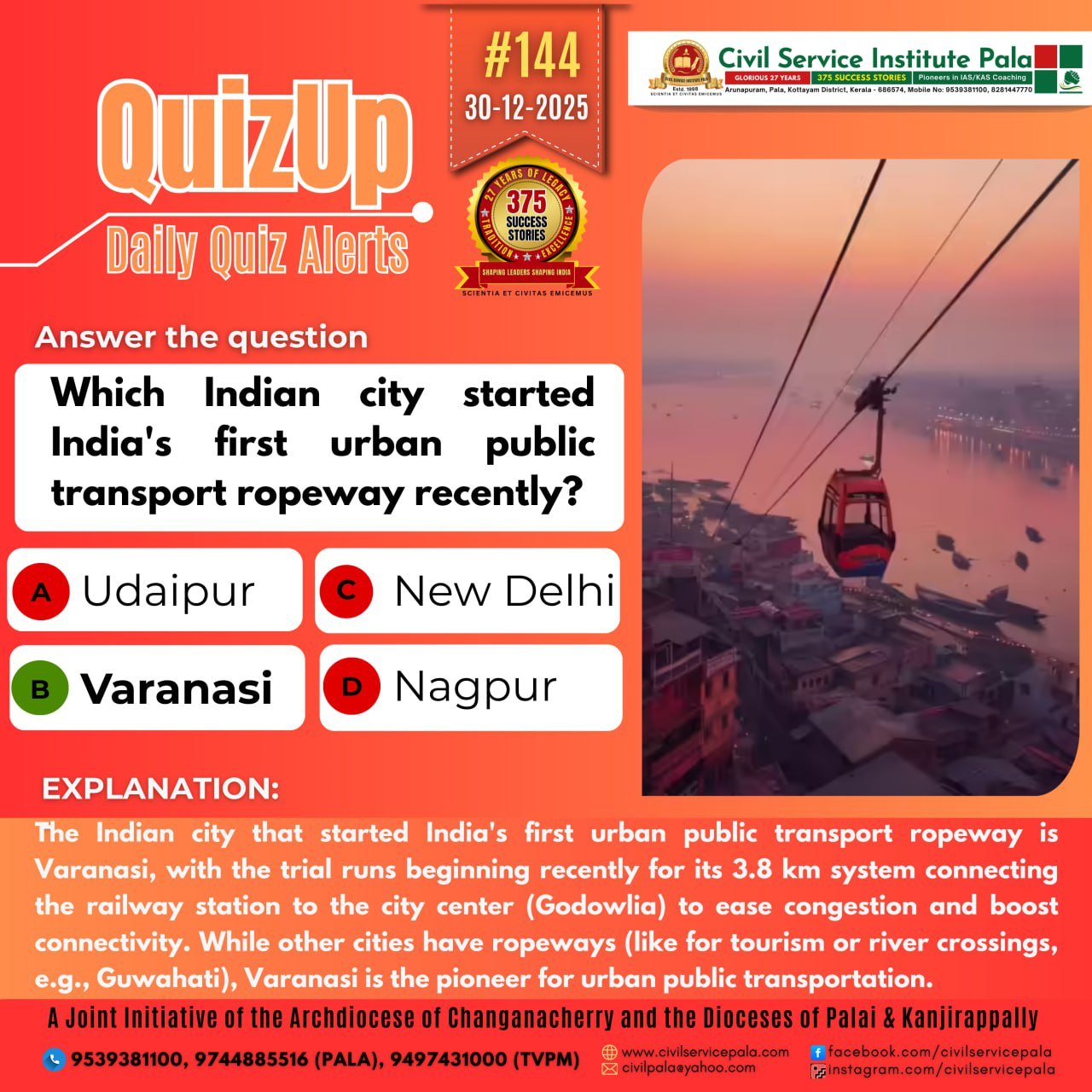
Varanasi Ropeway
The Varanasi Ropeway, officially known as the Varanasi Urban Ropeway Project, is India’s first ropeway system developed specifically for urban public transport. It is a pioneering initiative aimed at addressing severe traffic congestion in the ancient city of Varanasi, where narrow roads, dense population, and heavy tourist and pilgrim movement make conventional transport expansion difficult. The project represents a shift towards innovative and sustainable urban mobility solutions in India.
The ropeway covers a distance of about 3.9 kilometres, connecting Cantt Railway Station with Godowlia Chowk, one of the busiest areas near the Kashi Vishwanath Corridor. Along the route, it includes intermediate stations at Vidya Peeth and Rath Yatra, thereby linking major transport hubs, commercial centres, and pilgrimage locations. This connectivity is expected to greatly ease movement for both residents and visitors.
Technologically, the project uses Monocable Detachable Gondola (MDG) technology, with fully automated cable cars operating continuously. Each cabin can carry around 10 passengers and is designed to be barrier-free, making it accessible to elderly people and persons with disabilities. The ropeway operates at a speed of around 5–6 metres per second, reducing travel time from nearly an hour by road to about 15–16 minutes.
The choice of a ropeway system is particularly suited to Varanasi’s urban landscape, as it requires minimal land acquisition and avoids large-scale demolition in heritage areas. Being electrically operated, it produces no direct emissions, helping reduce air and noise pollution while preserving the city’s cultural and historical character.
The Varanasi Ropeway is being implemented under the National Ropeways Development Programme – Parvatmala on a Public–Private Partnership (PPP) model, with National Highways Logistics Management Limited (NHLML) as the implementing agency. With a passenger capacity of around 3,000 persons per hour per direction, the project is expected to significantly decongest city roads and improve urban mobility.
Overall, the Varanasi Ropeway holds national significance as India’s first urban ropeway transport system and serves as a model for other congested Indian cities. It aligns with the goals of sustainable development, green transport, and smart urban infrastructure, demonstrating how modern technology can be integrated into heritage cities without compromising their identity.
