



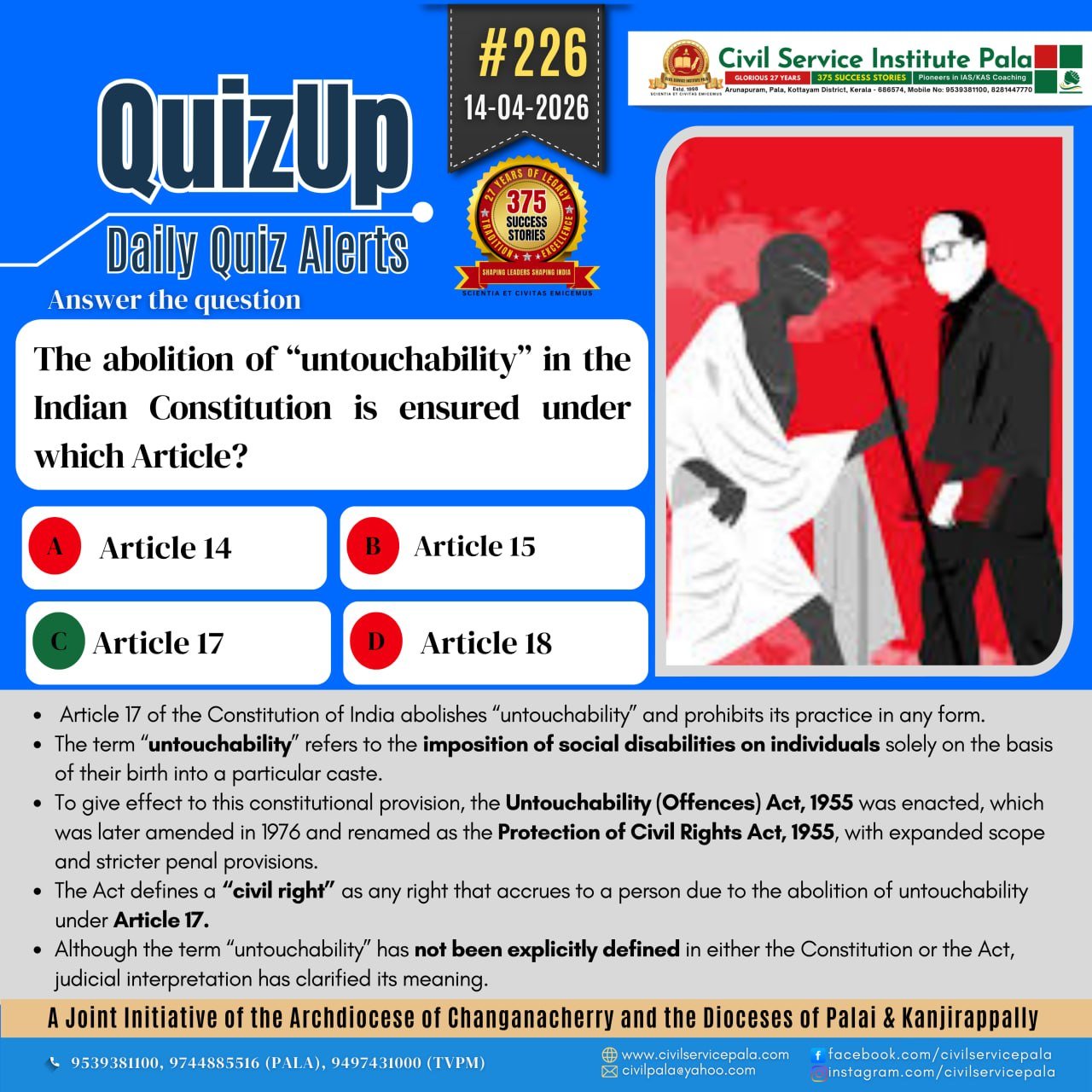
Untouchability
Constitutional Provision: Article 17
• Article 17 of the Constitution of India abolishes “untouchability” and prohibits its practice in any form, making its enforcement a punishable offence under law.
• The term “untouchability” refers to the imposition of social disabilities on individuals solely on the basis of their birth into a particular caste.
Legal Framework & Enforcement
• To give effect to this constitutional provision, the Untouchability (Offences) Act, 1955 was enacted, which was later amended in 1976 and renamed as the Protection of Civil Rights Act, 1955, with expanded scope and stricter penal provisions.
• The Act defines a “civil right” as any right that accrues to a person due to the abolition of untouchability under Article 17.
Judicial Interpretation
• Although the term “untouchability” has not been explicitly defined in either the Constitution or the Act, judicial interpretation has clarified its meaning.
• The Mysore High Court held that Article 17 does not refer to untouchability in a literal sense, but rather to the practice as it historically evolved in India, particularly the social disabilities imposed on certain castes.
• The Supreme Court has further emphasized that the right under Article 17 is enforceable not only against the State but also against private individuals, placing a constitutional obligation on the State to prevent its violation.
Social Context: Caste System
• The persistence of untouchability is rooted in India’s caste system, one of the world’s oldest surviving social hierarchies.
• Closely associated with Hindu social structure, the caste system is based on a complex ordering of groups determined by ritual purity.
• Individuals are born into a caste and generally remain within it throughout their lives, with status traditionally justified by the doctrine of karma, which links one’s social position to actions in past lives.
Structure of Caste Hierarchy
• Traditionally, the caste system has been understood through the framework of four varnas: Brahmins (priests and teachers), Kshatriyas (rulers and warriors), Vaishyas (traders and merchants), and Shudras (labourers and artisans).
• Outside this system are those historically referred to as “untouchables” or Dalits, who were assigned tasks considered ritually impure and were excluded from the varna hierarchy.
Despite the constitutional abolition of untouchability in 1950, its practice continues in various forms, particularly in rural India, where social discrimination and exclusion based on caste still persist, highlighting the gap between legal provisions and social reality.
