



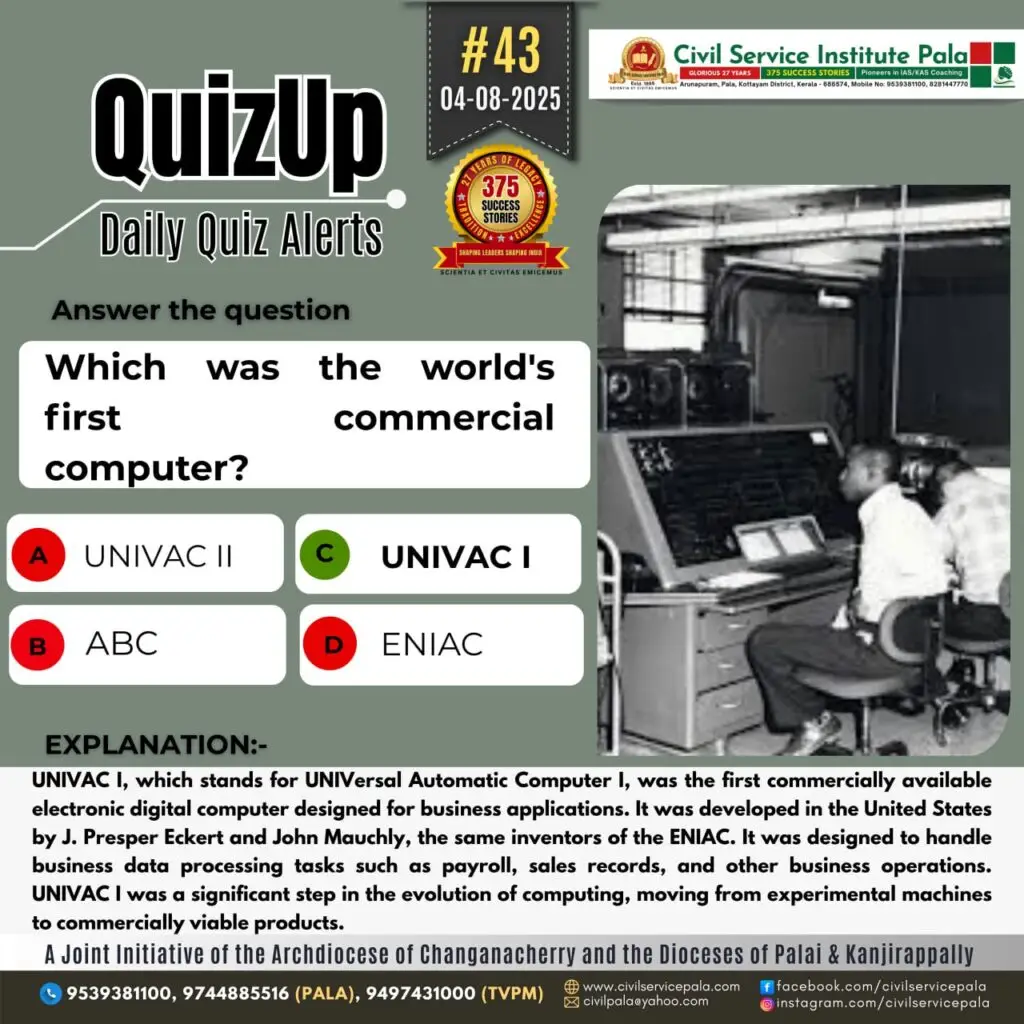
UNIVAC I (Universal Automatic Computer I)
UNIVAC I (Universal Automatic Computer I) was the first commercial computer produced in the United States. It holds a significant place in computing history as a pioneer in bringing computers out of military and academic labs and into the business world.
Key Facts about UNIVAC I:
Developed by: J. Presper Eckert and John Mauchly (creators of the earlier ENIAC)
Company: Eckert-Mauchly Computer Corporation (later acquired by Remington Rand)
Introduced in: 1951
First customer: U.S. Census Bureau
Technical Features:
Technology: Used vacuum tubes (over 5,000 of them)
Memory: Used mercury delay lines for main memory with a capacity of about 1,000 words (12 characters each)
Storage: Magnetic tape system (one of the first to use it for input/output)
Speed: Could perform ~1,000 calculations per second
Input/Output: Used punched cards and magnetic tape
Importance and Legacy:
First computer used for business applications, including insurance, banking, and inventory.
Famously predicted the 1952 U.S. Presidential election results live on CBS—correctly forecasting Eisenhower’s win.
Marked a shift from custom-built computers to mass-produced commercial machines.
Helped lay the foundation for modern data processing in government and business.
Fun Fact:
Only 46 UNIVAC I systems were ever built, but their success helped launch the commercial computing industry.
