



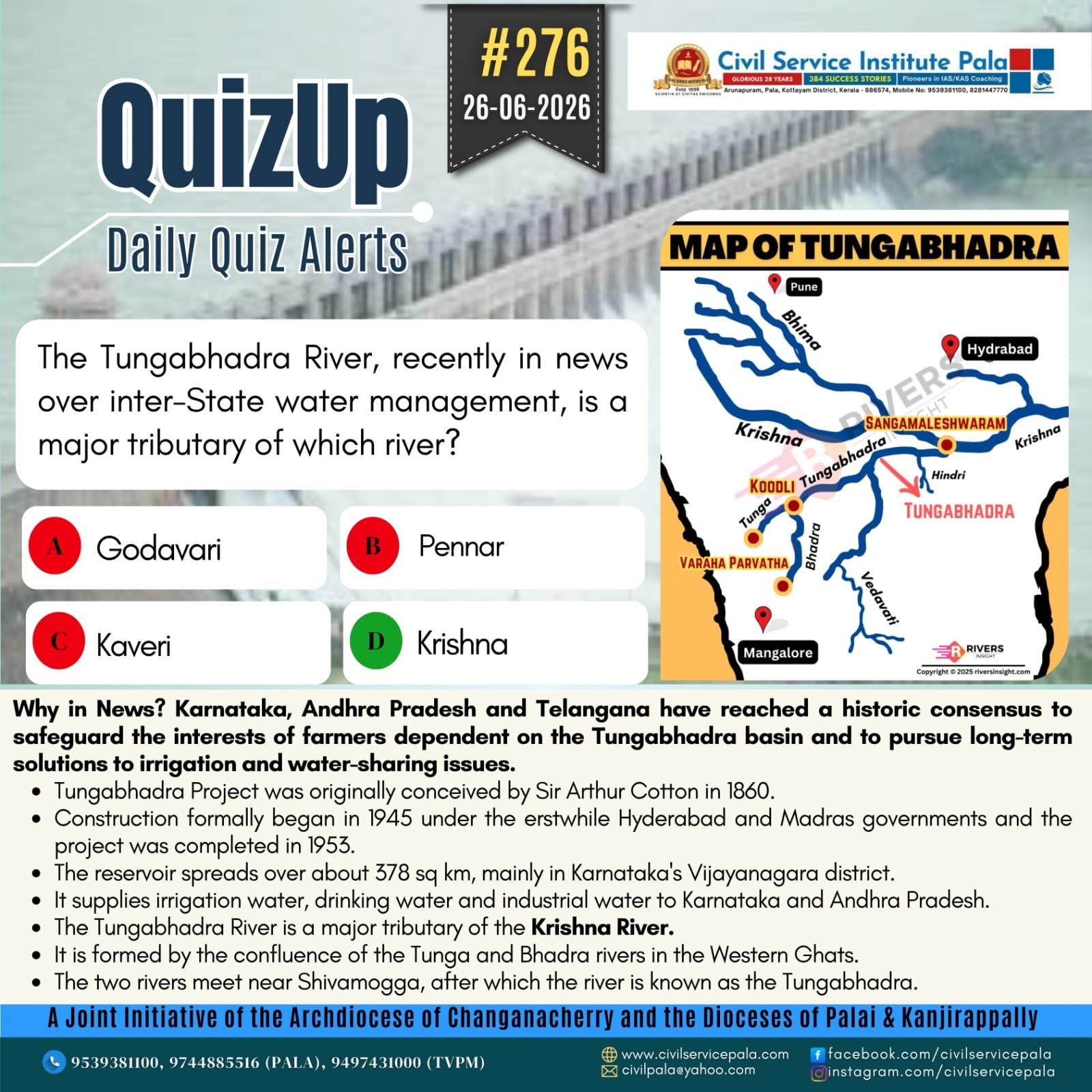
Tungabhadra River
Why in News?
• Karnataka, Andhra Pradesh and Telangana have reached a historic consensus to safeguard the interests of farmers dependent on the Tungabhadra basin and to pursue long-term solutions to irrigation and water-sharing issues.
• The announcement coincided with the inauguration of 33 newly installed spillway gates of the Tungabhadra Dam.
• The three States, along with the Union Government, also agreed to cooperate in the desilting of the Tungabhadra Reservoir, where nearly 33 TMC ft of silt has accumulated, reducing its storage capacity.
Tungabhadra River
• The Tungabhadra River is a major tributary of the Krishna River.
• It is formed by the confluence of the Tunga and Bhadra rivers, both of which originate in the Western Ghats.
• The two rivers meet near Shivamogga, after which the river is known as the Tungabhadra.
• The river flows for about 531 km before joining the Krishna River at Sangamaleshwaram.
• The combined waters ultimately drain into the Bay of Bengal at Hamsaladeevi.
• Of its total course:
o 382 km flows through Karnataka.
o 58 km forms the Karnataka–Andhra Pradesh boundary.
o 91 km flows through Andhra Pradesh.
• The river is largely dependent on the South-West Monsoon and remains perennial, although summer discharge declines considerably.
Tungabhadra Project
• The project was originally conceived by Sir Arthur Cotton in 1860 to mitigate recurring famines in the Rayalaseema region.
• Construction formally began in 1945 under the erstwhile Hyderabad and Madras governments and the project was completed in 1953.
• Technical disagreements during construction regarding dam design and engineering were resolved by a Board of Engineers chaired by M. Visvesvaraya.
• Following the reorganisation of States in 1956, the project became a joint responsibility of Karnataka and Andhra Pradesh.
• The reservoir spreads over about 378 sq km, mainly in Karnataka's Vijayanagara district.
• It supplies irrigation water, drinking water and industrial water to Karnataka and Andhra Pradesh.
Tungabhadra Board
• The Tungabhadra Board was established through a Presidential Order in 1953.
• The Board consists of:
o A Chairman appointed by the Union Government.
o Four members representing the Union Government, Karnataka, Andhra Pradesh and Telangana.
• It oversees the operation, maintenance and management of the Tungabhadra Project.
Current Challenges and Recent Developments
• Decades of sediment deposition have resulted in the accumulation of nearly 33 TMC ft of silt, reducing the effective storage capacity of the reservoir.
• The Union Government has proposed large-scale dredging and desilting, with technical assistance from the Centre and cooperation from all three basin States.
• Replacement of all 33 spillway gates has strengthened the long-term safety and operational efficiency of the dam.
• The recent agreement among Karnataka, Andhra Pradesh and Telangana reflects a cooperative approach towards sustainable water management and farmer welfare in the Tungabhadra basin.
