



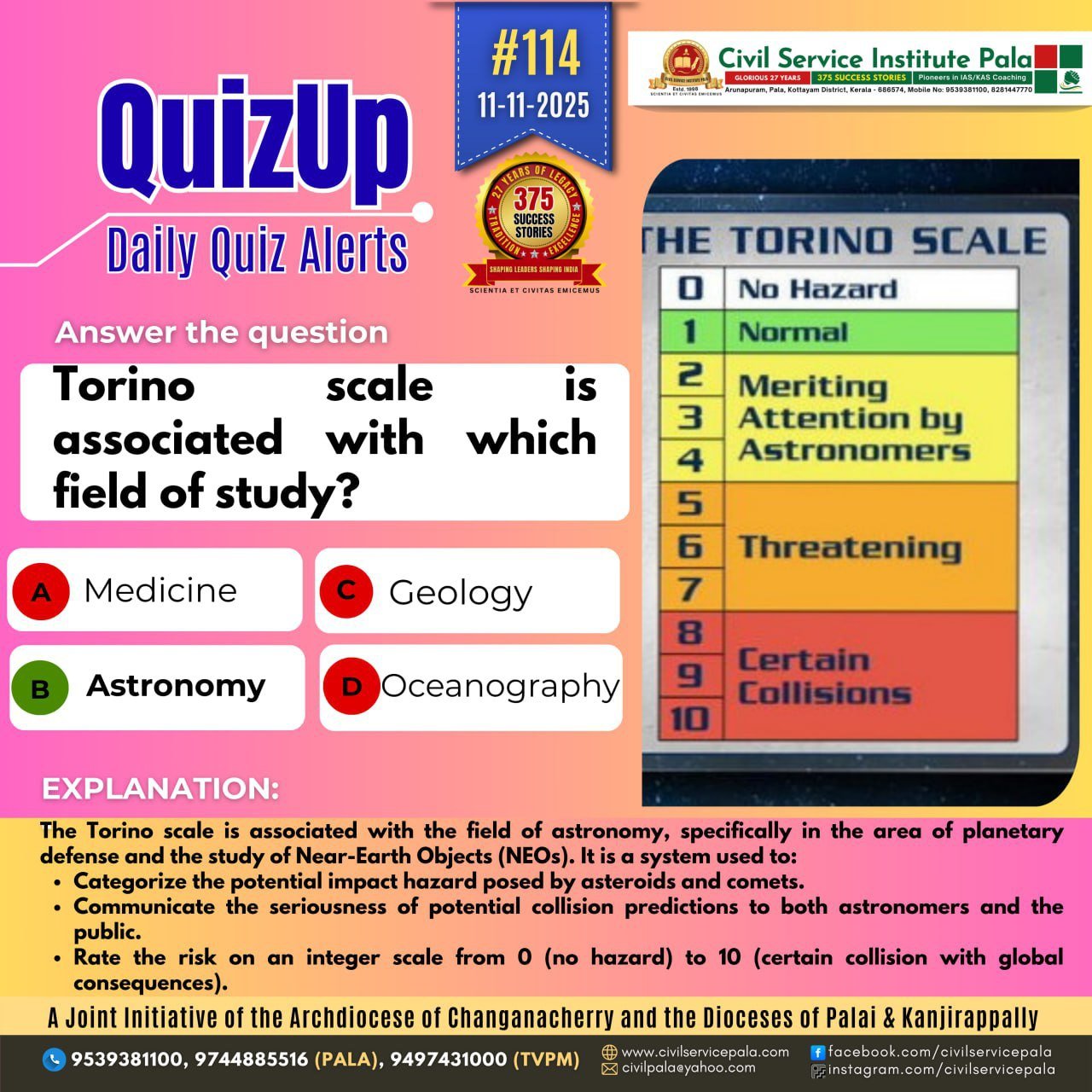
Torino Scale
1. What is the Torino Scale? The Torino Scale is a scientific tool used to measure the potential hazard of near-Earth objects (NEOs) — such as asteroids or comets — that could impact Earth. It was developed in 1999 by Professor Richard P. Binzel of the Massachusetts Institute of Technology (MIT). The scale combines two key factors: Probability of collision Kinetic energy (impact energy) of the object
2. Structure of the Scale The scale ranges from 0 to 10, with: 0 = No risk (or so small that it’s negligible) 10 = Certain collision with global catastrophic effects
3. Purpose and Importance It provides a clear and standardized way for scientists, governments, and the public to understand and communicate the risk posed by an approaching celestial object.Helps prioritize monitoring efforts for objects that pose higher potential threats.
4. Applications of the Torino Scale Risk Assessment: Helps astronomers and space agencies (like NASA and ESA) evaluate which asteroids need further observation or tracking. Public Communication: Offers an easy-to-understand numerical rating to communicate the real level of danger to the public, reducing misinformation or panic. Policy and Preparedness: Assists decision-makers in creating planetary defense strategies, such as deflection missions or evacuation plans if a credible threat exists. Scientific Collaboration: Encourages international cooperation through shared databases of NEO observations and unified risk scales.
5. Related Scales The Palermo Technical Impact Hazard Scale is a more technical, logarithmic version used by scientists for detailed calculations, while the Torino Scale is designed for public communication.
