



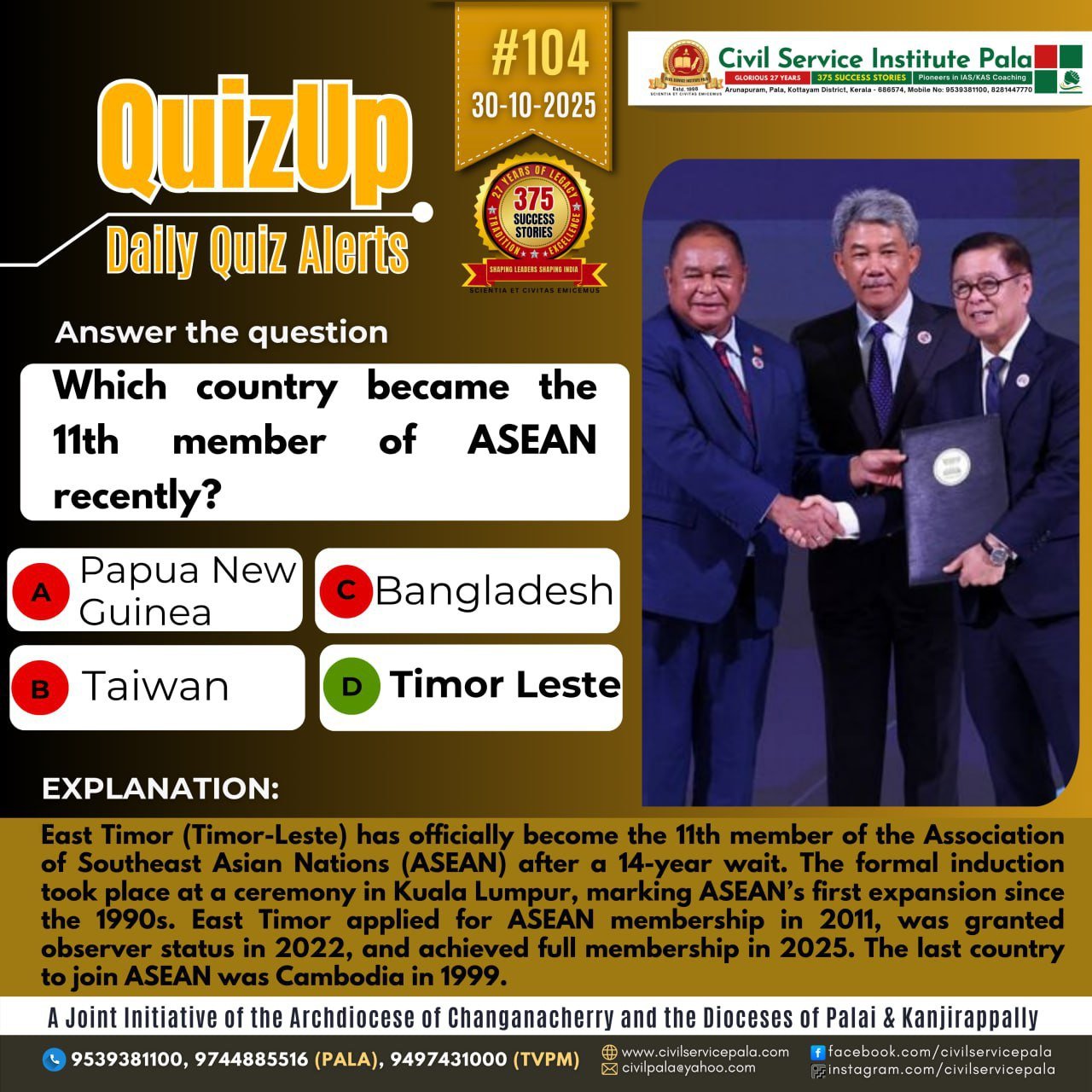
Timor-Leste
Timor-Leste (also known as East Timor) officially became the 11th member of Association of Southeast Asian Nations (ASEAN) on 26 October 2025. Background & Timeline Timor-Leste first gained independence in 2002, after a long period of colonial rule and conflict. It applied for full ASEAN membership, and after years of preparation and negotiation (including being an observer). The ASEAN Summit in Kuala Lumpur in October 2025 formalised its accession.
Why is this important? This is the first expansion of ASEAN since the 1990s. It reflects ASEAN’s aim to be more inclusive of all Southeast Asian nations and to bring in a low-income, young democracy into the regional fold. For Timor-Leste, membership opens up access to ASEAN’s economic, security and sociocultural frameworks: trade, investment, regional cooperation. For ASEAN, integrating Timor-Leste adds to its unity and perhaps its strategic depth: a nation in a key location with ASEAN neighbours. Challenges & Considerations Timor-Leste is one of Asia’s youngest and least developed countries, with many structural economic and governance hurdles.
Ensuring it meets ASEAN’s economic integration standards (free trade, infrastructure, connectivity) will be a major task. Its full participation means ASEAN will need to invest in capacity-building and cooperation to bring it up to speed. Implications for India / Our Region With Timor-Leste in ASEAN, India’s relations with ASEAN (via its “Act East” policy, etc) may deepen to include one more member. There may be new bilateral and multilateral opportunities (trade, maritime security, development) involving Timor-Leste and neighbouring ASEAN states.
