



Time Zones
Time Zones
Why do we have different time zones?
• The Earth rotates from west to east, completing one rotation in 24 hours, which causes different places to experience day and night at different times.
• To standardise time, the world is divided into 24 longitudinal zones, each roughly 15° wide, with a difference of one hour between adjacent zones.
• This system ensures that local time corresponds approximately to the position of the Sun in the sky, making daily activities more practical.
Reference Line for Time Calculation
• All time zones are measured from the Prime Meridian, which passes through Greenwich Observatory.
• Time at this line is called Greenwich Mean Time (GMT) or Universal Time (UT).
• Regions east of Greenwich add hours, while those west subtract hours.
International Date Line (IDL)
• • Located roughly opposite the Prime Meridian at 180° longitude.
* Crossing the IDL results in a change of date (forward or backward by one day).
* This system ensures global consistency in calendar dates.
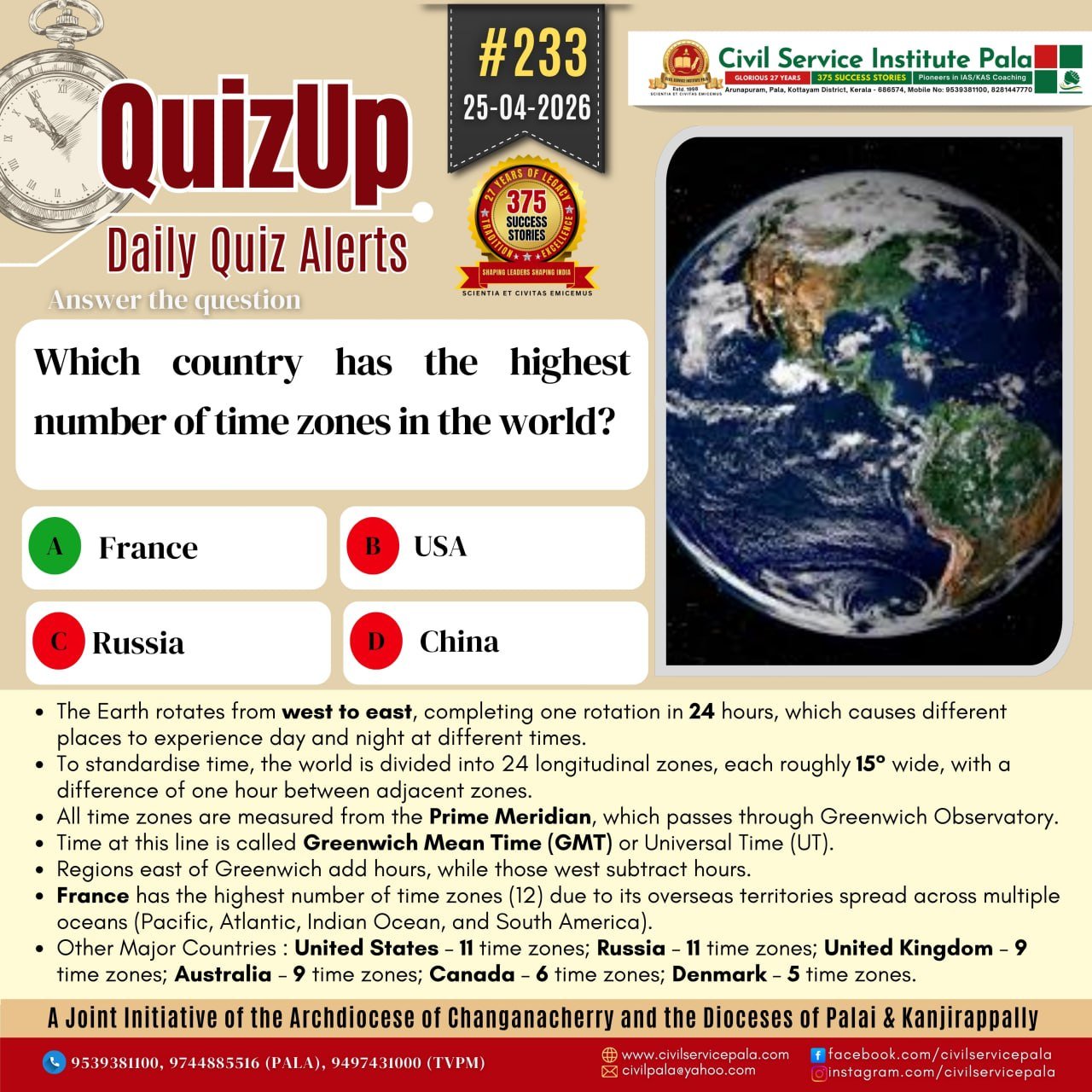
France has the highest number of time zones (12) due to its overseas territories spread across multiple oceans (Pacific, Atlantic, Indian Ocean, and South America).
Other Major Countries
* United States – 11 time zones
* Russia – 11 time zones
* United Kingdom – 9 time zones
* Australia – 9 time zones
* Canada – 6 time zones
* Denmark – 5 time zones
* New Zealand – 5 time zones
* Brazil – 4 time zones
* Mexico – 4 time zones
