



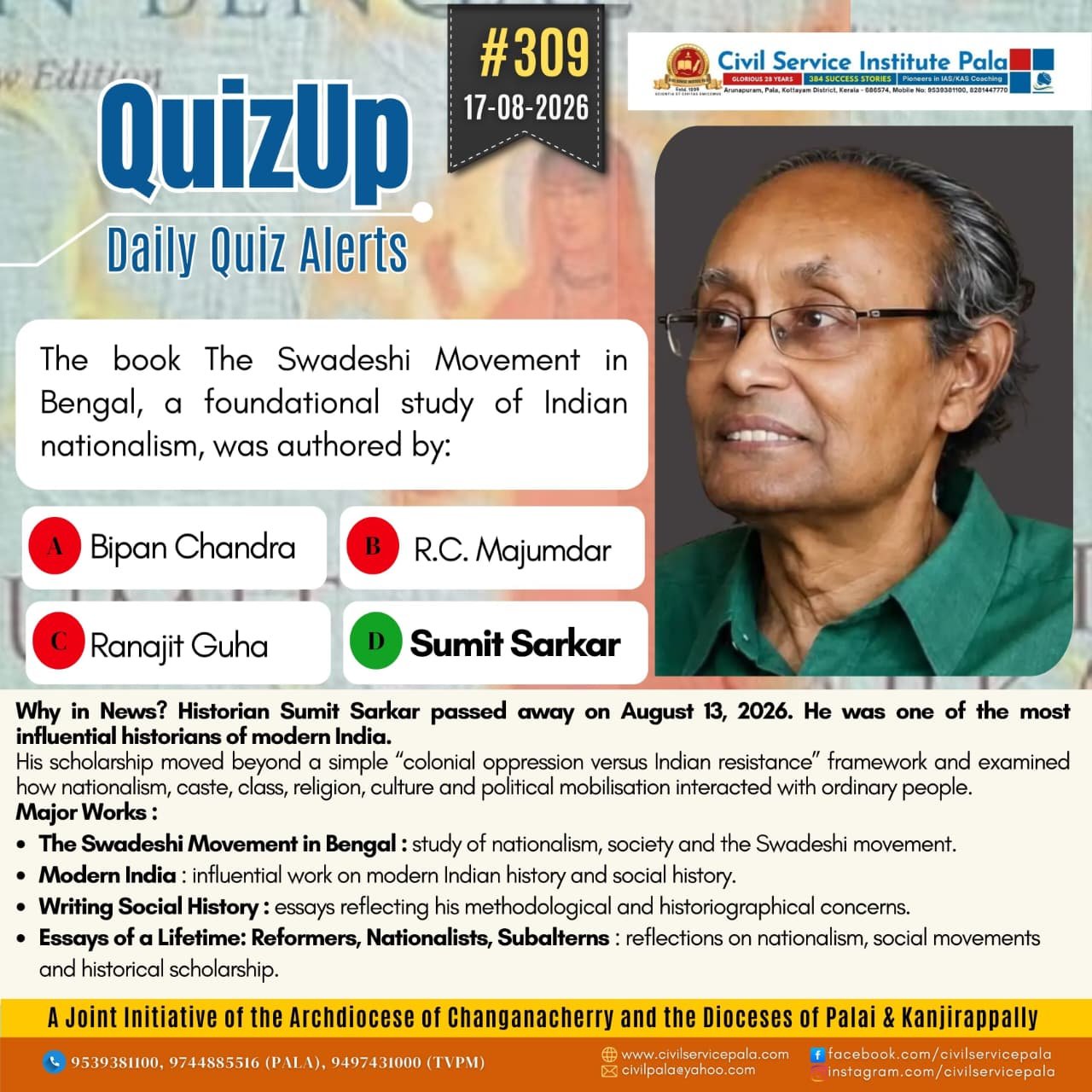
Sumit Sarkar and the Study of Modern Indian History
Sumit Sarkar and the Study of Modern Indian History
Why in News? Historian Sumit Sarkar passed away on August 13, 2026. He was one of the most influential historians of modern India.
His major works include:
• The Swadeshi Movement in Bengal — study of nationalism, society and the Swadeshi movement.
• Modern India — influential work on modern Indian history and social history.
• Writing Social History — essays reflecting his methodological and historiographical concerns.
• Essays of a Lifetime: Reformers, Nationalists, Subalterns — reflections on nationalism, social movements and historical scholarship.
Impact
His works, particularly The Swadeshi Movement in Bengal, Modern India and Writing Social History, made important contributions to Marxist social history and the emerging Subaltern Studies tradition.
A New Approach to the Swadeshi Movement
Sarkar's The Swadeshi Movement in Bengal is regarded as a foundational work on the anti-partition movement that followed the 1905 Partition of Bengal. Its methodological importance lay in his use of a wide range of sources covering plays, novels, newspapers and pamphlets.
He examined the Swadeshi movement through multiple social and cultural factors.
His research helped understand how economic difficulties such as educated unemployment and rising prices contributed to popular anger, while Japan's victory over Russia in the Russo-Japanese War (1904–05) also influenced contemporary perceptions of imperial power.
Sarkar was particularly interested in contradictions within nationalist politics where the nationalist discourse could simultaneously support labour mobilisation and caste hierarchy, and why participation in revolutionary nationalism was particularly significant among sections of the upper-caste educated classes. This helped widen the exploration of how Hindu nationalism gradually acquired wider social acceptance.
From Nationalist History to History from Below
Sarkar challenged the economic determinism and narrow positivism that he associated with much Marxist scholarship of his time. Although Marxism remained an important influence, he did not treat it as a rigid framework. Instead, he combined material conditions with culture, religion, caste, print, urban life and everyday social experiences.
His Modern India became particularly influential among students and is associated with the development of social history and Subaltern Studies.
His approach focused on the “pressure from below”—examining how ordinary people shaped historical processes rather than viewing history solely through major political leaders and nationalist icons.
This included attention to farmers, workers, women, tribals, Dalits and lower-caste and class communities. He also explored how ordinary people could simultaneously display apparently contradictory characteristics—being hierarchical as well as democratic, or communal as well as nationalist.
Religion, Culture and Social History
Sarkar treated religion as an important historical archive, studying it as a social and cultural phenomenon rather than from the standpoint of religious belief.
His study of Ramakrishna Paramhansa connected religious ideas with the social environment in which they emerged.
He examined the relationship between Ramakrishna's ideas and the emerging urban middle class and clerical culture of nineteenth-century Bengal.
His work sought to connect seemingly different dimensions of history such as material conditions, cultural forms, religious ideas and social structures within a broader historical framework.
His scholarship also examined figures such as Ishwar Chandra Vidyasagar, focusing not simply on whether reformers “succeeded” or “failed”, but on the social processes underlying these outcomes.
