



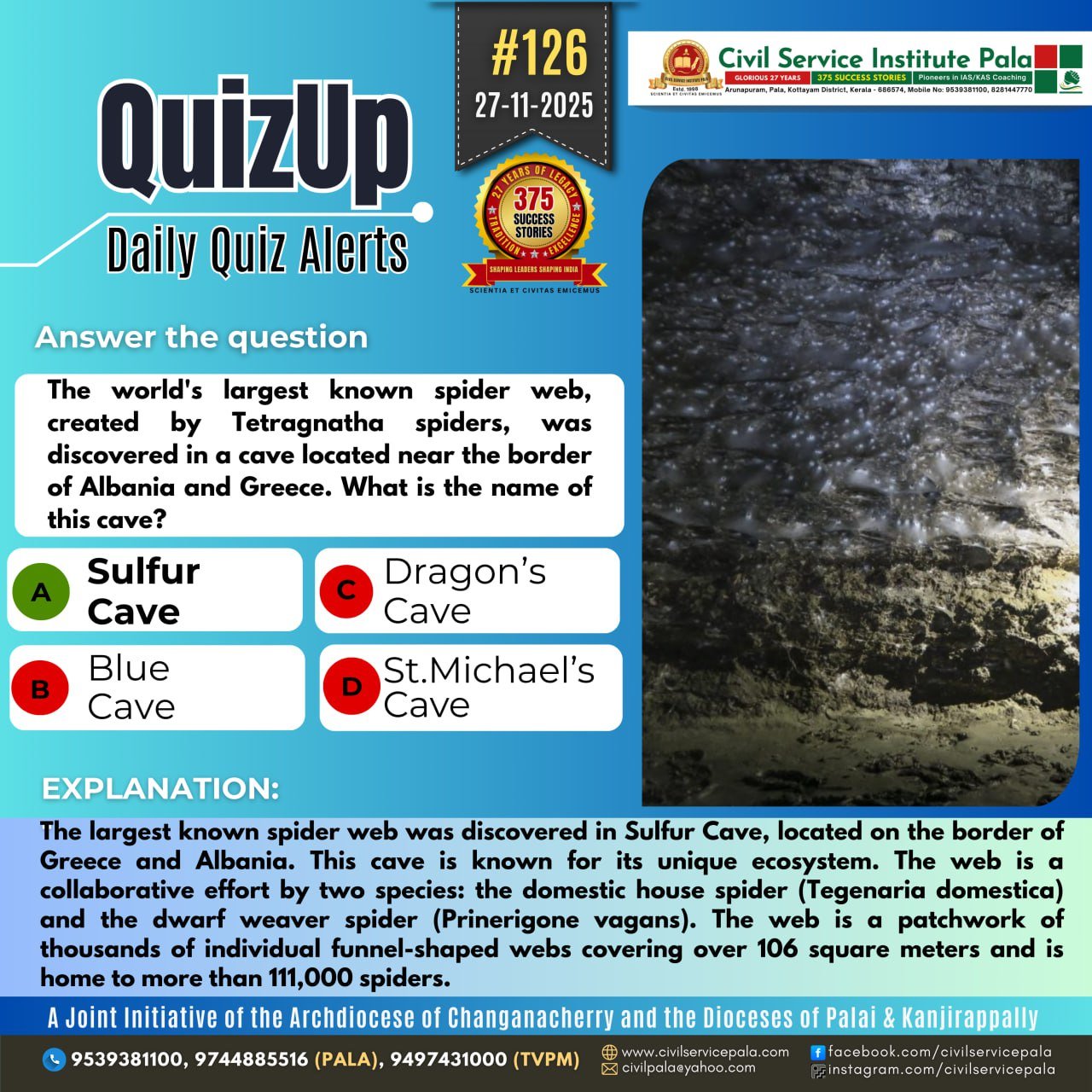
Sulfur Cave
What was discovered
In late 2025 scientists announced that within a cave straddling the border of Greece and Albania — known as Sulfur Cave — they found what’s likely the largest spider web ever documented.
The web spans about 106 square metres (≈ 1,140 square feet — roughly half the size of a tennis court).
The structure is not just a single web, but a huge, multi-layered network composed of thousands of individual funnel-shaped webs, all intertwined across a cave wall.
Who lives there — and why this is surprising
The web is home to about 111,000 spiders.
These belong to two species usually solitary on the surface:
Tegenaria domestica (barn funnel-weaver / domestic house spider) — roughly 69,000 individuals.
Prinerigone vagans (a sheet-weaver / dwarf-weaver) — over 42,000 individuals.
Importantly — this is the first time scientists have documented these two common species building a “colonial” web together (i.e., cooperating rather than living separately).
On the surface, these spiders would often prey on each other; but inside this cave, they live together. That shift — from solitary or antagonistic life to a communal “web city” — is what makes this discovery extraordinary.
How they survive in a dark, toxic cave
The cave is dark, low-ceilinged, and sulfidic — meaning the water/stream inside is rich in sulfur and hydrogen sulfide, and it's not a typical sunlight-driven ecosystem.
There are microbial communities (sulfur-oxidizing bacteria) that feed on the sulfur compounds. These microbes form biofilms on cave surfaces.
Tiny insects — non-biting midges (chironomids) — feed on these microbial biofilms. These midges, in turn, become prey for the spiders.
So, although there is no sunlight (the usual basis for life via photosynthesis), this ecosystem is sustained via chemoautotrophy — chemical energy (from sulfur) fueling a food web independent of the surface world.
Biological & evolutionary significance
Genetic and microbiome analyses show that the cave-dwelling spiders are distinct from their surface counterparts — suggesting they are adapting to this extreme subterranean lifestyle.
The existence of such a stable, high-density, multi-species spider colony challenges assumptions about spiders as strictly solitary predators. This is a rare documented case of “colonial web formation” in species previously thought of as solitary.
It reveals how life can organize into complex communities in harsh, lightless, sulfur-rich environments — expanding our understanding of ecological possibilities and biodiversity in extreme habitats.
Broader importance & what it shows about nature
This discovery is a reminder that Earth still holds a lot of unknown ecological marvels, even in extreme and remote places.
It broadens our understanding of how life can adapt — showing that even “house spiders” from ordinary environments can drastically change behavior under different conditions, forming communal colonies.
The cave ecosystem — driven not by sunlight but by sulfur-based chemoautotrophy — is a vivid example of how life can thrive through alternative food chains, potentially offering insights for astrobiology (how life might exist on other worlds).
Finally, it underscores the value of exploring and documenting underexplored underground ecosystems, which might hold many more surprises.
