



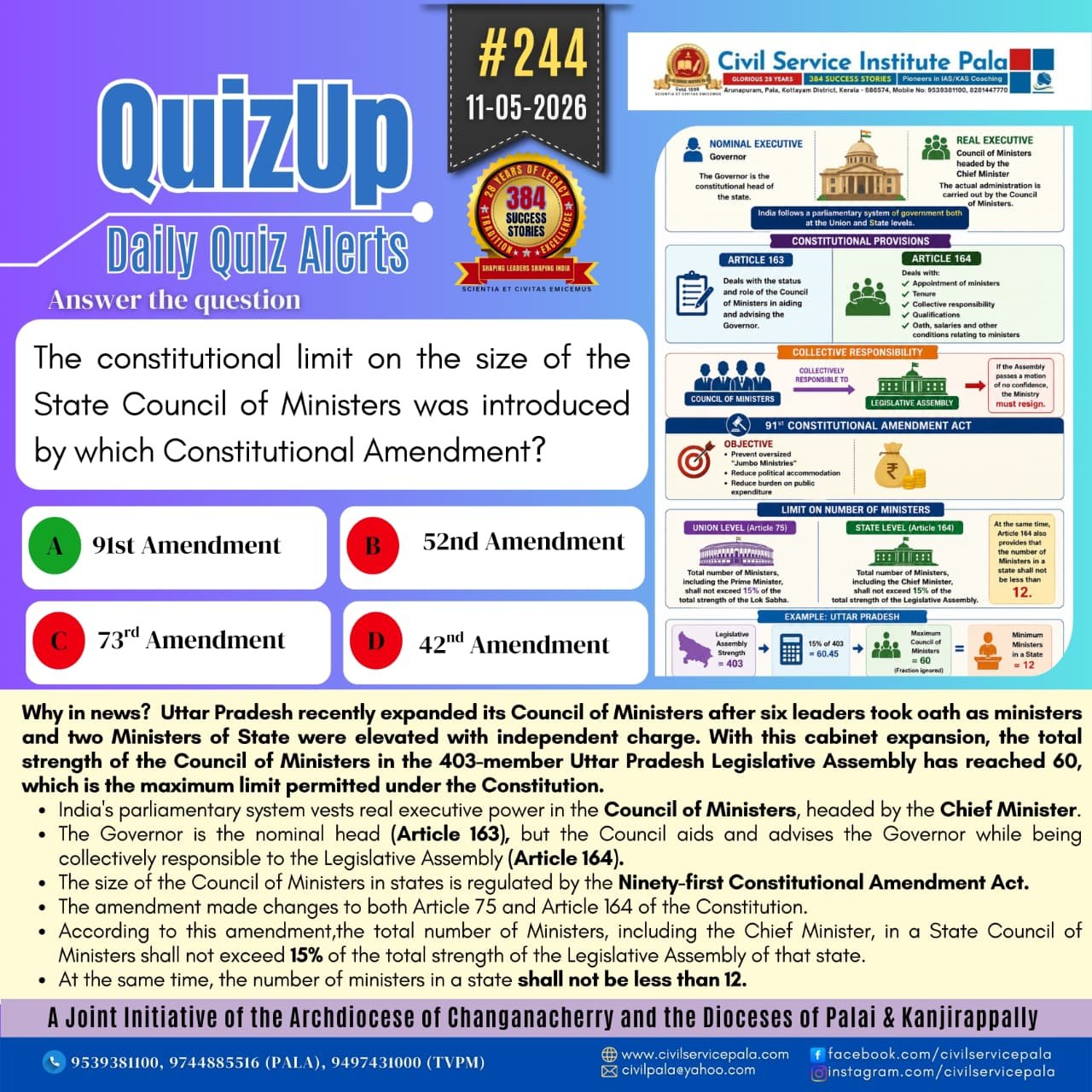
State Council of Ministers: Constitutional Position
Why in news? Uttar Pradesh recently expanded its Council of Ministers after six leaders took oath as ministers and two Ministers of State were elevated with independent charge. With this cabinet expansion, the total strength of the Council of Ministers in the 403-member Uttar Pradesh Legislative Assembly has reached 60, which is the maximum limit permitted under the Constitution.
State Council of Ministers: Constitutional Position
India follows a parliamentary system of government both at the Union and State levels. In the states, the real executive authority is exercised by the Council of Ministers headed by the Chief Minister.
The Governor is the constitutional head of the state, but the actual administration is carried out by the Council of Ministers.
The constitutional provisions regarding the State Council of Ministers are mainly contained in:
Article 163 — Deals with the status and role of the Council of Ministers in aiding and advising the Governor.
Article 164 — Deals with appointment, tenure, responsibility, qualifications, oath, salaries, and other conditions relating to ministers.
· The size of the Council of Ministers in states is regulated by the Ninety-first Constitutional Amendment Act.
· The amendment made changes to both Article 75 and Article 164 of the Constitution.
· Amendment to Article 75
· The amendment inserted a provision stating that:
· The total number of Ministers, including the Prime Minister, in the Union Council of Ministers shall not exceed 15% of the total strength of the Lok Sabha.
· Amendment to Article 164
· The same amendment extended a similar principle to states by providing that:
· The total number of Ministers, including the Chief Minister, in a State Council of Ministers shall not exceed 15% of the total strength of the Legislative Assembly of that state.
· At the same time, Article 164 was also amended to ensure that:
· The number of ministers in a state shall not be less than 12.
· These provisions were introduced to prevent the formation of oversized “jumbo ministries” created mainly for political accommodation and to reduce unnecessary expenditure from the public exchequer.
Example: UP (403 seats) → Max 60 (, rounded down).
Minimum: 12 ministers per state.
