



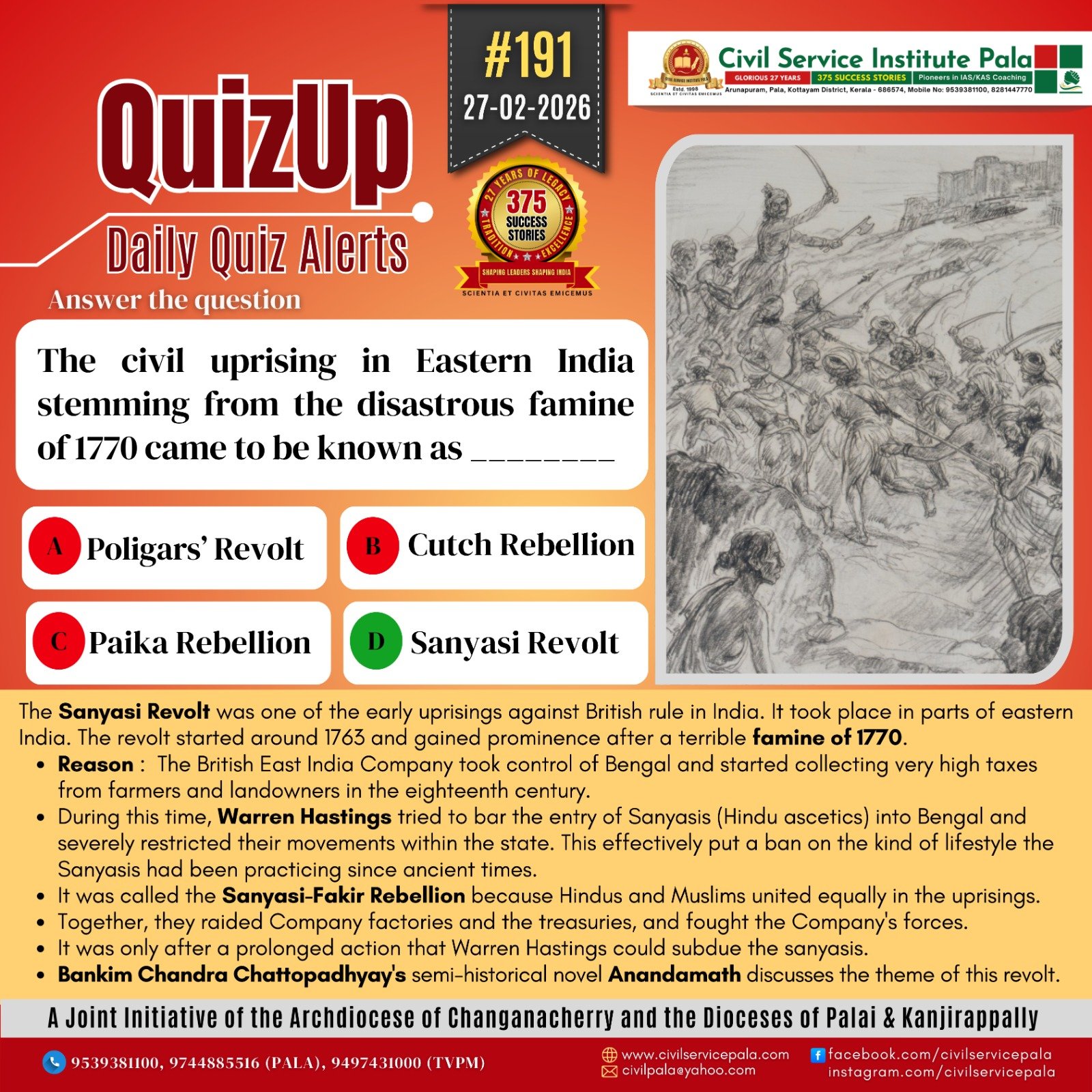
Sanyasi Revolt
The Sanyasi Revolt was one of the early uprisings against British rule in India. It took place mainly in parts of eastern India, like Bengal and Bihar.
Location : The revolt started around 1763. It gained prominence in the 1770s after a terrible famine hit the area in 1770. The main places were eastern India—Bengal, Bihar, and parts of what is now Bangladesh, including Dhaka, Rangpur Boalia, Dinajpur, Rangpur, Bogra, and Govindganj.
Reason :
• The British East India Company took control of Bengal after winning battles like Plassey (1757) and Buxar (1764).
• After gaining control, they started collecting very high taxes from farmers and landowners. The Great Bengal Famine of 1770 killed millions of people in Bengal.
• The British reaction was to increase the tax burden and further torture the people. During this time, Warren Hastings tried to bar the entry of Sanyasis (Hindu ascetics) into Bengal and severely restricted their movements within the state.
• This effectively put a ban on the kind of lifestyle the Sanyasis had been practicing since ancient times.
• Then in 1771, a hundred and fifty fakirs were killed for no good reason.
• This was a trigger for the rebellion to kick-start. Originally peasants, even some evicted from land, these sanyasis were joined by a large number of dispossessed small zamindars, disbanded soldiers, and rural poor.
• They raided Company factories and the treasuries, and fought the Company's forces. It was only after a prolonged action that Warren Hastings could subdue the sanyasis.
Sanyasi-Fakir Rebellion
• The leaders were sanyasis (Hindu monks without homes) and fakirs (Muslim holy men). Hindus and Muslims fought together side by side.
• Equal participation of Hindus and Muslims characterised the uprisings, sometimes referred to as the Sanyasi-Fakir Rebellion.
Main Leaders
• Majnu Shah (or Majnum Shah), Chirag Ali (or Cherag Ali Shah), Musa Shah, Bhabani Pathak (or Bhawani Pathak), and Debi Chaudhurani.
Legacy
• Bankim Chandra Chattopadhyay's semi-historical novel Anandamath discusses the theme of this revolt.
• It has the famous song Vande Mataram, which became India's national song later.
• He also wrote Devi Chaudhurani about the spirited leader who led women in the revolt.
• The revolt inspired later peasant uprisings. It proved that ordinary people could stand up to the Company.
