



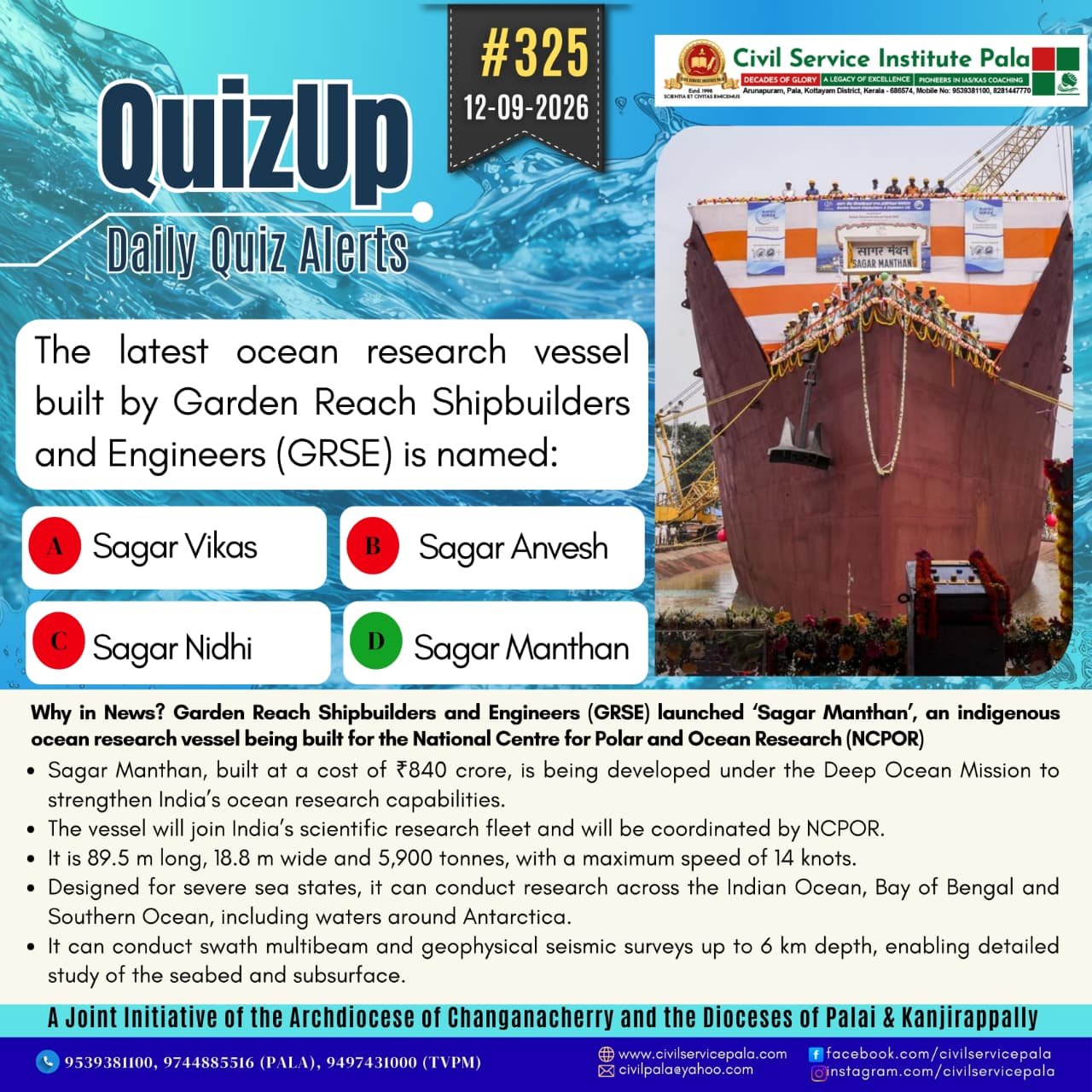
Sagar Manthan: India’s Indigenous Ocean Research Vessel
Sagar Manthan: India’s Indigenous Ocean Research Vessel
Why in News?
Garden Reach Shipbuilders and Engineers (GRSE) launched ‘Sagar Manthan’, an indigenous ocean research vessel being built for the National Centre for Polar and Ocean Research (NCPOR), strengthening India’s capabilities in deep-sea exploration and oceanographic research.
Building India’s Ocean Research Capability
• Sagar Manthan is being built at a cost of ₹840 crore and is expected to be ready for use by early 2028.
• The vessel is being developed as part of the government’s Deep Ocean Mission and will significantly expand India’s research capabilities in the Indian Ocean region and beyond.
• Its launch, only about five months after its keel was laid, highlights GRSE’s ability to achieve major shipbuilding milestones ahead of schedule.
• The vessel will become an important addition to India’s scientific research fleet and will be coordinated by NCPOR under the Ministry of Earth Sciences.
What Makes Sagar Manthan Significant?
• The vessel is 89.5 metres long, 18.8 metres wide and has a gross tonnage of 5,900 tonnes, with a maximum speed of 14 knots at 90% maximum continuous rating.
• It is designed to operate in severe sea states, allowing scientists to conduct research in the equatorial Indian Ocean, Bay of Bengal and Southern Ocean, including waters around Antarctica.
• Its ability to operate in the Southern Ocean will strengthen India's capacity to undertake research in difficult and remote marine environments.
Scientific and Oceanographic Capabilities
Sagar Manthan is designed as a multi-purpose platform for oceanographic and geophysical research in both coastal seas and deep waters.
• It can conduct swath multibeam and geophysical seismic surveys at depths of up to 6 km, allowing detailed study of the seabed and subsurface structures.
• Sub-bottom profilers, seismic equipment and advanced oceanographic instruments will enable measurements and surveys of the ocean floor and underlying geological structures.
• Conductivity, Temperature and Depth (CTD) profiling and water sampling will support the study of physical and biological properties of seawater.
• The vessel can undertake biological sampling using vertical and horizontal nets, as well as seabed sampling using corers and grabs and rock dredging.
Underwater and Atmospheric Research
• The vessel will be capable of launching and recovering Autonomous Underwater Vehicles (AUVs) and Remotely Operated Vehicles (ROVs) being developed by the National Institute of Ocean Technology under the Deep Ocean Mission.
• It will support surface and deep-sea mooring and data buoy operations, enabling long-term collection of oceanographic information.
• An advanced Doppler weather radar will support atmospheric observations, while the vessel will also undertake surface meteorological and current measurements and upper-air data collection.
• Scientists will be able to conduct analytical work and data processing onboard, while the vessel will also provide training and educational facilities for scientists and technicians.
Deep Ocean Mission and Marine Mineral Exploration
• Sagar Manthan will strengthen the Deep Ocean Mission by providing an indigenous platform for scientific exploration of deep-sea environments.
• Its deep-water survey capabilities will support India's efforts to explore marine mineral resources, including manganese nodules and polymetallic sulphides in the Indian Ocean region.
• The vessel therefore links ocean science with resource exploration, enabling India to better understand and assess resources located in deep-sea environments.
Contribution to India’s Blue Economy
The vessel is expected to support India's broader Blue Economy vision by generating scientific knowledge relevant to marine resources, shipping, energy, logistics and tourism. By strengthening India's ability to observe, survey and understand its marine environment, Sagar Manthan can contribute to both scientific research and the sustainable development of ocean-linked sectors.
