



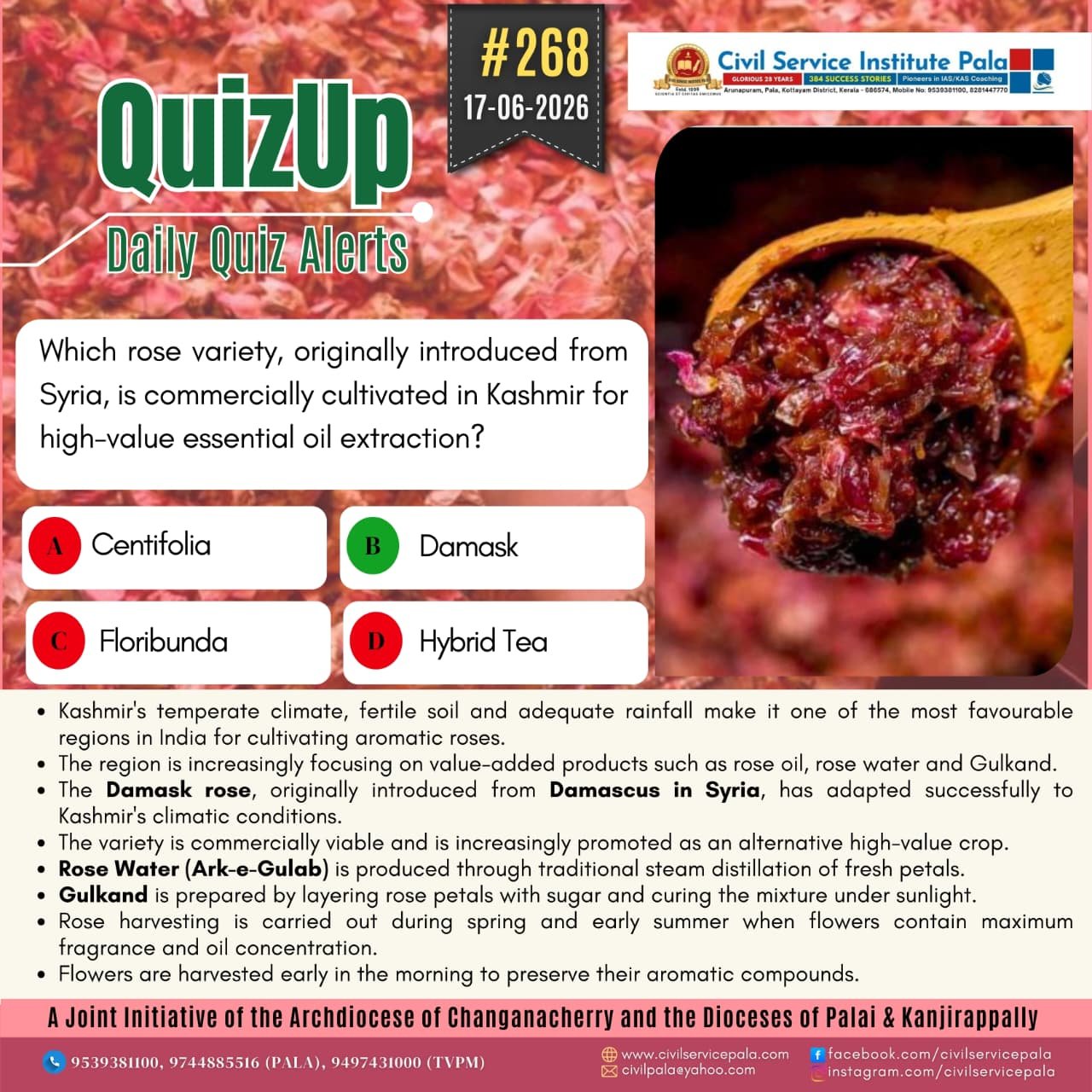
Rose Cultivation Culture of Kashmir
Rose Cultivation Culture of Kashmir
• Kashmir's temperate climate, fertile soil and suitable rainfall make it one of the most favourable regions in India for cultivating aromatic roses.
• Rose cultivation has emerged as an important component of Kashmir's floriculture and aromatic plant sector.
• The region is increasingly focusing on value-added products such as rose oil, rose water and Gulkand, creating new livelihood opportunities for farmers.
• Present-day rose cultivation combines traditional knowledge and modern processing technologies to strengthen rural incomes and agro-based industries
Important Varieties Cultivated
Damask Rose (Damas Rose)
• The Damask rose, originally introduced from Damascus in Syria, has adapted successfully to Kashmir's climatic conditions.
• It is highly valued for its rich fragrance and high essential oil content.
• The variety is commercially viable and is increasingly promoted as an alternative high-value crop.
Bulgarian Rose
• Bulgarian roses are cultivated mainly in the Bijbehara region of Anantnag district.
• The variety is used primarily for the extraction of rose water and essential oils.
Major Centres of Rose Cultivation
Pulwama District
• Pulwama has emerged as an important centre for Damask rose cultivation and rose oil extraction.
• The CSIR–Indian Institute of Integrative Medicine cultivates Damask roses alongside lavender, rosemary, mint and other aromatic crops.
• The institute is actively promoting rose cultivation among farmers as a high-value horticultural activity.
Bijbehara (Anantnag District)
• The Agriculture Department's aromatic farm at Sirhama in Bijbehara is a major centre for Bulgarian rose cultivation.
• The farm operates dedicated distillation units for processing rose petals into value-added products.
Rose-Based Products
Rose Water (Ark-e-Gulab)
• Rose water is produced through traditional steam distillation of freshly harvested petals.
• It is widely used in cosmetics, perfumes, pharmaceuticals, food products and religious practices.
• Modern distillation units have improved processing efficiency and reduced transportation requirements.
Gulkand
• Gulkand is prepared by layering rose petals with sugar and curing the mixture under sunlight.
• The product is widely used in Ayurvedic traditions and is valued for its cooling and digestive properties.
Rose Essential Oil
• Rose essential oil is among the most expensive natural oils in the world.
• The oil is extensively used in perfumes, cosmetics, toiletries and wellness products.
• It also possesses medicinal and aromatherapeutic value.
Cultivation and Processing Features
• Rose harvesting is carried out during spring and early summer when flowers contain maximum fragrance and oil concentration.
• Flowers are harvested early in the morning to preserve their aromatic compounds.
• Steam distillation is the principal method used for extracting rose water and essential oils.
• Distillation units established under the Holistic Agriculture Development Programme (HADP) have strengthened local value addition.
Economic Significance
• Rose cultivation provides supplementary income opportunities for farmers and rural labourers.
• The activity supports employment in cultivation, harvesting, processing and marketing.
• Value-added products from roses have strong domestic and export market potential.
• Growing demand for natural fragrances and herbal products can further expand Kashmir's aromatic crop economy.
