



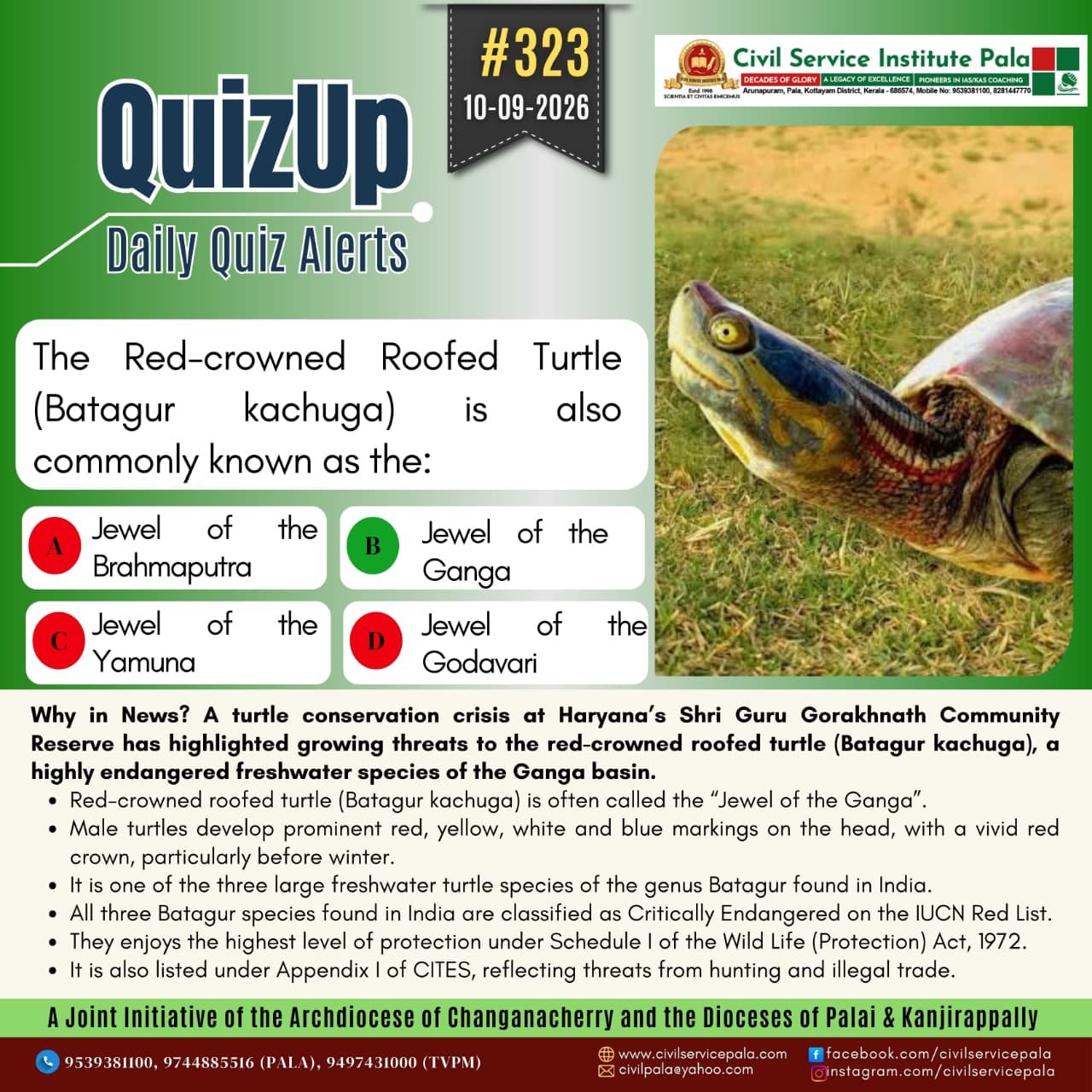
Red-Crowned Roofed Turtle (Batagur kachuga)
Red-Crowned Roofed Turtle (Batagur kachuga)
Why in News?
The Shri Guru Gorakhnath Community Reserve at Kajalheri village in Haryana’s Fatehabad district, notified in 2019, is facing a serious conservation crisis due to untreated sewage, habitat neglect, stray dogs, cattle and inadequate fencing. The reserve supports an estimated 150–200 turtles, including Indian Softshell, Red-roofed and Indian Peacock turtles. Pollution has reportedly caused skin lesions, fungal infections and blindness among softshell turtles, while turtles leaving the reserve in search of cleaner water face the risk of being crushed on roads.
The crisis is significant for the red-crowned roofed turtle (Batagur kachuga), a highly threatened freshwater turtle historically distributed across the Ganga river basin.
Red-Crowned Roofed Turtle
• The red-crowned roofed turtle (Batagur kachuga), often described as the “Jewel of the Ganga”, is known for its striking colouration, particularly in males before winter, when the head develops prominent red, yellow, white and blue markings and the crown becomes vividly red.
• It is one of the three large freshwater turtle species of the genus Batagur found in India. All three are listed as Critically Endangered on the IUCN Red List.
• The species receives the highest level of statutory protection under Schedule I of the Wild Life (Protection) Act, 1972 and is also listed in Appendix I of CITES, reflecting the seriousness of threats from hunting and illegal trade.
Historical Range and Population Decline
• Historically, the red-crowned roofed turtle had a wide distribution across the Ganga river basin, occupying major rivers and tributaries across a landscape of about 400,000 sq km.
• Intensive hunting of adult turtles and collection of eggs resulted in an estimated 80% population decline, accompanied by a major contraction of its historical range.
• A 1993 survey in the upper Ganga around Rishikesh and Kanpur recorded several individuals, but subsequent surveys around Narora and Haidarpur in 2006 and 2020 found none.
Major Threats
• The species has faced multiple pressures, including harvesting of adults and eggs, illegal trade, habitat degradation, sand mining, erratic water releases from upstream dams and agriculture on nesting banks.
• Unsustainable fishing practices and fatal entanglement in fishing nets further threaten the remaining population.
• The Kajalheri case demonstrates how polluted freshwater habitats can directly affect turtle health and behaviour, while inadequate fencing exposes nests to stray dogs and cattle and increases the risk of turtles being killed while moving across roads.
Conservation Significance
The Kajalheri crisis illustrates that legal protection alone cannot ensure species recovery. For freshwater turtles, conservation requires clean aquatic habitats, protection of nesting banks, control of sewage and other pollution, prevention of egg predation, protection from livestock and vehicles, and protection from fishing-related mortality. The proposed measures at Kajalheri include diverting sewage away from the pond, erecting fencing and creating raised nesting mounds.
