


Ramasamy Aiyer Krishnamurthy
Ramasamy Aiyer Krishnamurthy, born on 9 September 1899 at Puthamangalam near Manalmedu in Mayiladuthurai district, Tamil Nadu.He rose from a modest Tamil Brahmin Iyer family; his father was an accountant in the village .Educated initially at his local village school and later at Municipal High School in Mayiladuthurai, he left formal education in 1921 to join Mahatma Gandhi’s Non‑Cooperation Movement .
Entered journalism in 1923 as a sub‑editor at Navasakthi, mentored by Thiru Vi Ka, and published his first short story in 1927 . Collaborated with C. Rajagopalachari on Vimochanam, a liquor prohibition journal, and was jailed in 1931 for six months for his participation in freedom activities .Joined Ananda Vikatan under S. S. Vasan, writing wit-infused fiction, cultural criticism, and political commentary using pen names like “Ra.Ki”, “Tamil Theni”, and “Karnatkam”.
Founding Kalki Magazine
In 1941, he co-founded the weekly Kalki magazine in Chennai with T. Sadasivam and edited it till his death in 1954 .At its peak, the magazine had a circulation exceeding 71,000 copies per week, more than any Indian magazine of its time.
Literary Career & Major Works
Authored over 120 short stories, 10 novellas, 5 full-length novels, 3 historical romances, political essays, and hundreds of film and music reviews.
His historical novels include: Sivagamiyin Sapatham (1944–46), set in the Pallava era.
Parthiban Kanavu (1941–43), exploring Pallava Chola dynamics.
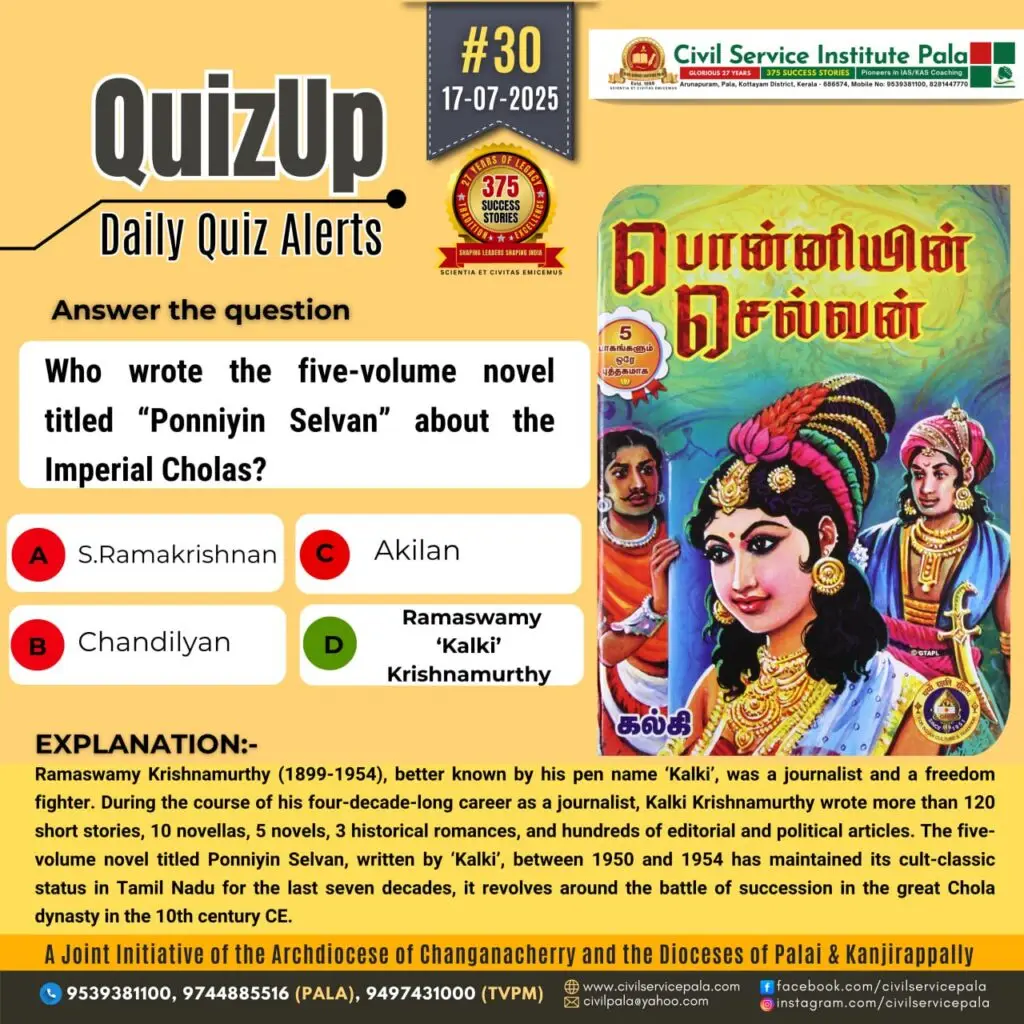
Ponniyin Selvan (1950–54), an epic set during the Chola empire, serialized over nearly four years and later published in five volumes in 1955 (~2210 pages)
Other notable novels: Kalvanin Kadhali (1937), Thyaga Bhoomi, Alai Osai (for which he received the Sahitya Akademi Award), Magudapathi, and Solaimalai Ilavarasi (about India’s independence).
Style, Influence & Legacy
His writing style—called Kalkitamizh—is known for its fluidity, humor, conversational tone, vivid imagery, and emotional depth. It made historical fiction both accessible and engaging.Kalki also championed social reform, criticized caste discrimination, child marriage, and advocated for women’s empowerment and scientific progress through his fiction and essays. As a music critic, he helped promote the Tamil Isai movement and Carnatic music, working with luminaries like M. S. Subbulakshmi.
Personal Life & Honors
Married Rukmani, with whom he had two children: son Rajendran and daughter Anandi. His family maintained close ties with co-founder Sadasivam’s family and musical circles.In 1953, he received the Sangeetha Kalasikhamani Award from the Indian Fine Arts Society, and his works were later nationalised by the Tamil Nadu government, enabling widespread reprints. A commemorative postage stamp was issued on his centenary.
Final Years and Death
Kalki continued to edit his magazine until his health deteriorated from tuberculosis. He passed away on 5 December 1954 in Chennai at the age of 55.
Enduring Impact
Kalki’s novels, especially Ponniyin Selvan and Sivagamiyin Sapatham, are considered monumental in Tamil literature—regular bestsellers, widely translated, and celebrated across generations.His novel Ponniyin Selvan has been adapted into a high-profile film series by Mani Ratnam (PS I in September 2022 and PS II in April 2023), bringing Kalki’s vision to wider audiences .
