



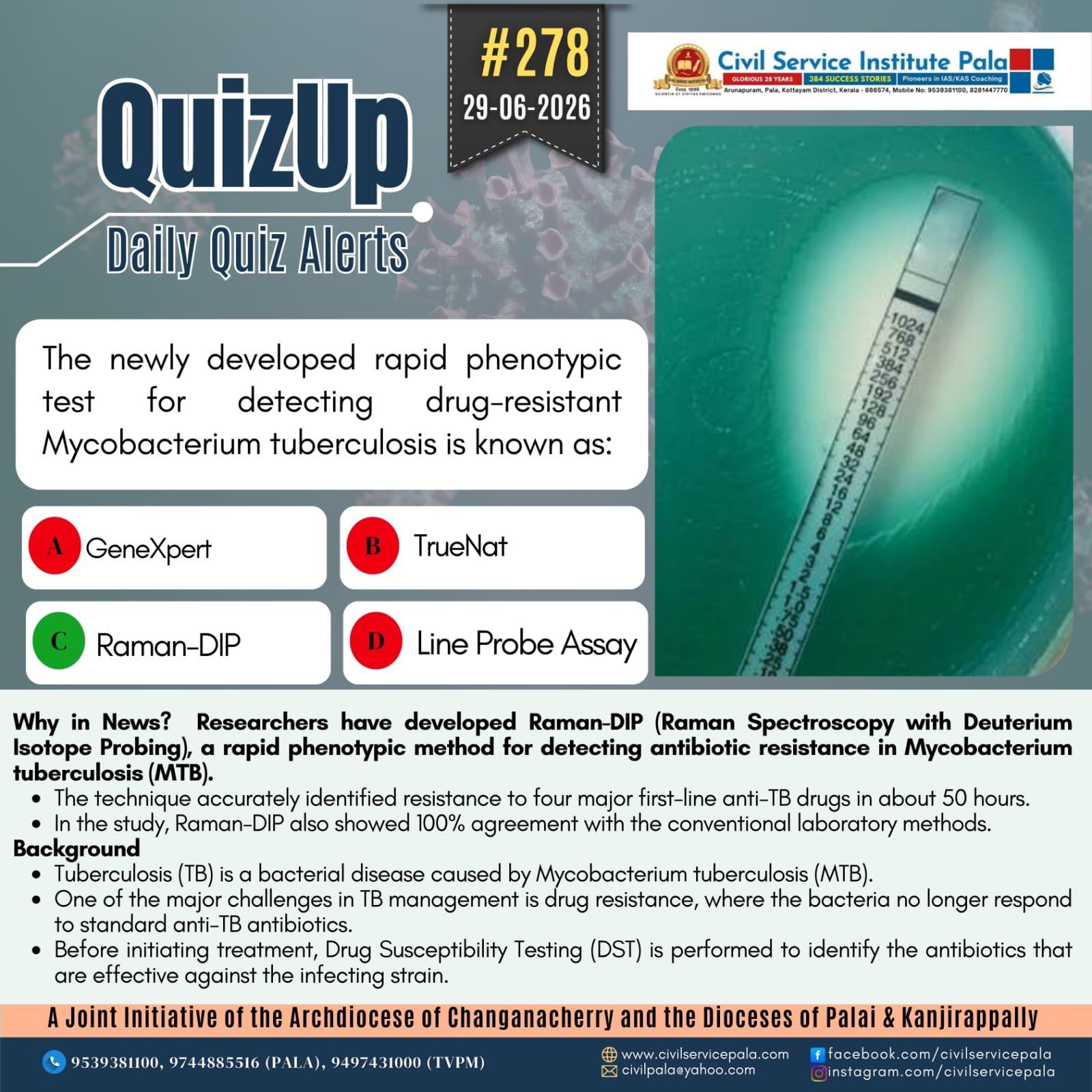
Raman-DIP – A Rapid Test for Drug-Resistant Tuberculosis (TB)
Raman-DIP – A Rapid Test for Drug-Resistant Tuberculosis (TB)
Why in News?
• Researchers have developed Raman-DIP (Raman Spectroscopy with Deuterium Isotope Probing), a rapid method for detecting antibiotic resistance in Mycobacterium tuberculosis.
• The technique accurately identified resistance to four major first-line TB drugs in about 50 hours.
• In the reported study, Raman-DIP showed 100% agreement with the conventional laboratory method for the tested strains.
• Tuberculosis (TB) is a bacterial disease caused by Mycobacterium tuberculosis (MTB).
• One of the biggest challenges in TB treatment is drug resistance, where the bacteria no longer respond to standard antibiotics.
• Before starting treatment, doctors perform Drug Susceptibility Testing (DST) to determine which antibiotics can effectively kill the bacteria.
Why is a Faster TB Test Needed?
The Problem with Conventional Testing
• The traditional Phenotypic Drug Susceptibility Test (pDST) requires the TB bacteria to grow and multiply in the laboratory.
• Since Mycobacterium tuberculosis grows very slowly, the test usually takes 4–8 weeks to produce results.
• This delay can postpone effective treatment and increase the risk of disease transmission.
Limitations of Molecular Tests
• Molecular tests detect known genetic mutations associated with drug resistance.
• However, they may miss resistant bacteria if the resistance is caused by unknown or uncommon mutations.
What is Raman-DIP?
• Raman-DIP (Raman Spectroscopy with Deuterium Isotope Probing) is a rapid phenotypic test that determines whether Mycobacterium tuberculosis is resistant or sensitive to antibiotics by measuring the metabolic activity of individual bacterial cells.
• The bacteria are exposed to antibiotics and heavy water (D₂O). Metabolically active bacteria absorb the heavy water, while bacteria whose metabolism is inhibited do not.
• A Raman spectroscope detects this difference at the single-cell level without waiting for the bacteria to grow in the laboratory.
• As a result, active bacteria indicate drug resistance, whereas inactive bacteria indicate drug sensitivity, enabling results in about 50 hours instead of several weeks.
Key Findings of the Study
• Results were obtained in approximately 50 hours (about 2 days).
• Successfully tested five strains of Mycobacterium tuberculosis.
• Correctly identified resistance against four first-line anti-TB drugs: Rifampicin, Isoniazid, Streptomycin, and Ethambutol.
• It demonstrated 100% categorical agreement with the conventional broth-based phenotypic DST in the tested strains.
Important Concepts
Phenotypic Drug Susceptibility Testing (pDST)
• Determines whether bacteria are actually inhibited or killed by an antibiotic based on their observed behaviour.
• Considered highly reliable but requires several weeks because bacterial growth must be observed.
Heavy Water (D₂O)
• Heavy water contains deuterium, a naturally occurring heavier form (isotope) of hydrogen.
• Active bacterial cells incorporate deuterium into their cellular components during metabolism.
• Measuring this uptake reveals whether the bacteria remain metabolically active.
Significance
For Patients
• Enables earlier identification of effective antibiotics.
• Reduces delays in starting appropriate treatment.
• Improves chances of successful recovery.
For Public Health
• It helps detect multidrug-resistant TB (MDR-TB) more rapidly.
• It may reduce transmission of resistant TB strains through earlier intervention.
For Healthcare
• It eliminates the need to wait for slow bacterial growth.
• It offers the potential for Point-of-Care Testing (POCT) in the future.
• It supports more personalized TB treatment based on actual drug response.
