



Rakhigarhi Skeletons and Harappan Burial Practices
Rakhigarhi Skeletons and Harappan Burial Practices
Why in News?
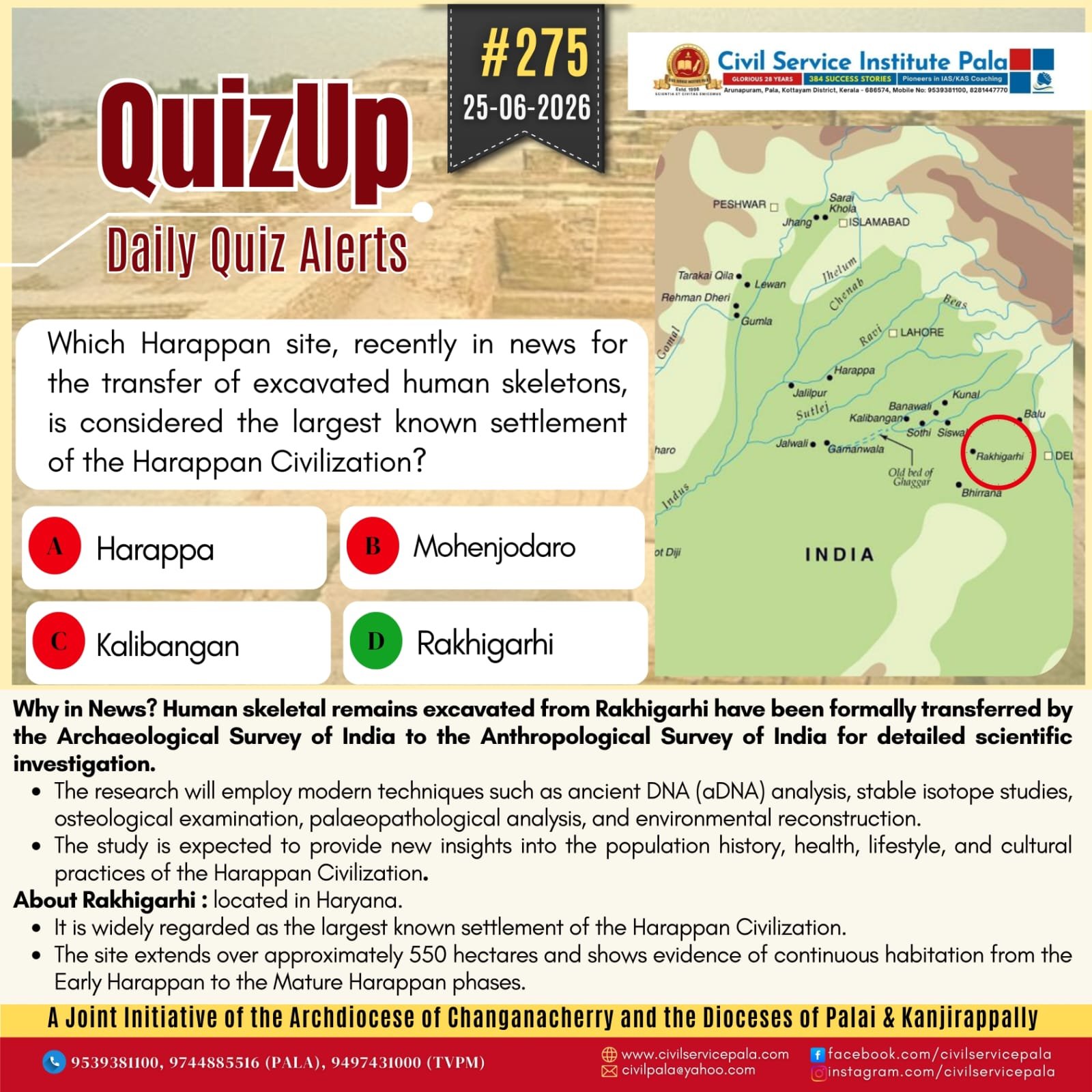
• Human skeletal remains excavated from Rakhigarhi have been formally transferred by the Archaeological Survey of India to the Anthropological Survey of India for detailed scientific investigation.
• The research will employ modern techniques such as ancient DNA (aDNA) analysis, stable isotope studies, osteological examination, palaeopathological analysis, and environmental reconstruction.
• The study is expected to provide new insights into the population history, health, lifestyle, and cultural practices of the Harappan Civilization.
Rakhigarhi: The Largest Known Harappan Settlement
• Rakhigarhi, located in Haryana, is widely regarded as the largest known settlement of the Harappan (Indus-Saraswati) Civilization.
• The site extends over approximately 550 hectares and shows evidence of continuous habitation from the Early Harappan to the Mature Harappan phases.
• Among its several excavation areas, Mound 7 has been identified as a major cemetery.
• Excavations at this mound yielded 56 human skeletons, making it one of the most important sources for understanding Harappan burial traditions.
• Among the discoveries was a 4,600-year-old female skeleton, which attracted international attention in the fields of archaeology, anthropology, genetics, and linguistics.
• DNA studies on this skeleton reported the absence of the Steppe pastoralist genetic component, contributing to ongoing academic debates regarding ancient population movements into the Indian subcontinent.
What Harappan Burials Reveal
• Burial practices provide some of the most direct evidence about Harappan society because written records remain undeciphered.
• The most common burial practice involved placing the deceased in an extended position, usually with the head oriented towards the north.
• Burials were generally made in simple pits or brick-lined chambers.
• Objects such as pottery, food offerings, tools, and ornaments were often placed alongside the dead.
• However, grave goods were usually modest rather than lavish, suggesting that Harappan society did not emphasize extravagant funerary displays.
• Archaeologists often note that the Harappans appear to have invested wealth and resources more in life than in elaborate burials.
Diversity in Harappan Funerary Traditions
• Harappan burial customs were not uniform and varied across different settlements.
Harappa
• Evidence of a coffin burial with a reed shroud has been discovered.
• Fractional burials, where only selected bones were buried after exposure of the body, have also been found.
• Urn burials suggestive of cremation practices have been reported.
Kalibangan
• Archaeologists discovered symbolic burials, where grave goods were present but no human skeleton was found.
Mohenjodaro
• Evidence exists for both fractional burials and urn burials.
Lothal
• Multiple burials containing more than one individual have been discovered.
Surkotada and Rakhigarhi
• Important cemetery sites that provide valuable evidence regarding Harappan funerary practices.
Significance of the Current Study
• The transfer of Rakhigarhi skeletons marks an important step in applying modern scientific techniques to ancient Indian archaeology.
• Ancient DNA and isotope studies can help reconstruct ancestry, diet, health conditions, migration patterns, and environmental conditions of Harappan populations.
• The findings may deepen our understanding of one of the world's earliest urban civilizations and contribute to broader debates on the origins and development of ancient South Asian populations.
