



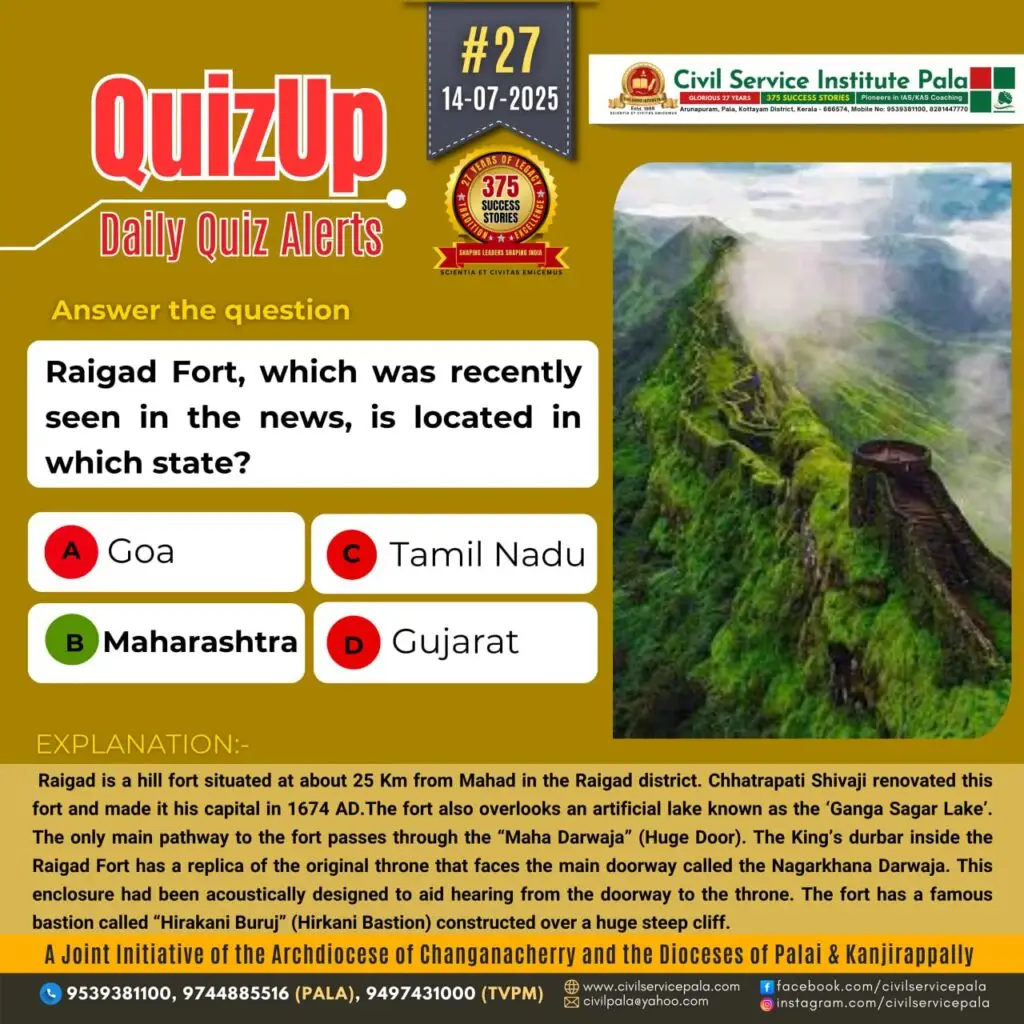
Raigad Fort
Raigad Fort is one of the most iconic and historically significant forts in India, especially associated with the rise of the Maratha Empire under Chhatrapati Shivaji Maharaj. It served as the capital of the Maratha kingdom and stands as a symbol of Maratha pride, valor, and sovereignty.
Location and Geography:
Location: Mahad Taluka, Raigad district, Maharashtra
Altitude: About 820 meters (2,700 feet) above sea level
Range: Situated in the Sahyadri Hills (Western Ghats)
Accessibility: Can be reached by a ropeway or by climbing nearly 1,700 steps from the base village
The fort is naturally well-defended by steep cliffs on all sides, making it almost impregnable.
Historical Significance:
Capital of the Maratha Empire:
In 1674, Shivaji Maharaj was crowned as Chhatrapati (king) at Raigad Fort in a grand coronation ceremony, marking the foundation of Hindavi Swarajya (self-rule of Hindus).
Raigad became the political, administrative, and military center of the Maratha Empire.
Built and Fortified by Shivaji:
Originally known as Rairi Fort, it was captured from the More clan and extensively renovated and expanded by Shivaji Maharaj.
Architect Hiroji Indulkar was responsible for designing much of the fort’s layout and palaces.
Place of Shivaji’s Samadhi:
Shivaji Maharaj passed away in 1680 at Raigad. His tomb (samadhi) is located on the fort premises, beside a statue of his loyal dog Waghya.
Key Structures within the Fort:
The Maha Darwaja: The grand main entrance, flanked by massive bastions.
King’s Court (Raj Sabha): A stone platform with a throne replica facing the audience, overlooking a vast courtyard.
Queen’s Quarters (Rani Vasa): A set of six chambers, believed to be for Shivaji’s queens.
Market Area (Bazar Peth): A well-planned bazaar area with stone-walled shops aligned in rows.
Jagadishwar Temple: A temple dedicated to Lord Shiva, where Shivaji is said to have offered prayers daily.
Takmak Tok: A cliff used for executing criminals, offering breathtaking views of the valleys.
Hirakani Buruj: A wall and bastion built at the cliff’s edge, associated with the legend of a brave milkmaid named Hirakani who descended the fort at night for her child.
Strategic and Architectural Features:
Built with local stone, the fort integrates naturally into the mountainous terrain.
Water was supplied through artificial lakes and tanks, ensuring year-round availability.
The fort’s design reflects Maratha military architecture, prioritizing defense, self-sufficiency, and administrative functionality.
Present Day and Tourism:
Maintained by the Archaeological Survey of India (ASI).
Accessible via a ropeway, which provides an aerial view of the Western Ghats.
Popular with trekkers, history enthusiasts, and pilgrims, especially during Shivaji Jayanti (birth anniversary) celebrations.
