


Rahul Sankrityayan
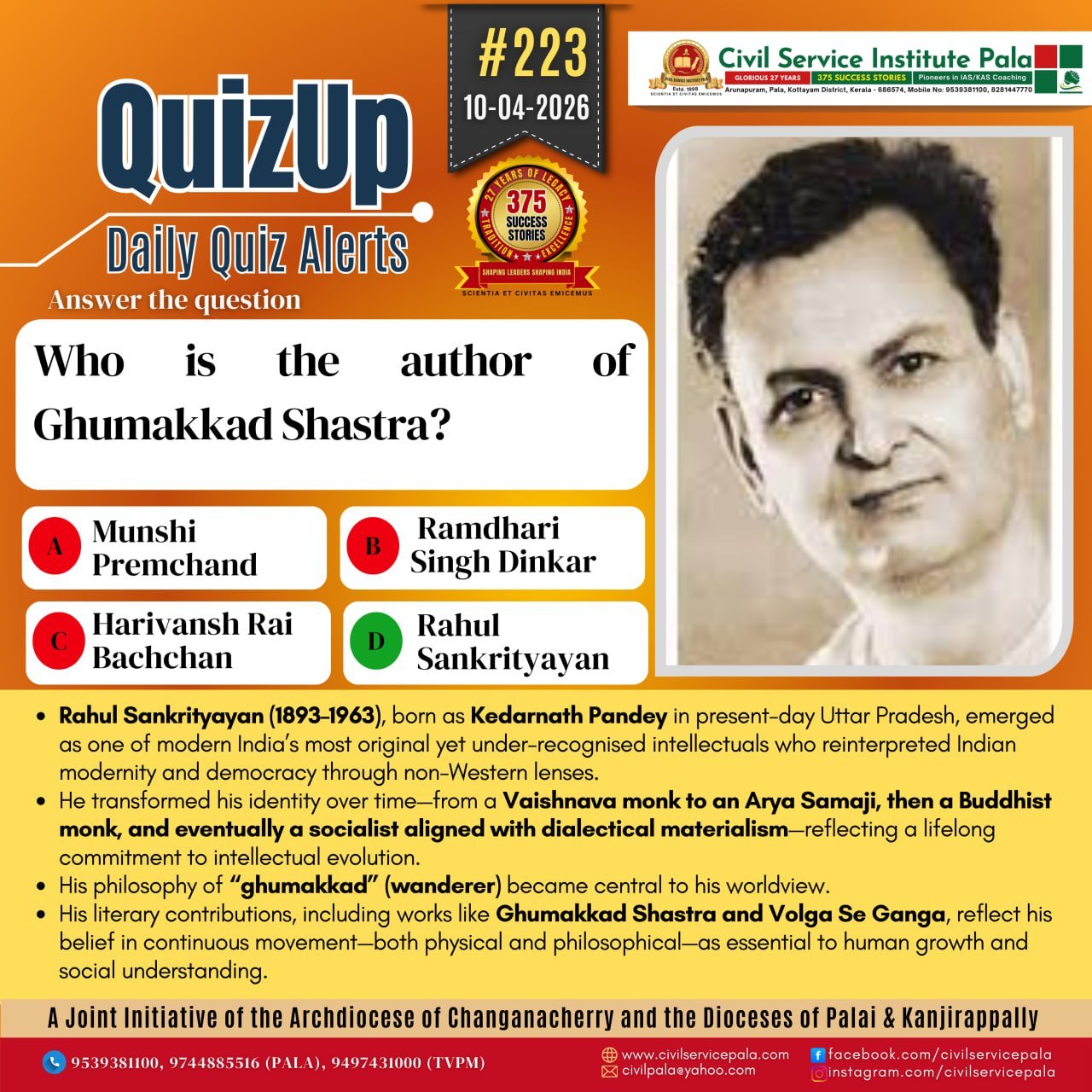
Rahul Sankrityayan (1893–1963), born as Kedarnath Pandey in present-day Uttar Pradesh, emerged as one of modern India’s most original yet under-recognised intellectuals who reinterpreted Indian modernity and democracy through non-Western lenses.
Intellectual Evolution & Ideological Journey
* He transformed his identity over time—from a Vaishnava monk to an Arya Samaji, then a Buddhist monk, and eventually a socialist aligned with dialectical materialism—reflecting a lifelong commitment to intellectual evolution.
* His association with the Arya Samaj introduced him to reformist and revivalist ideas, but he eventually grew disillusioned with its limitations on free thought and rational inquiry.
* His turn to Buddhism marked a decisive intellectual phase, during which he studied Pali, Tibetan texts, and Buddhist philosophy across regions like Sri Lanka and Tibet, while appreciating the rational and emancipatory aspects of Buddhist thought.
* His intellectual trajectory eventually led him to embrace dialectical materialism, which he considered the most scientific framework of his time, though he remained open to revising his beliefs if proven irrational.
Early Life & Wanderlust
* His early life was marked by a strong spirit of rebellion, as he left home at a young age and undertook extensive journeys across India and the Himalayas in search of knowledge, spirituality, and experience.
Religious Engagement & Rationalism
* His initial engagement with religion included deep immersion in Sanskrit learning and Brahminical traditions, though he later became a sharp critic of orthodox and hierarchical social structures.
* He developed a strong rationalist outlook rooted not in Western Enlightenment alone but in his lived experiences and engagement with traditions like Madhyamika Buddhism, which questioned fixed identities and absolute truths.
Philosophy of Ghumakkad (Wanderer)
* His philosophy of “ghumakkad” (wanderer) became central to his worldview, where physical travel combined with intellectual openness fostered critical thinking, cultural empathy, and resistance to rigid identities.
Literary Contributions
* His literary contributions, including works like Ghumakkad Shastra and Volga Se Ganga, reflect his belief in continuous movement—both physical and philosophical—as essential to human growth and social understanding.
Political Engagement & Activism
* He actively participated in India’s freedom struggle, including the Non-Cooperation Movement, and later engaged deeply with peasant movements such as the Kisan Sabha, aligning himself with anti-feudal and anti-colonial struggles.
* His political journey included association with the Communist movement, though his independent thinking led to both conflict and eventual expulsion from party structures at different points in time.
Scholarship & Intellectual Contributions
* He was a prolific scholar and linguist, reportedly mastering multiple languages and contributing extensively to history, archaeology, linguistics, and travel literature, earning the title “Father of Hindi travel writing.”
Contradictions & Intellectual Tensions
* Despite his commitment to socialist ideas, he retained a deep engagement with cultural traditions, leading to an unresolved tension between his modernist, productivist vision and his appreciation of indigenous cultural diversity.
* His thought resisted rigid categorisation, as he rejected both narrow nationalism and blind traditionalism while advocating a rational, humanist, and socially engaged worldview.
Vision of Ideal Individual & Society
* His concept of the ideal individual combined elements of a monk, intellectual, and activist—someone detached from power structures yet deeply committed to the welfare of society.
* His life reflected a unique blend of activism and philosophy, where intellectual inquiry and social transformation were seen as inseparable pursuits.
Later Life & Final Years • In his later years, he served as a scholar abroad and continued writing, though he struggled to fully reconcile the contradictions within his own ideological journey.
* He spent his final years in relative obscurity and ill health, marking a quiet end to an otherwise extraordinarily dynamic and adventurous life.
Legacy & Significance
His legacy lies in his fearless pursuit of knowledge, his rejection of dogma, and his attempt to build a rational, inclusive, and critically engaged framework for understanding society and human existence.
