



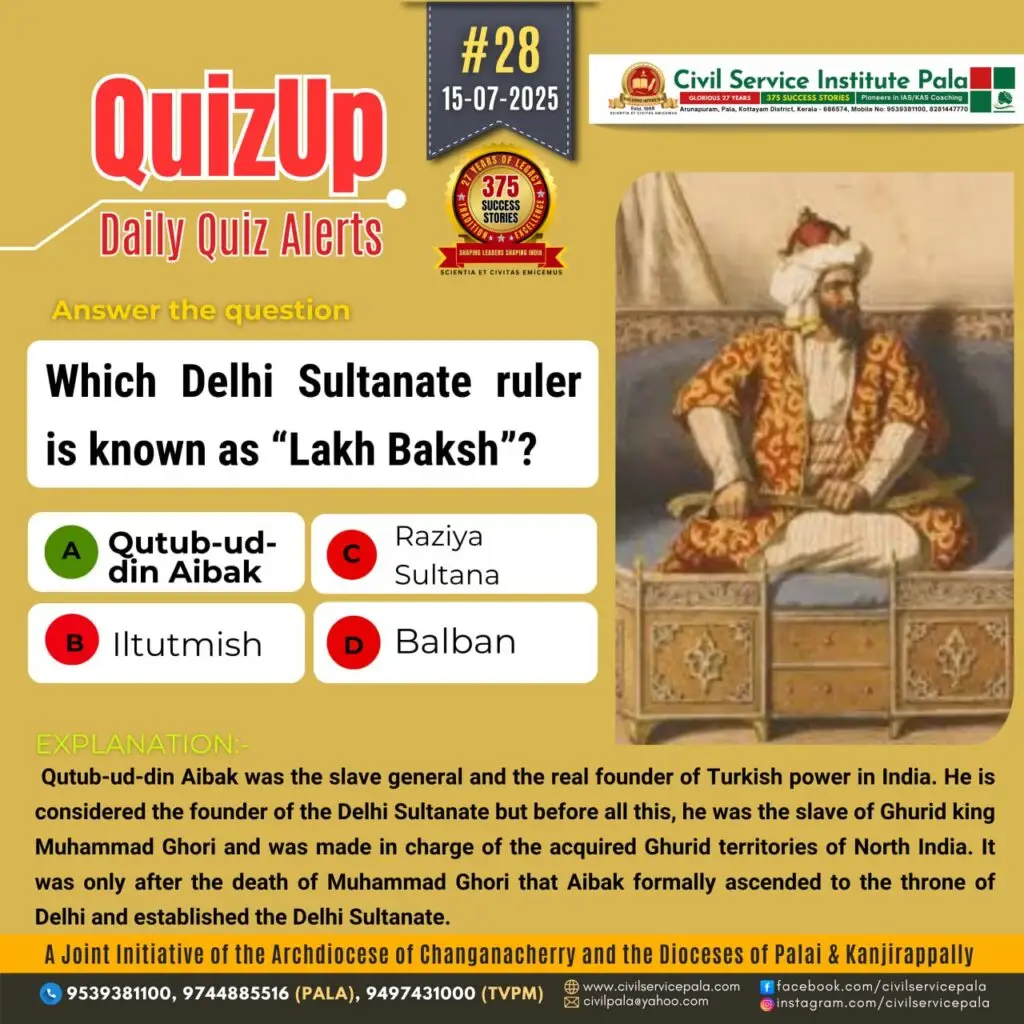
Qutub-ud-Din Aibak
Qutub-ud-Din Aibak was the first Sultan of Delhi and a prominent figure in the establishment of the Delhi Sultanate in India. His reign marked the beginning of the Mamluk Dynasty in 1206, which lasted until 1290. Aibak is recognized for his significant contributions to the political and cultural landscape of medieval India.
Early Life and Background:
Aibak was originally born in Turkistan (modern-day Uzbekistan). He was captured as a young boy and sold into slavery in the court of the Ghurid Sultan, Muhammad Ghori.
Over time, he rose through the ranks due to his military skill, loyalty, and leadership, becoming a trusted general and the governor of Northeastern India.
Rise to Power:
After the death of Muhammad Ghori in 1206, Aibak became the Sultan of Delhi, as he was appointed by the Ghurid court due to his military strength.
His ascendancy to the throne marked the beginning of Muslim rule in northern India, which lasted for several centuries.
Reign and Achievements:
Foundation of the Delhi Sultanate:
Aibak is credited with laying the foundation of the Delhi Sultanate, an empire that ruled large parts of northern and central India for over three centuries.
He consolidated the territories of Hindustan and the region around Delhi, establishing a political system that would remain central to the Sultanate for years to come.
Military Campaigns:
Aibak led several military campaigns to expand the Sultanate’s territory, particularly in the northwestern regions and eastern India.
He was instrumental in defeating Rajputs, particularly in regions like Ajmer and Delhi.
Construction of Architectural Monuments:
Aibak is renowned for his architectural contributions. The Qutub Minar in Delhi, one of India’s most iconic monuments, was started by him in 1193 (though it was completed by his successor, Iltutmish).
He also built the Quwwat-ul-Islam Mosque in Delhi, one of the first mosques built after the Muslim conquest of India.
Administrative Reforms:
Aibak consolidated his rule by strengthening the administration and introducing reforms that supported the growth of a centralized government.
He maintained a relatively peaceful administration, allowing local rulers some autonomy, which helped in integrating the diverse regions of northern India.
Legacy:
Though his reign lasted only a short time (1206-1210), Aibak’s contributions had a lasting impact on Indian history.
He laid the groundwork for the Mamluk Dynasty, which was later succeeded by Iltutmish, his general, and a key figure in strengthening the Delhi Sultanate.
Aibak’s military and architectural contributions helped define the early medieval period of Indian history, especially regarding the influence of Islamic culture and architecture.
Death:
Qutub-ud-Din Aibak died in 1210 during a game of polo, after falling from his horse. His death marked the end of his direct rule but paved the way for Iltutmish to take over and further solidify the Delhi Sultanate.
