



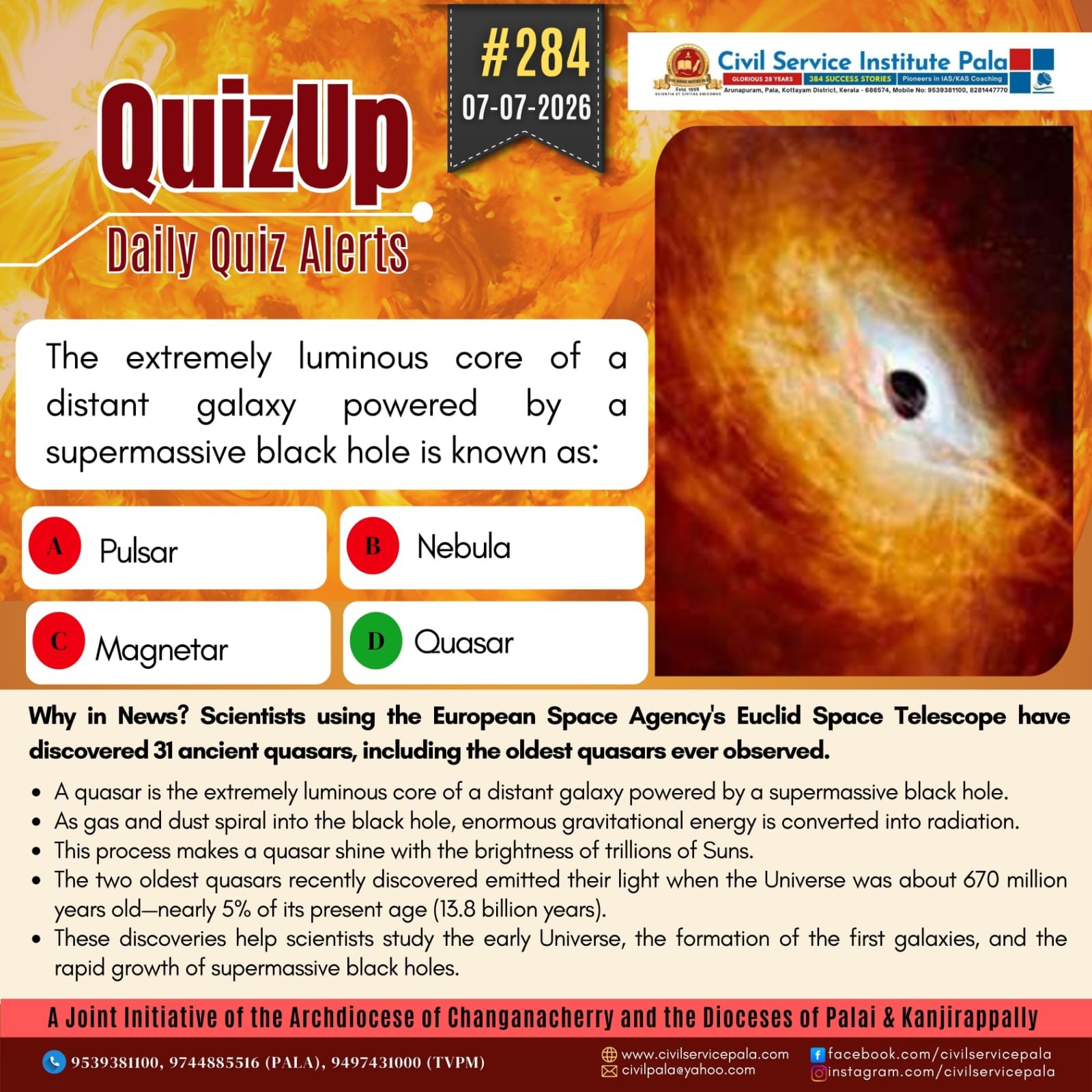
Quasars
Quasars
Why in News?
• Scientists using the European Space Agency's Euclid Space Telescope have discovered 31 ancient quasars, including the oldest quasars ever observed.
• The two oldest quasars recently discovered emitted their light when the Universe was about 670 million years old—nearly 5% of its present age (13.8 billion years).
• These discoveries help scientists study the early Universe, the formation of the first galaxies, and the rapid growth of supermassive black holes.
What is a Quasar?
• A quasar is the extremely luminous core of a distant galaxy powered by a supermassive black hole.
• As gas and dust spiral into the black hole, enormous gravitational energy is converted into radiation.
• This process makes a quasar shine with the brightness of trillions of Suns, making it one of the brightest objects in the Universe.
Why are Quasars Important?
• They provide valuable information about the formation and evolution of the earliest galaxies.
• Because light takes time to travel, observing distant quasars allows astronomers to look back in time and study the infancy of the Universe.
• Quasars also act as cosmic lighthouses, helping scientists study the gas lying between Earth and the quasar.
Quasars and the Epoch of Reionisation
• The newly discovered quasars date back to the Epoch of Reionisation, when the first stars and galaxies formed, ending the Universe's Cosmic Dark Ages.
• Their light helps scientists understand how the early Universe became reionised and evolved into the transparent Universe seen today.
Role of the Euclid Space Telescope
• The Euclid Space Telescope, launched by the European Space Agency (ESA) in 2023, is located about 1.5 million km from Earth.
• Within just two years, Euclid has doubled the number of known ancient quasars.
• It has enabled astronomers to discover the oldest quasars observed so far, surpassing the previous record set in 2021 by about 20 million years.
The Cosmic Mystery
• The newly discovered quasars contain supermassive black holes with masses billions of times greater than the Sun.
• Their existence only 670 million years after the Big Bang challenges current theories of black hole and galaxy formation.
• Scientists are still trying to explain how these enormous black holes formed and grew so rapidly in the early Universe.
Future Research
• The newly discovered quasars have also been observed by the James Webb Space Telescope (JWST).
