



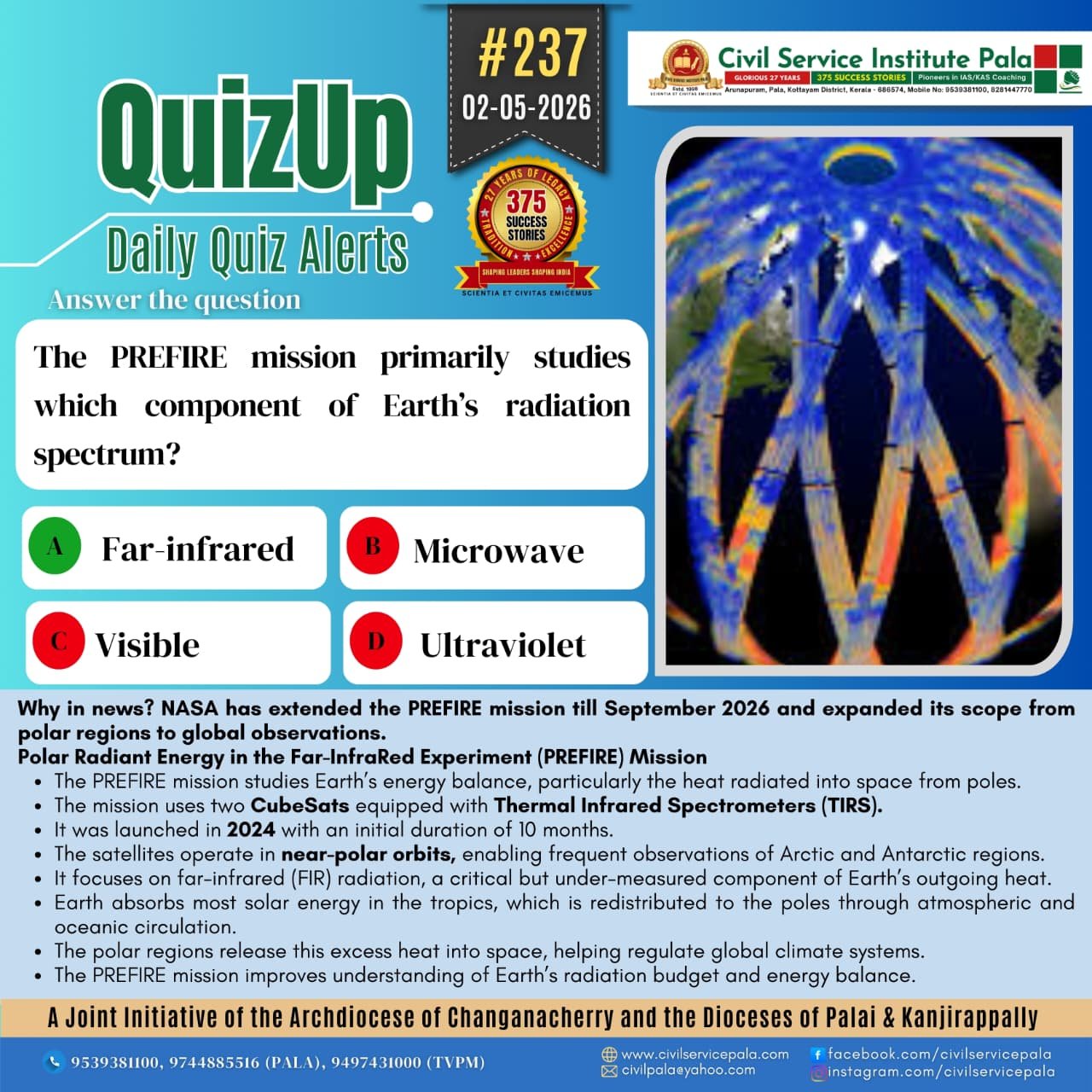
PREFIRE mission
Why in News
• NASA has extended the PREFIRE mission till September 2026 and expanded its scope from polar regions to global observations.
Polar Radiant Energy in the Far-InfraRed Experiment (PREFIRE) Mission
• The PREFIRE mission studies Earth’s energy balance, particularly the heat radiated into space from polar regions.
• It focuses on far-infrared (FIR) radiation, a critical but under-measured component of Earth’s outgoing heat.
• Earth absorbs most solar energy in the tropics, which is redistributed to the poles through atmospheric and oceanic circulation.
• The polar regions release this excess heat into space, helping regulate global climate systems.
Features of the Mission
• The mission uses two CubeSats equipped with Thermal Infrared Spectrometers (TIRS).
• It was launched in 2024 with an initial duration of 10 months.
• The satellites operate in near-polar orbits, enabling frequent observations of Arctic and Antarctic regions.
• It measures the role of water vapour, clouds, ice, and snow in heat retention and radiation.
• The mission has now expanded to global coverage, improving climate system understanding.
• Data can be integrated with missions like GRACE mission for enhanced insights.
Key Data
• Far-infrared radiation lies in the 15–100 micrometre wavelength range.
• Nearly 60% of Arctic heat emission occurs at wavelengths above 15 micrometres.
• PREFIRE sensors measure radiation across the 5–54 micrometre spectrum.
Challenges
• Far-infrared radiation has been poorly measured globally, especially in polar regions.
• Climate models face uncertainty in estimating heat loss and energy balance.
• Experts suggest that limited FIR data restricts accurate prediction of extreme weather and climate change impacts.
Applications
• The mission improves understanding of Earth’s radiation budget and energy balance.
• It enhances predictions of weather severity, storm frequency, and climate change trends.
• The data supports analysis of sea ice dynamics, permafrost changes, and polar warming.
• Improved FIR data leads to more reliable climate models and projections.
Way Forward
• Expanding FIR observations globally will reduce uncertainties in climate modelling.
• Integration with global satellite systems will strengthen Earth observation networks.
• Improved data can guide climate adaptation and mitigation policies.
• Continued investment in CubeSat technology can make climate monitoring more scalable and cost-effective.
