



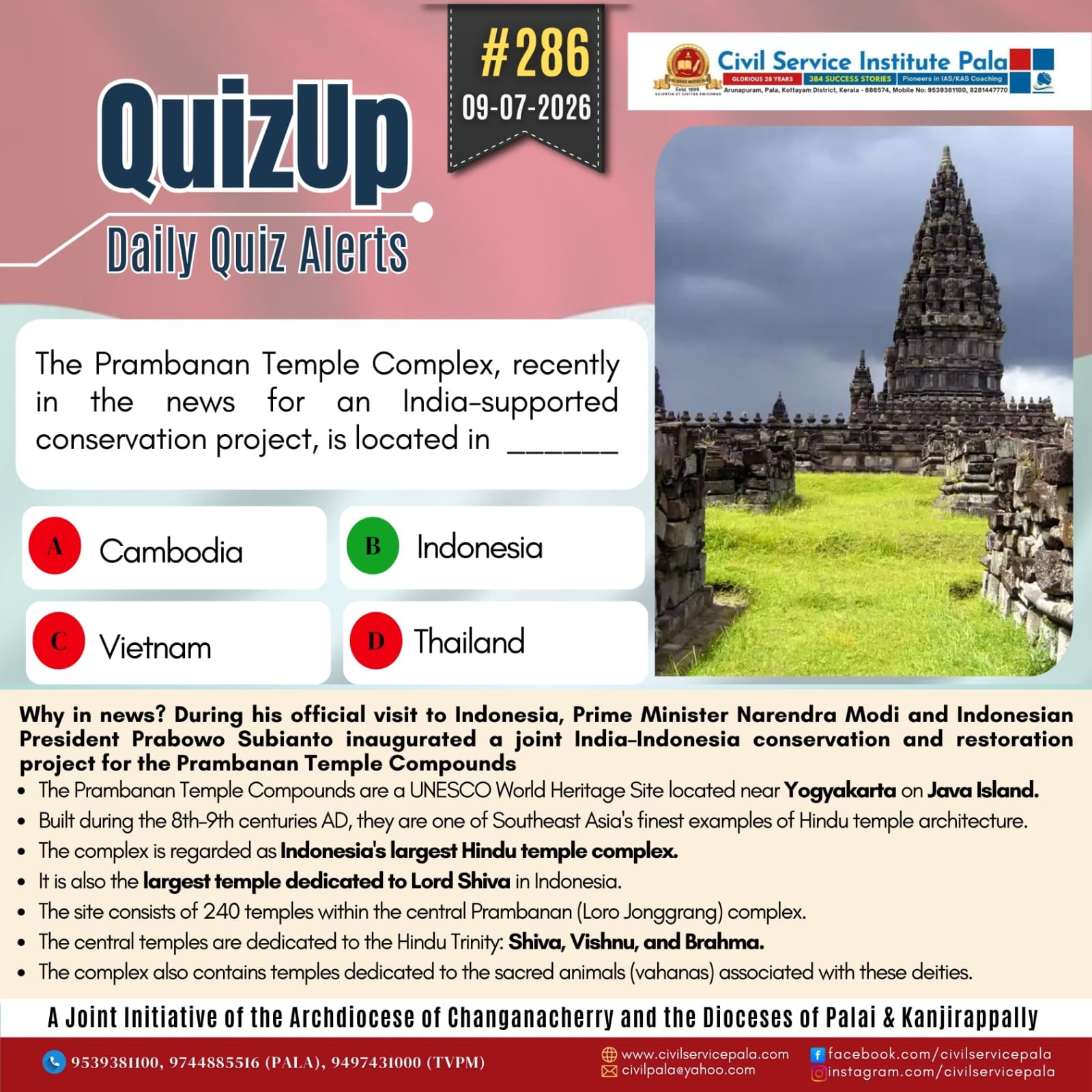
Prambanan Temple Complex
Prambanan Temple Complex
Why in News?
• During his official visit to Indonesia, Prime Minister Narendra Modi and Indonesian President Prabowo Subianto inaugurated a joint India–Indonesia conservation and restoration project for the Prambanan Temple Compounds.
• India and Indonesia had earlier exchanged a Letter of Intent to undertake the conservation and restoration of the temple complex with India's assistance.
• Prime Minister Modi described the temple as a symbol of the enduring cultural links between the two countries.
Prambanan Temple Complex
• The Prambanan Temple Compounds are a UNESCO World Heritage Site located near Yogyakarta on Java Island.
• Built during the 8th–9th centuries AD, they represent one of Southeast Asia's finest examples of Hindu temple architecture.
• The complex is regarded as Indonesia's largest Hindu temple complex and the largest temple dedicated to Lord Shiva in Indonesia.
• The site consists of over 500 temples, including 240 temples within the central Prambanan (Loro Jonggrang) complex, reflecting the advanced stone architecture of ancient Java.
Major Components of the Complex
The Prambanan Temple Compounds comprise several important temple groups including
• Prambanan (Loro Jonggrang) – the principal Hindu temple complex.
• Sewu Temple – Indonesia's largest Buddhist temple complex.
• Lumbung Temple
• Bubrah Temple
• Asu (Gana) Temple
Together, these form the Prambanan Archaeological Park.
Religious and Cultural Significance
• The central temples are dedicated to the Hindu Trinity: Shiva, Vishnu and Brahma.
• The complex also contains temples dedicated to the sacred animals (vahanas) associated with these deities.
• The temple walls are adorned with intricate bas-reliefs depicting the Indonesian version of the Ramayana, regarded as masterpieces of stone carving.
• The coexistence of the Hindu Prambanan complex alongside the nearby Buddhist Sewu complex reflects the region's tradition of peaceful religious coexistence.
UNESCO World Heritage Value
Integrity
• The property includes all major temple groups required to demonstrate its outstanding universal value.
• The site remains well protected, although it is vulnerable to earthquakes and volcanic eruptions.
Authenticity
• The temples retain their original 9th-century structures.
• Although many structures collapsed following earthquakes, volcanic activity, and political changes in the early 11th century, they were rediscovered in the 17th century.
• Restoration has been undertaken since 1918, using both traditional interlocking stone techniques and modern engineering methods while preserving historical authenticity.
Protection and Management
• Declared a National Cultural Property by Indonesia in 1998.
• Protected under national legislation enacted in 2010.
• The site is recognised as a Strategic National Area, with integrated conservation and spatial planning measures supporting its long-term preservation.
India–Indonesia Cultural Cooperation
• The latest conservation initiative highlights the growing cultural partnership between India and Indonesia.
• India's assistance in restoring the Prambanan Temple Complex reflects the shared civilisational heritage rooted in Hindu traditions, the Ramayana, and centuries of cultural exchange across Southeast Asia.
