



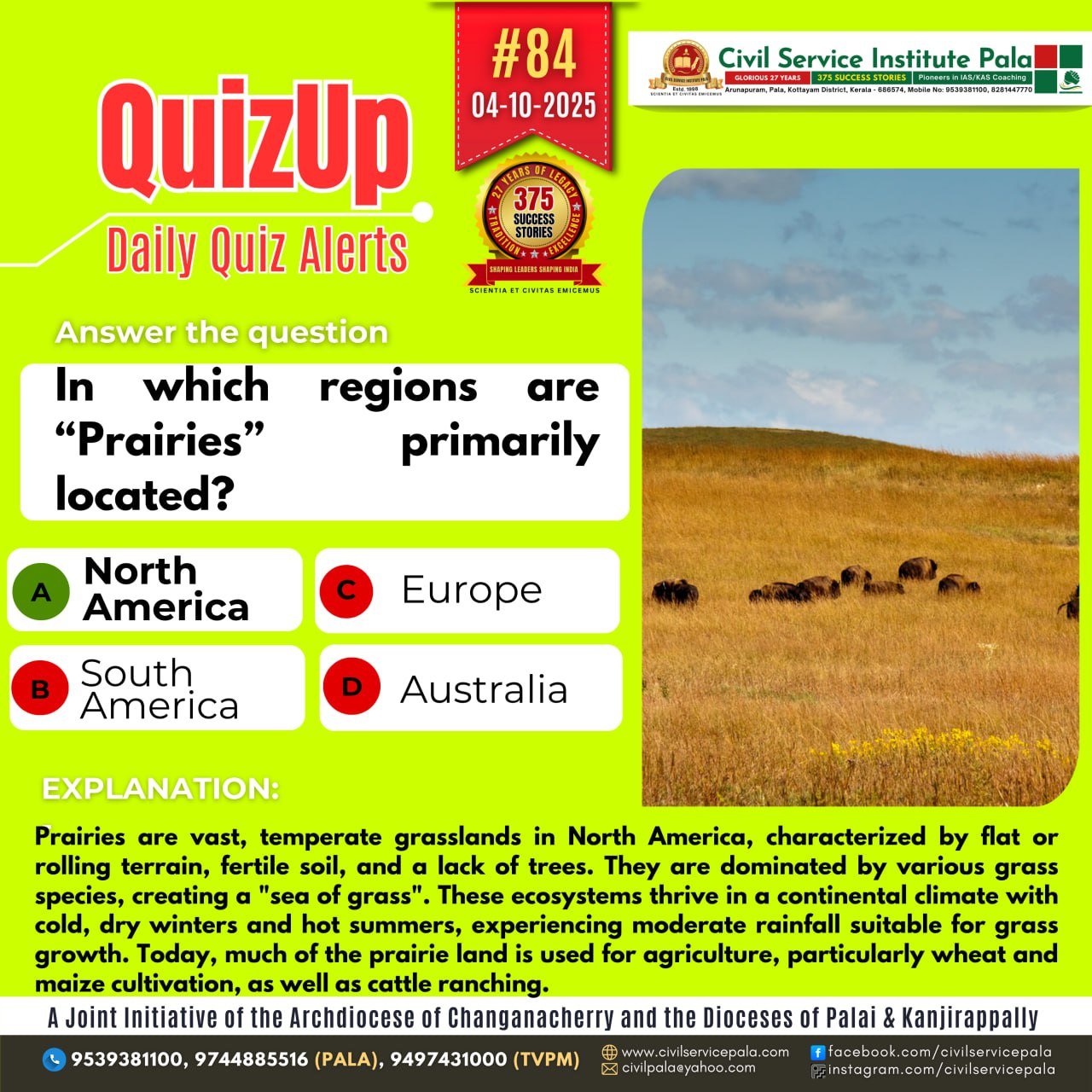
Prairies
The prairies of North America are vast, flat or gently rolling grasslands that stretch across the central part of the continent, mainly in Canada and the United States. They form part of the larger temperate grassland biome, known for its fertile soil and rich biodiversity.
Location
The prairies extend through the central United States (from Texas to North Dakota) and into the Canadian provinces of Alberta, Saskatchewan, and Manitoba. They lie between the Rocky Mountains in the west and the forested regions of the east.
Climate
The region has a continental climate — hot summers and cold winters. Rainfall is moderate, decreasing from east to west, which influences vegetation density. Vegetation Dominated by grasses, such as blue grama, buffalo grass, and wheatgrass. Trees are rare except along rivers and streams due to limited rainfall. Wildflowers and shrubs are also found, especially in the mixed-grass areas.
Types of Prairies
Tall Grass Prairie – Found in the wetter eastern region; grasses can grow up to 2 meters tall.
Mixed Grass Prairie – Transitional zone between tall and short grass areas.
Short Grass Prairie – Found in the drier western part; grasses are shorter and sparser.
Economic
Importance The fertile soil makes the prairies the “breadbasket of North America”, ideal for wheat, corn, and barley cultivation. The region also supports cattle ranching and other forms of agriculture.
Wildlife
Native species include bison, prairie dogs, antelope, coyotes, and many bird species. Much of this wildlife has declined due to large-scale farming and human settlement.
Human Impact
Large parts of the natural prairie have been converted to farmland. Conservation efforts now aim to restore grasslands and protect native species.
