



PM SHRI Scheme
PM SHRI Scheme
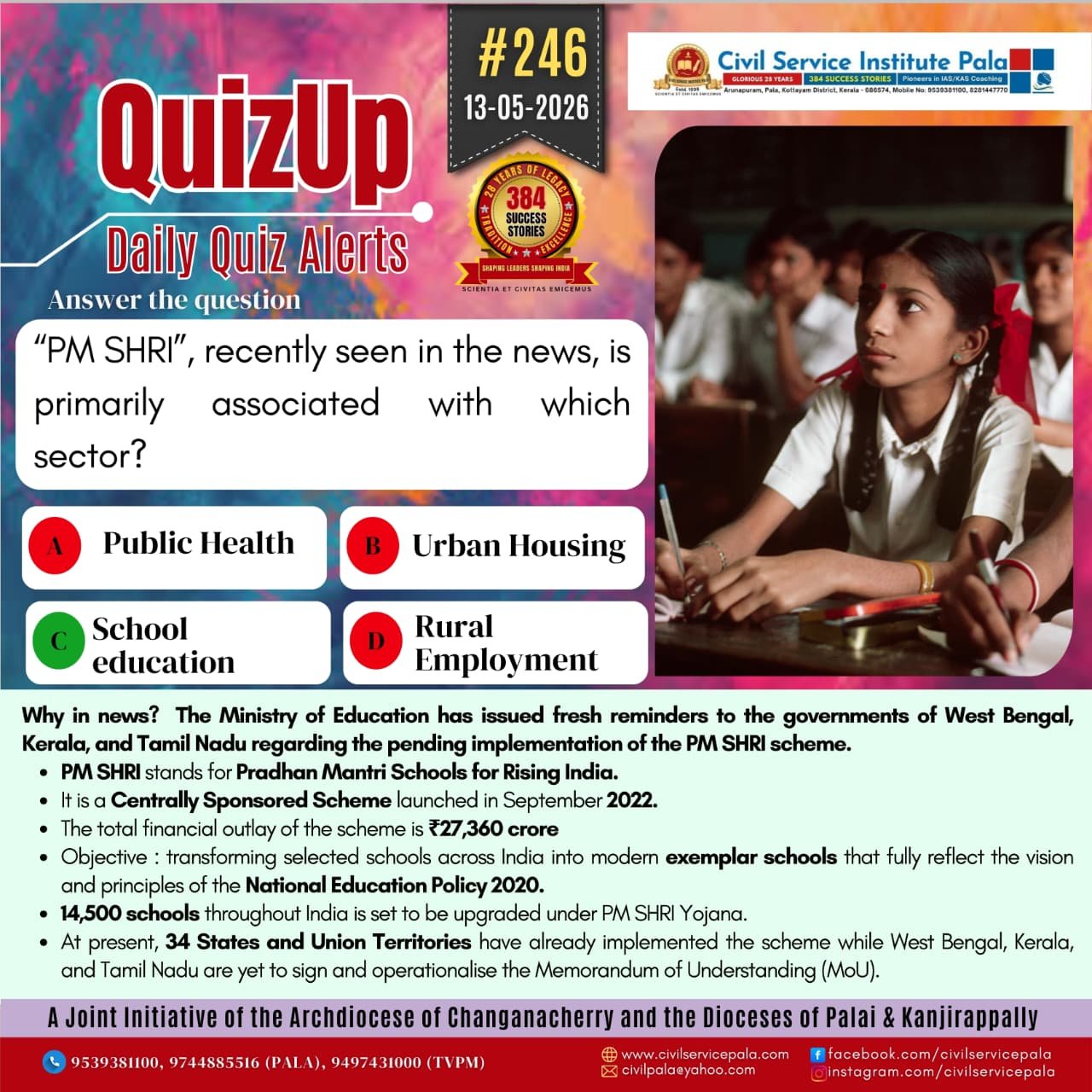
Why is PM SHRI in News?
The Ministry of Education recently issued reminders to West Bengal, Kerala, and Tamil Nadu for pending PM SHRI implementation post-assembly elections.
These three states have not signed or operationalized the required MoU, unlike 34 states/UTs that have already proceeded.
Delays risk missing the scheme's five-year timeline (2022-23 to 2026-27), limiting educational upgrades and benefits.
What is PM SHRI ?
PM SHRI stands for Pradhan Mantri Schools for Rising India, a Centrally Sponsored Scheme launched in September 2022.
It aims to transform 14,500 selected government schools into NEP 2020 exemplars with high-quality, holistic, skill-oriented, tech-enabled education.
The total outlay is ₹27,360 crore over five years (2022-23 to 2026-27), with ₹18,128 crore from the Centre (60:40 Centre-state ratio).
Objectives include improving learning outcomes, promoting experiential/competency-based learning, enhancing digital infrastructure, multilingualism, foundational literacy/numeracy, green campuses, and inclusive education.
Schools will feature modern classrooms, labs, libraries, sports facilities, vocational training, child-centred pedagogy, and teacher capacity building.
Why Some States Have Not Implemented It?
West Bengal has not signed the MoU since 2022 despite reminders, citing concerns like prefixing "PM-SHRI" to school names and cost-sharing.
Kerala delayed by keeping the MoU in abeyance, forming a review committee, and recently signed after withholding affected Samagra Shiksha funds.
Tamil Nadu gave assurances for 2024-25 but remains incomplete, opposing full NEP implementation as per MoU terms.
The MoU mandates implementing NEP 2020 "in entirety," including national/state curriculum frameworks, which some states prefer to adapt selectively.
Funding linkage
· The Centre has linked the release of funds under the Samagra Shiksha scheme to the implementation of PM-SHRI.
· Samagra Shiksha is funded by the Centre and States in a 60:40 ratio.
· Samagra Shiksha funds support implementation of the Right to Education Act, provides uniforms and textbooks to students in government schools, supports differently abled children, and covers reimbursement provided to private schools for admissions under the economically weaker section category.
· States that refused to implement PM-SHRI have not received funds under Samagra Shiksha.
