



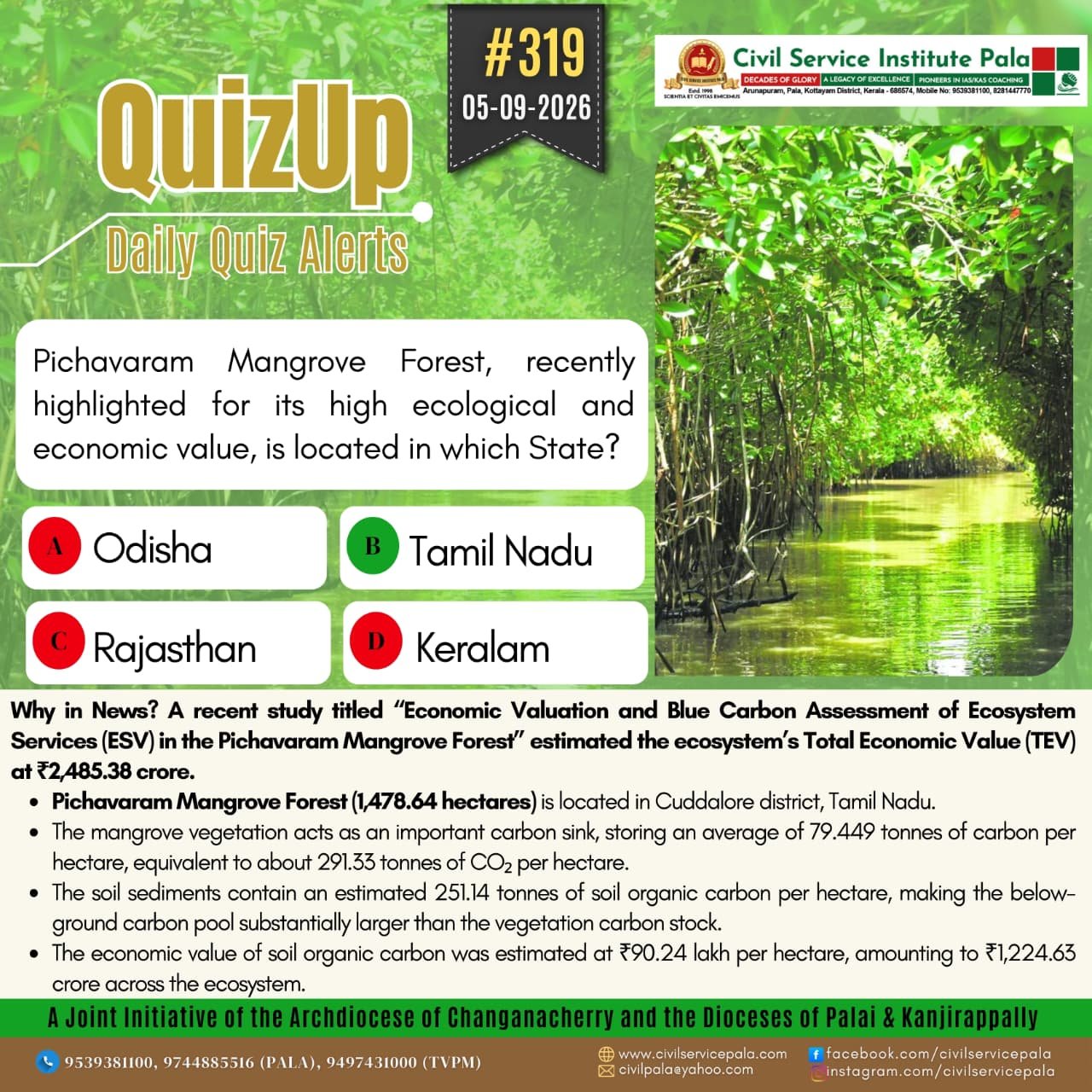
Pichavaram Mangrove Forest
Pichavaram Mangrove Forest
About Pichavaram Mangroves
• Pichavaram Mangrove Forest is located in Cuddalore district, Tamil Nadu, between the Vellar and Coleroon estuaries.
• Spread over about 1,478.64 hectares, it is one of India's significant and well-preserved mangrove ecosystems.
• It is characterised by an intricate network of waterways and rich estuarine biodiversity, including mangrove species, migratory birds and aquatic fauna.
• The ecosystem supports fisheries, coastal protection, biodiversity conservation, climate regulation, blue-carbon sequestration and local livelihoods.
• Its extensive waterways also make Pichavaram an important ecotourism destination.
Latest Study: Economic Value of Pichavaram
A recent study titled “Economic Valuation and Blue Carbon Assessment of Ecosystem Services (ESV) in the Pichavaram Mangrove Forest” assessed the economic and ecological value of the ecosystem.
• Total Economic Value (TEV): ₹2,485.38 crore (about $289 million).
• Per-hectare value: ₹1.83 crore.
• The assessment used primary and secondary data, including information collected from 302 households across five mangrove-dependent villages.
• The valuation highlights that many important mangrove services are non-market benefits and therefore often remain undervalued in conventional development planning.
Blue Carbon Findings
• Pichavaram acts as a significant natural carbon sink, with mangrove vegetation storing an average of 79.449 tonnes of carbon per hectare, equivalent to about 291.33 tonnes of CO₂ per hectare.
• The sediments/soil contain an even larger carbon reservoir, with an estimated 251.14 tonnes of soil organic carbon per hectare.
• The estimated economic value of soil organic carbon was ₹1,224.63 crore.
• When vegetation and soil carbon pools are combined, the total blue-carbon asset value was estimated at ₹1,612.40 crore.
• The study therefore highlights that a substantial share of mangrove carbon is stored below ground in sediments, making conservation of both vegetation and soil important.
Why the Study Matters
• Climate regulation: Mangroves sequester and store substantial amounts of carbon.
• Coastal resilience: They act as nature-based solutions for coastal protection, climate adaptation and disaster-risk reduction.
• Biodiversity: They provide nursery and habitat functions for diverse aquatic and terrestrial species.
• Livelihoods: Fisheries, ecotourism and other ecosystem services support coastal communities.
• Natural capital: Assigning an economic value to these services can help integrate ecosystems into development planning and environmental decision-making.
Recommendations of the Study
• Integrate ecosystem-service valuation into coastal development planning.
• Develop blue-carbon financing mechanisms and carbon-credit programmes.
• Explore Payment for Ecosystem Services (PES) schemes.
• Incorporate mangrove values into Natural Capital Accounting and Green GDP frameworks.
• Promote sustainable livelihoods through fisheries, ecotourism, community-based conservation and mangrove restoration.
• Adopt long-term ecosystem-based management to strengthen climate resilience and biodiversity conservation.
Wider Context
• The importance of mangrove conservation is heightened by climate change, biodiversity loss and increasing coastal vulnerability.
• In 2024, the IUCN's first global Red List of Ecosystems assessment of mangroves reported that 50% of the world's mangrove ecosystems are at risk of collapse.
