



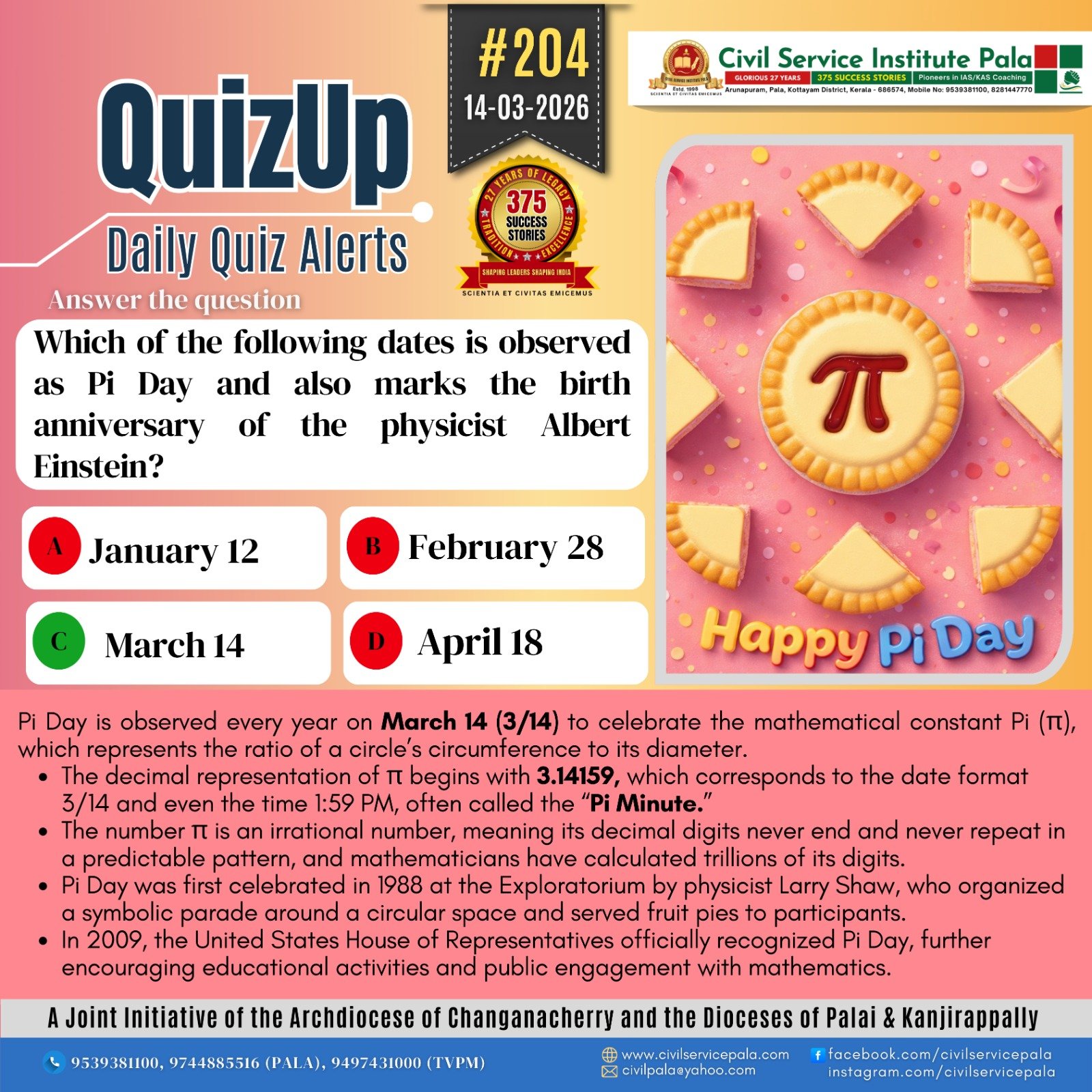
Pi Day
• Pi Day is observed every year on March 14 (3/14) to celebrate the mathematical constant Pi (π), which represents the ratio of a circle’s circumference to its diameter.
• The decimal representation of π begins with 3.14159, which corresponds to the date format 3/14 and even the time 1:59 PM, often called the “Pi Minute.”
• The number π is an irrational number, meaning its decimal digits never end and never repeat in a predictable pattern, and mathematicians have calculated trillions of its digits using advanced computers.
• Pi Day was first celebrated in 1988 at the Exploratorium by physicist Larry Shaw, who organized a symbolic parade around a circular space and served fruit pies to participants.
• The celebration gradually spread worldwide as a way to promote enthusiasm for mathematics and science.
• In 2009, the United States House of Representatives officially recognized Pi Day, further encouraging educational activities and public engagement with mathematics.
The Albert Einstein Connection
Pi Day is also special because it marks the birthday of Albert Einstein, one of the most influential physicists in history. Born on March 14, 1879, in Ulm, in the German state of Württemberg, Einstein spent much of his childhood in Munich. He later continued his education in Aarau, Switzerland, before enrolling in the Swiss Federal Polytechnic School in Zurich to train as a teacher of physics and mathematics.
After graduating in 1901, Einstein struggled to find an academic position and eventually worked as a technical assistant at the Swiss Patent Office in Bern. Remarkably, during his spare time at the patent office, he produced some of the most revolutionary scientific work in modern physics. His year 1905 is often called the “Annus Mirabilis” (Miracle Year) because he published several groundbreaking papers that transformed scientific understanding.
Major Scientific Contributions
Einstein’s work reshaped physics in multiple ways:
• Special Theory of Relativity (1905): Einstein showed that space and time are interconnected and that the speed of light is constant for all observers. This theory also led to the famous equation E = mc², demonstrating the equivalence of mass and energy.
• Photoelectric Effect: Einstein explained how light can behave as discrete packets of energy called photons. This work earned him the Nobel Prize in Physics in 1921 and helped lay the foundation of quantum theory.
• Brownian Motion: He provided a mathematical explanation for the random movement of microscopic particles in fluids, offering strong evidence for the existence of atoms and molecules.
• General Theory of Relativity (1915–1916): Einstein expanded his earlier theory to include gravity, describing it not as a force but as the curvature of spacetime caused by massive objects. This theory predicted phenomena such as gravitational lensing and gravitational waves, many of which were confirmed decades later.
Beyond these achievements, Einstein contributed to statistical mechanics, quantum theory, and cosmology, and he spent later years trying to develop a unified field theory that could combine gravity and electromagnetism into a single framework.