



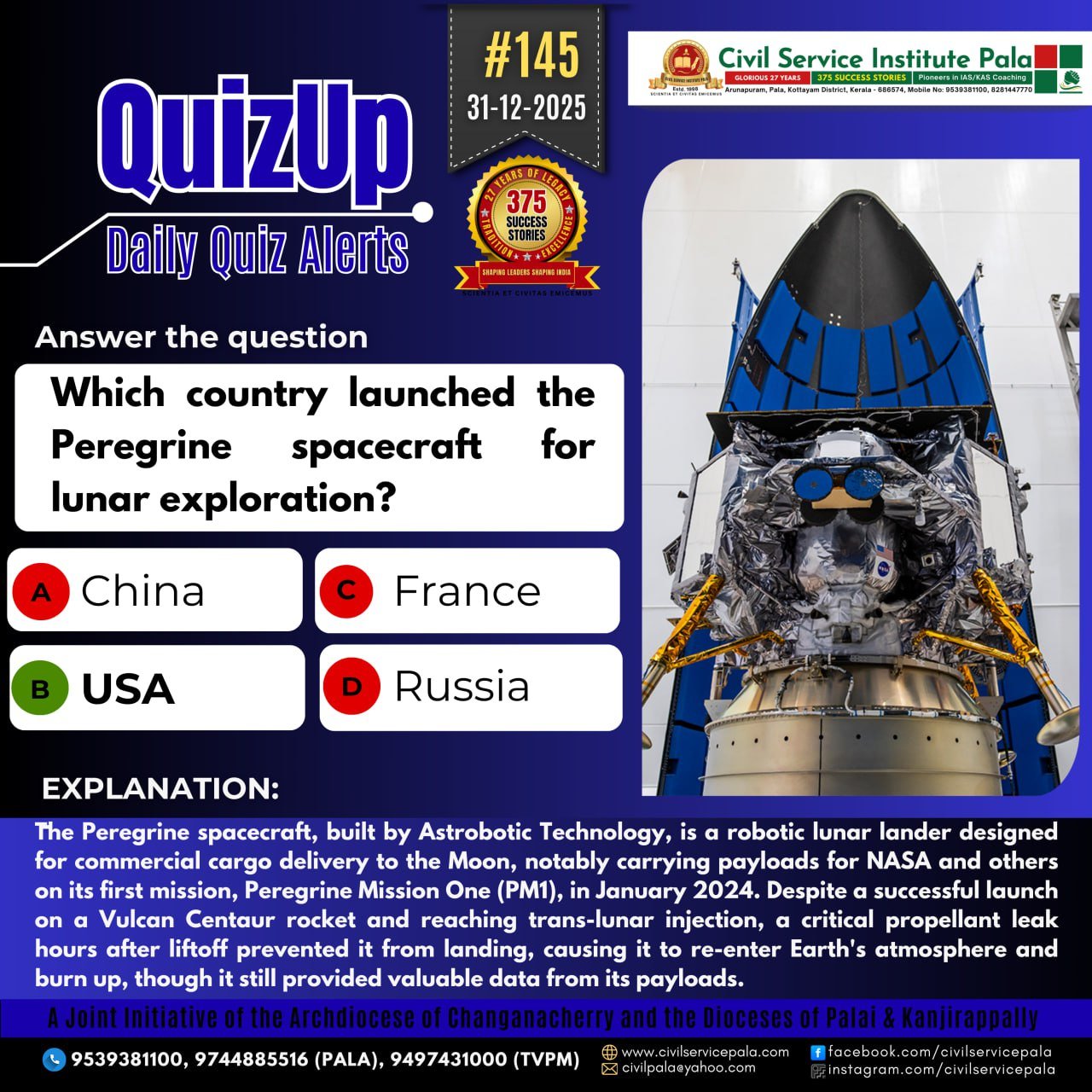
Peregrine Spacecraft
The Peregrine spacecraft is a commercial lunar lander developed by the US-based company Astrobotic Technology as part of NASA’s efforts to promote private participation in lunar exploration. It was designed under NASA’s Commercial Lunar Payload Services (CLPS) program, which aims to deliver scientific instruments and technology demonstrations to the Moon at lower cost and with greater frequency, supporting the broader Artemis program.
Peregrine is intended to carry a diverse set of NASA and commercial payloads, including scientific instruments to study lunar soil, radiation, and surface conditions, as well as technology experiments and even symbolic payloads. The spacecraft is designed to land on the Moon’s surface and operate for about one lunar day (around 14 Earth days), relying primarily on solar power. It uses advanced navigation, propulsion, and landing systems to achieve a soft landing on the lunar surface.
Although the Peregrine Mission One faced technical challenges shortly after launch, it marked an important milestone as the first US commercial lunar lander launched toward the Moon. The mission highlighted both the risks and learning opportunities associated with private-sector-led deep space missions. Overall, the Peregrine spacecraft represents a significant step in the commercialization of lunar exploration and reflects a new model in which government and private companies collaborate to return humans and instruments to the Moon sustainably.
