



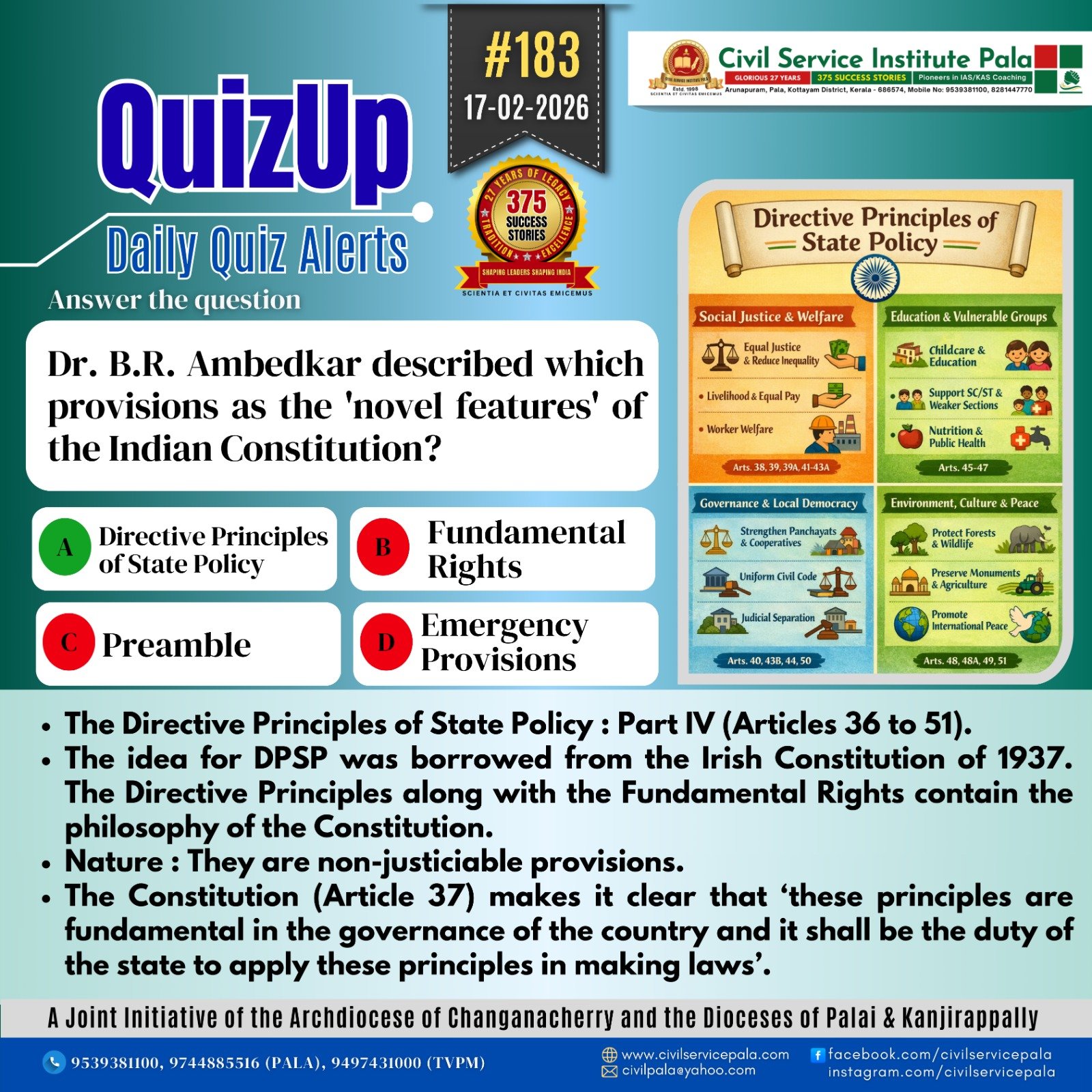
Part IV (Articles 36 to 51)
The Directive Principles of State Policy : Part IV (Articles 36 to 51).
The idea for DPSP was borrowed from the Irish Constitution of 1937.
The Directive Principles along with the Fundamental Rights contain the philosophy of the Constitution and is the soul of the Constitution.
Nature : They are non-justiciable provisions. However, the Constitution (Article 37) makes it clear that ‘these principles are fundamental in the governance of the country and it shall be the duty of the state to apply these principles in making laws’.
Directive Principles of State Policy :
Article 38 - To promote the welfare of the people by securing a social order permeated by justice–social, economic and politi-cal and to minimise inequalities in income, status, facilities and opportunities.
Article 39 - To secure
(a) the right to adequate means of livelihood for all citizens;
(b) the equitable distribution of material resources of the community for the common good;
(c) prevention of concentration of wealth and means of production;
(d) equal pay for equal work for men and women;
(e) preservation of the health and strength of workers and children against forcible abuse;
(f) opportunities for healthy development of children.
Article 39 A - To promote equal justice and to provide free legal aid to the poor.
Article 40 – Organisation of village panchayats.
Article 41 - To secure the right to work, to education and to public assistance in cases of unemployment, old age, sickness and disablement
Article 42 - To make provision for just and humane conditions of work and maternity relief
Article 43 - To secure a living wage, a decent standard of life and social and cultural opportunities for all workers
Article 43 A -To take steps to secure the participation of workers in the management of industries
Article 43B - Promotion of co-operative societies
Article 44 - Uniform civil code for the citizens
Article 45 - Provision for early childhood care and education to children below the age of six years
Article 46 - Promotion of educational and economic interests of Scheduled Castes, Scheduled Tribes and other weaker sections
Article 47 - Duty of the State to raise the level of nutrition and the standard of living and to improve public health
Article 48 - Organisation of agriculture and animal husbandry.
Article 48A - Protection and improvement of environment and safeguarding of forests and wild life.
Article 49 - Protection of monuments and places and objects of national importance.
Article 50 - Separation of judiciary from executive.
Article 51 - Promotion of international peace and security.
Amendments to the DPSP
1. 42nd Amendment (1976) added four principles: healthy child development (Art. 39), free legal aid for poor (Art. 39A), worker participation in industries (Art. 43A), and environment protection (Art. 48A).
2. 44th Amendment (1978) updated Article 38 by adding a provision directing the State to reduce inequalities in income, status, facilities, and opportunities.
3. 86th Amendment (2002) changed Article 45 to focus on early childhood care and education for children up to age six, while making elementary education a fundamental right (Art. 21A).
4. 97th Amendment (2011) added Article 43B to promote voluntary formation, democratic control, and professional management of cooperative societies.
