



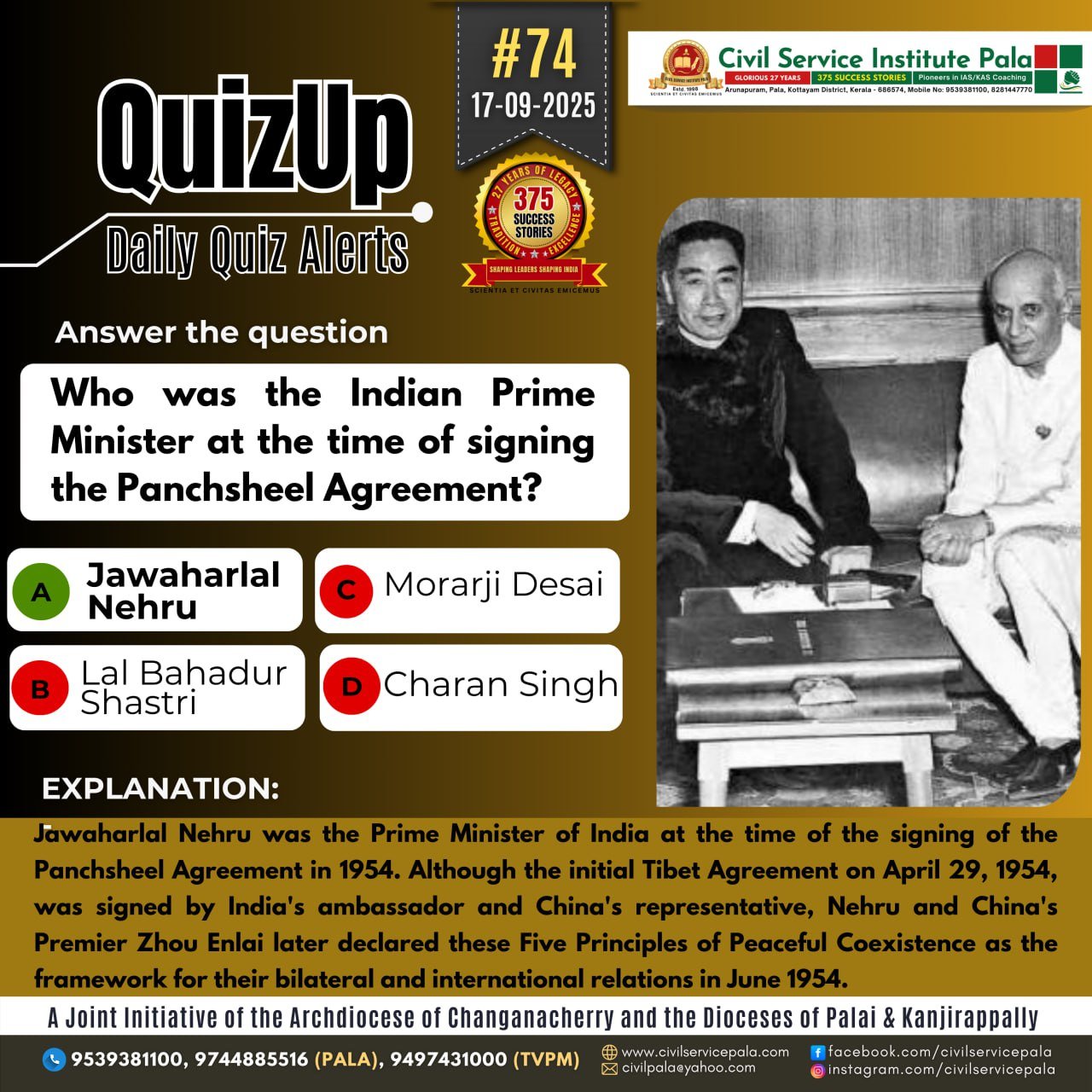
Panchsheel Agreement
The Panchsheel Agreement, also called the Five Principles of Peaceful Coexistence, was signed on 29 April 1954 between India and China. It was originally an agreement on trade and relations with Tibet, but the principles became a cornerstone of India-China foreign policy and later influenced global diplomacy.
Leaders associated: Jawaharlal Nehru (India’s Prime Minister) and Zhou Enlai (China’s Premier).
The Five Principles (Panchsheel) Mutual respect for each other’s territorial integrity and sovereignty. Mutual non-aggression (neither country would attack the other). Mutual non-interference in each other’s internal affairs. Equality and mutual benefit in relations. Peaceful coexistence as the basis of diplomacy. Importance It was seen as a framework to promote peace, stability, and cooperation in Asia after colonial rule.
The principles were later endorsed in the Bandung Conference (1955) and became central to the Non-Aligned Movement (NAM). Helped project India as a peace-loving nation with an independent foreign policy.
Limitations and Criticism
Despite the ideals, India-China relations deteriorated soon after: In 1962, the Sino-Indian War broke out, showing the limits of Panchsheel in practice. Critics argue that India’s trust in Panchsheel made it unprepared for Chinese aggression. Since then, while the principles remain symbolically important, their practical relevance has been questioned.
Contemporary Relevance
Still referred to in international diplomacy as a moral guideline for peaceful coexistence. Emphasized in India’s broader foreign policy of non-alignment, respect for sovereignty, and peaceful resolution of disputes.
