



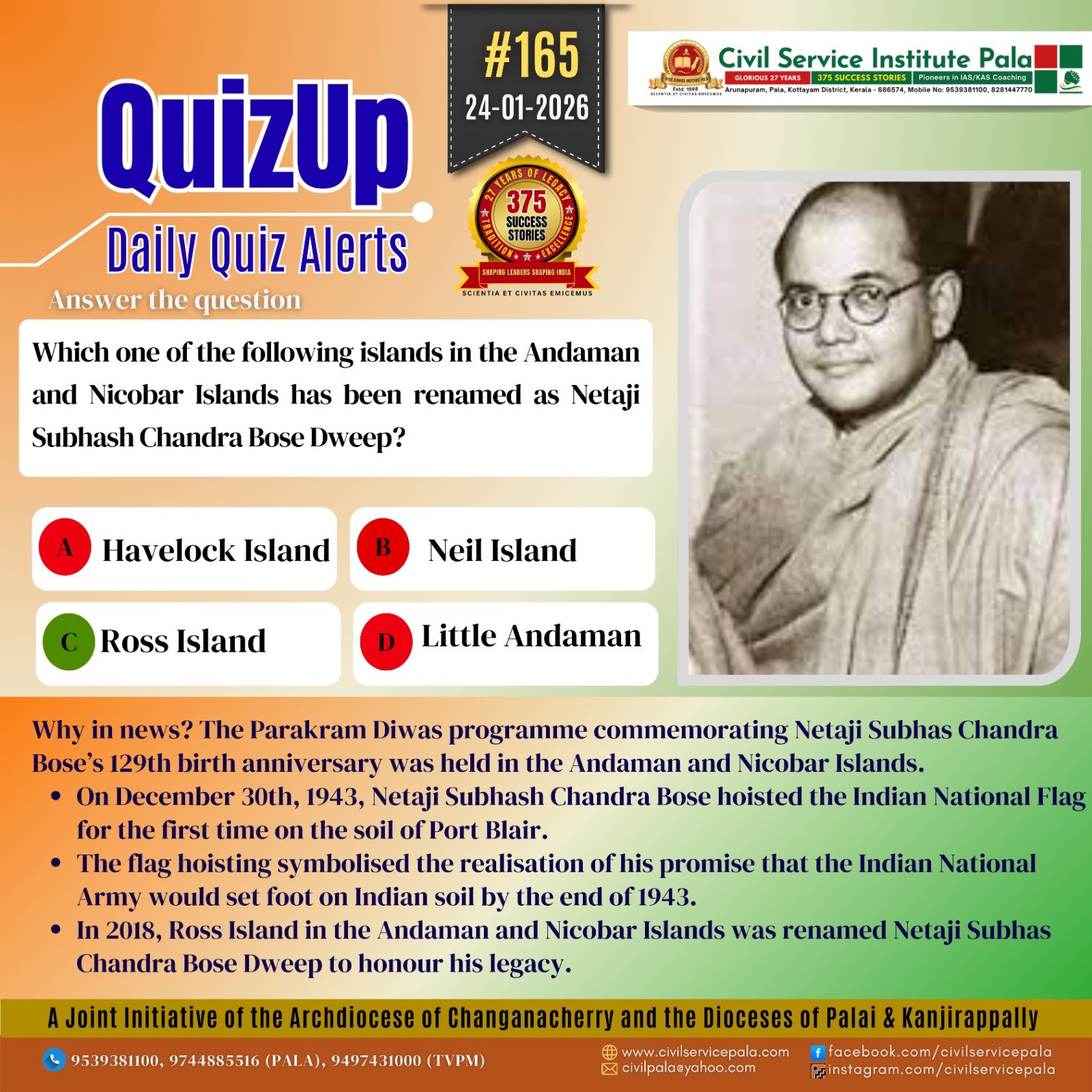
Netaji Subhas Chandra Bose Dweep
Netaji Subhas Chandra Bose Dweep
• On December 30th, 1943, Netaji Subhash Chandra Bose, the Supreme Commander of the Azad Hind, created a historic moment by hoisting the Indian National Flag for the first time on the soil of Port Blair.
• This significant event took place after his escape from British surveillance and his arrival in Port Blair on January 16, 1941.
• The flag hoisting symbolised the realisation of his promise that the Indian National Army would set foot on Indian soil by the end of 1943.
• In remembrance of this momentous occasion and as a tribute to the brave martyrs, the Sankalp Smarak was inaugurated in Port Blair, serving as a symbol of commitment, duty, and sacrifice associated with Netaji Subhash Chandra Bose.
• This historic event of hoisting the national flag in Port Blair in 1943 marked a watershed in the history of the freedom struggle, declaring the Andamans to be the first island to be liberated from the British hold.
• In 2018, Ross Island in the Andaman and Nicobar Islands was renamed Netaji Subhas Chandra Bose Dweep to honour his legacy.
Netaji Subhas Chandra Bose
• Born in Cuttack.
• Educated in Cuttack, Calcutta, and Cambridge.
• Qualified for the I.C.S. but resigned in April 1921.
• Returned home and joined the Non-Cooperation Movement, became a follower of C. R. Das.
• Arrested in 1924 and detained till 1927, mostly in Mandalay jail.
• Became President of Bengal P.C.C. and General Secretary of the Congress in 1927.
• President of the Congress in 1938, re-elected in 1939 defeating Mahatma Gandhi’s nominee.
• Resigned the presidency and founded the All India Forward Bloc.
• Placed under house arrest at the beginning of the Second World War.
• Escaped to Germany in 1941.
• Officially formed the Indian Independence League in South East Asia.
• Organized and led the Indian National Army, acclaimed as Netaji.
• Died in an aircraft accident on 18 August 1945 after the fall of Japan.
• The Government of India declared 23rd January, the birth anniversary of Netaji Subhas Chandra Bose, as “Parakram Diwas”.
