



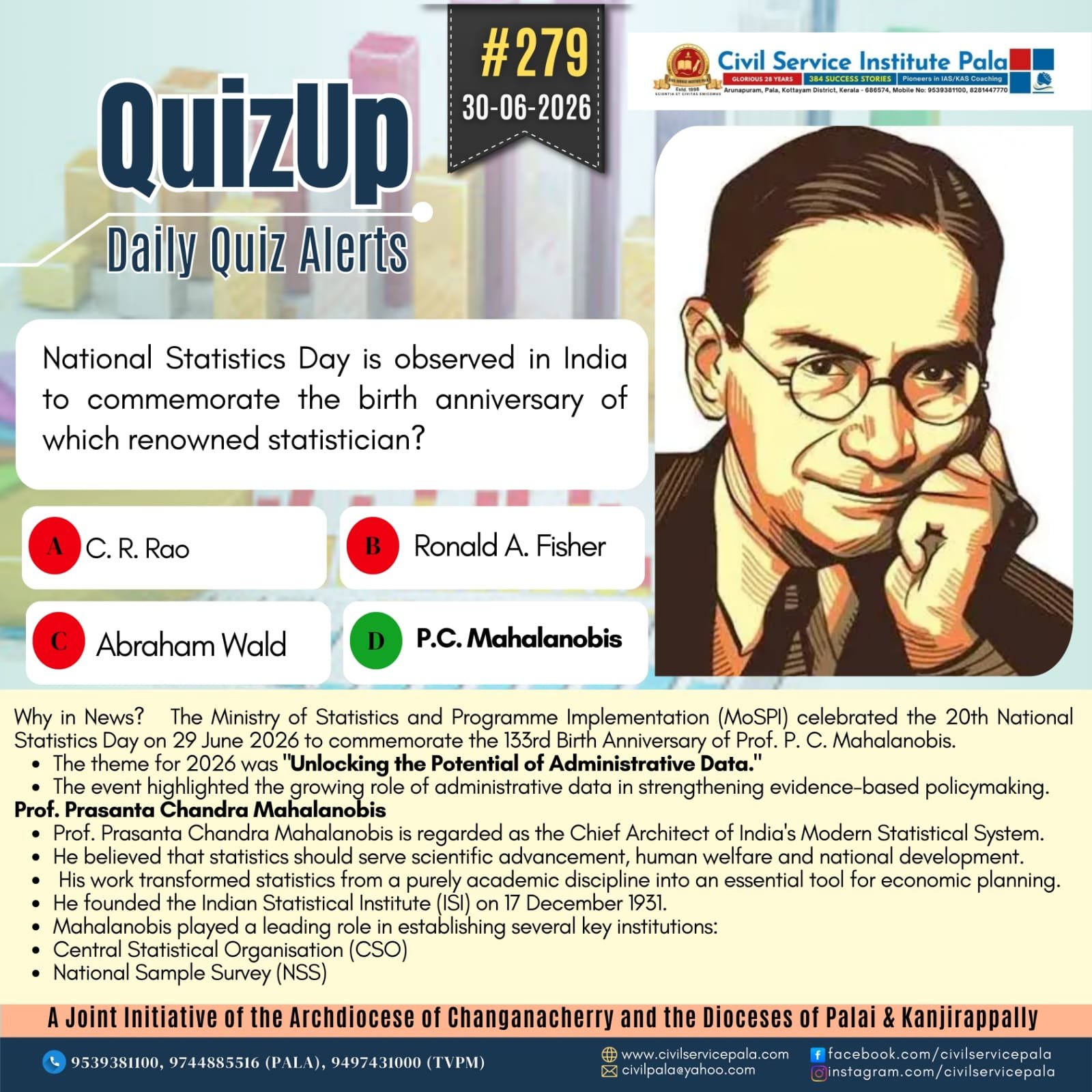
National Statistics Day 2026 – Prof. P. C. Mahalanobis & India's Statistical Legacy
National Statistics Day 2026 – Prof. P. C. Mahalanobis & India's Statistical Legacy
Why in News?
• The Ministry of Statistics and Programme Implementation (MoSPI) celebrated the 20th National Statistics Day on 29 June 2026 to commemorate the 133rd Birth Anniversary of Prof. P. C. Mahalanobis.
• The theme for 2026 was "Unlocking the Potential of Administrative Data."
• The event highlighted the growing role of administrative data in strengthening evidence-based policymaking, data harmonisation and digital governance.
Prof. P. C. Mahalanobis – Father of Modern Indian Statistics
• Prof. Prasanta Chandra Mahalanobis is regarded as the Chief Architect of India's Modern Statistical System and the Father of Statistical Science in India.
• He firmly believed that statistics should serve scientific advancement, human welfare and national development.
• His work transformed statistics from a purely academic discipline into an essential tool for economic planning, governance and public policy.
Institution Building and National Contributions
Indian Statistical Institute (ISI) - He founded the Indian Statistical Institute (ISI) on 17 December 1931.
• ISI became India's premier institution for statistical research and training.
Building India's Statistical Architecture
Mahalanobis played a leading role in establishing several institutions that continue to form the backbone of India's statistical system:
• Central Statistical Organisation (CSO)
• National Sample Survey (NSS)
• Annual Survey of Industries (ASI)
These institutions enabled systematic collection of national economic and social statistics.
Major Contributions to Statistical Science
1. Mahalanobis Distance
• Developed the famous Mahalanobis Distance, one of the most widely used multivariate statistical measures for measuring similarity between observations.
2. Pioneer of Sample Surveys
Mahalanobis revolutionised statistical data collection by promoting scientific sample surveys instead of complete enumeration.
His major innovations include:
a) Pilot Surveys
b) Optimum Survey Design
c) Interpenetrating Network of Sub-Samples (IPNS) for improving survey accuracy and controlling errors.
He successfully demonstrated that properly designed sample surveys could often be more accurate, faster and less expensive than complete census enumeration.
Role in Independent India's Development
• After Independence, Mahalanobis headed the committee that reassessed India's National Income.
• He served as the Honorary Statistical Adviser to the Government of India.
• His statistical framework became the foundation for India's Five-Year Plans and evidence-based economic planning.
• His methods greatly influenced policy formulation in agriculture, industry and national development.
International Recognition
• Served as Chairman of the United Nations Sub-Commission on Statistical Sampling (1947–1951).
• He was a staunch advocate for the global adoption of scientific sampling methods.
• He was awarded the Weldon Medal (1944) by Oxford University.
• Elected Fellow of the Royal Society (FRS) in 1945 for his pioneering work in statistics.
National Statistics Day 2026 Theme
Theme: "Unlocking the Potential of Administrative Data"
The theme emphasises transforming routine government-generated data into a secure, interoperable and reliable national resource for policymaking.
MoSPI highlighted the need to:
• Integrate administrative data with traditional statistical surveys.
• Improve data harmonisation across Ministries, States and Union Territories.
• Strengthen metadata standards, data quality assessment, uniform classifications, unique identifiers and common definitions.
• Support real-time, evidence-based governance using India's expanding Digital Public Infrastructure (DPI).
Administrative Data vs Sample Surveys
Traditional Sample Surveys
• Designed to collect representative data from selected samples.
• Scientifically planned and statistically reliable.
• Foundation of India's statistical system developed by Mahalanobis.
Administrative Data
• Generated routinely through government programmes, public service delivery systems, regulatory databases and digital platforms.
• Provides large-scale, real-time information.
• Modern policy requires combining administrative datasets with scientific sample surveys for more granular, reliable and timely statistics.
