



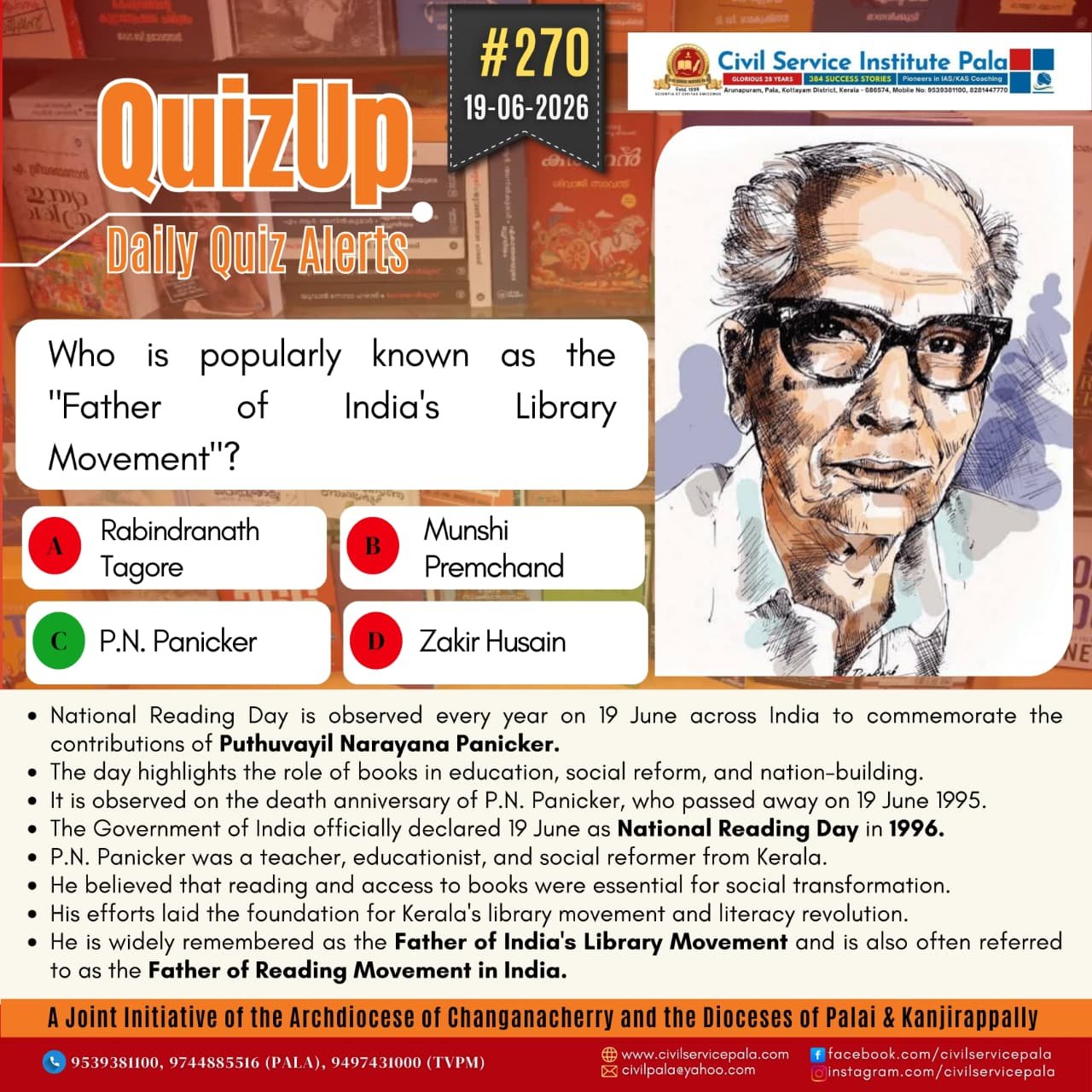
National Reading Day (19 June)
National Reading Day (19 June)
• National Reading Day is observed every year on 19 June across India to commemorate the contributions of Puthuvayil Narayana Panicker, popularly known as the Father of India’s Library Movement.
• The day promotes the habit of reading and highlights the role of books in education, social reform, and nation-building.
• It is observed on the death anniversary of P.N. Panicker, who passed away on 19 June 1995.
• The Government of India officially declared 19 June as National Reading Day in 1996.
Who Was P.N. Panicker?
• P.N. Panicker was a teacher, educationist, and social reformer from Kerala who dedicated his life to spreading literacy and reading culture.
• He firmly believed that reading and access to books were essential for individual empowerment and social transformation.
• His efforts laid the foundation for Kerala's library movement and literacy revolution.
• He is widely remembered as the Father of India's Library Movement and is also often referred to as the Father of Reading Movement in India.
Library Movement in Kerala
• P.N. Panicker played a key role in establishing Kerala's first public library movement.
• He was associated with the Sanatana Dharma Library, which became a symbol of community-based reading initiatives.
• In 1945, he helped strengthen organized library activities that later expanded across Kerala.
• His vision was to bring books and education directly to ordinary people through community libraries.
Kerala Granthshala Sangham (KGS)
• P.N. Panicker led the Kerala Granthshala Sangham, which became the driving force behind Kerala's library movement.
• The organization originally functioned as the Travancore Literary Association.
• It initially consisted of 47 local libraries working at the grassroots level.
• After the formation of Kerala State in 1956, the network expanded rapidly.
• More than 1,600 additional libraries were brought under the movement in the following years.
• The movement helped make books accessible even in rural and remote areas.
International Recognition
• The achievements of the Kerala library movement received international appreciation.
• Under P.N. Panicker's leadership, Kerala Granthshala Sangham earned the prestigious UNESCO Krupskaya Award in 1975.
• The award recognized its contribution to literacy, library development, and community education.
KANFED and Literacy Campaigns
• P.N. Panicker was instrumental in establishing the Kerala Association for Non-Formal Education and Development.
• KANFED worked to reduce illiteracy through non-formal education programmes.
• The organization focused particularly on rural populations and disadvantaged communities.
• It helped spread awareness about the importance of education and lifelong learning.
Reading Week (Vayana Varam)
• Kerala observes a special Reading Week (Vayana Varam) beginning on 19 June every year.
• Schools, libraries, and educational institutions organize reading campaigns, book discussions, and literary activities.
• The initiative seeks to cultivate a lifelong reading habit among children and adults.
Significance of National Reading Day
• The day celebrates the transformative power of reading and education.
• It encourages citizens to develop regular reading habits.
• It highlights the role of libraries in democratizing access to knowledge.
• It promotes literacy, critical thinking, and informed citizenship.
• The observance serves as a tribute to P.N. Panicker's vision of a knowledge-based society.
Impact on Kerala's Literacy Success
• Experts highlight that the library movement played a major role in Kerala's remarkable literacy achievements.
• Community libraries became centers of education, social awareness, and cultural development.
• Kerala consistently records one of the highest literacy rates in India.
• The success demonstrates the importance of grassroots educational initiatives.
