



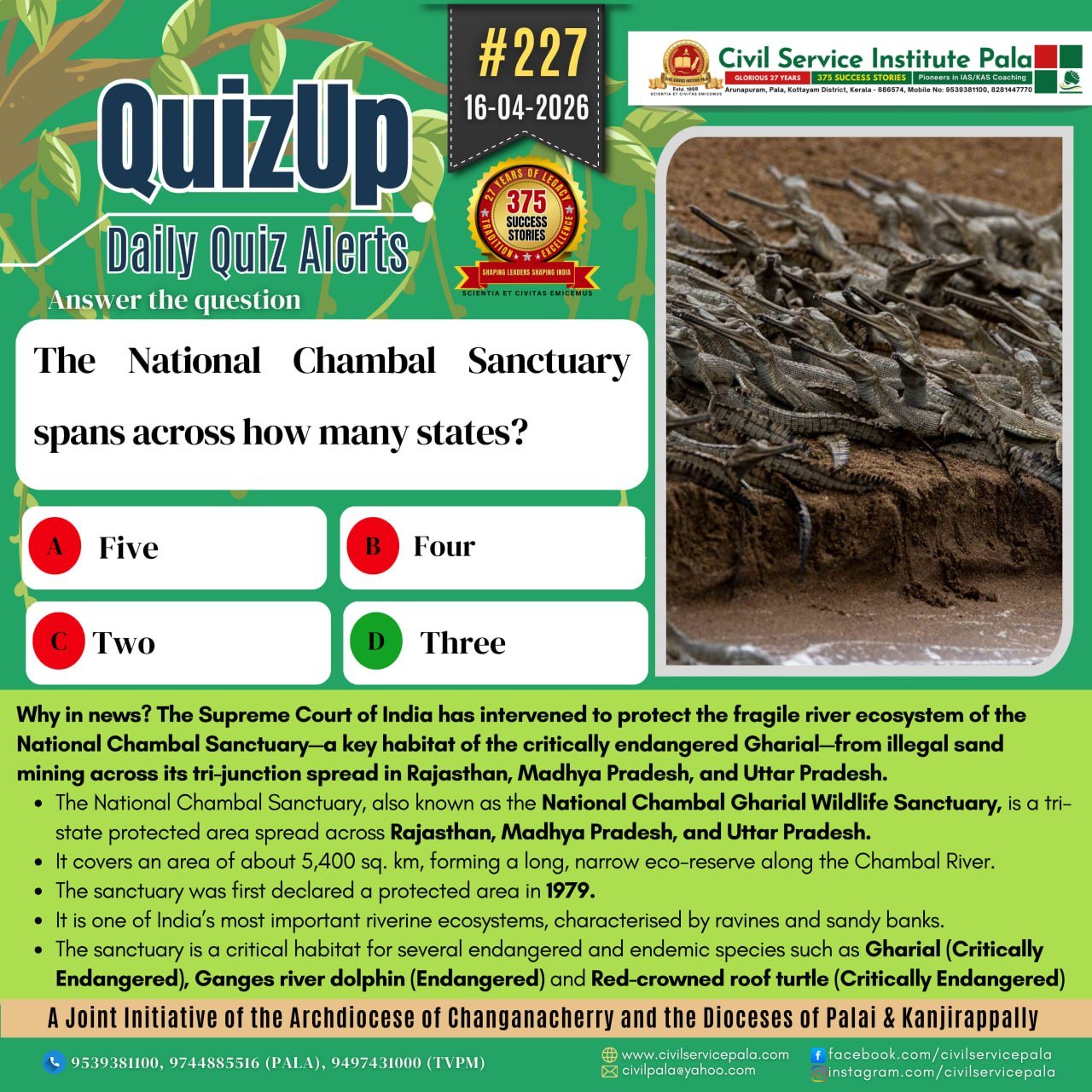
National Chambal Sanctuary
• The National Chambal Sanctuary, also known as the National Chambal Gharial Wildlife Sanctuary, is a tri-state protected area spread across Rajasthan, Madhya Pradesh, and Uttar Pradesh.
• It covers an area of about 5,400 sq. km, forming a long, narrow eco-reserve along the Chambal River.
• The sanctuary was first declared a protected area in 1978–79, with coordinated management by the three states.
• It is one of India’s most important riverine ecosystems, characterised by ravines, sandy banks, and relatively unpolluted waters.
Geographical Features
• The sanctuary lies along the Chambal River, which originates in the Vindhyan ranges and flows through Madhya Pradesh, Rajasthan, and Uttar Pradesh before joining the Yamuna River.
• The riverine landscape includes deep ravines, steep valleys, and sandy beaches, providing ideal habitat for aquatic and semi-aquatic species.
• The Chambal is considered one of the cleanest rivers in northern India, which supports high biodiversity.
Biodiversity Significance
• The sanctuary is a critical habitat for several endangered and endemic species:
o Gharial (Critically Endangered)
o Ganges river dolphin (Endangered)
o Red-crowned roof turtle (Critically Endangered)
• Other important fauna include mugger crocodile, otters, and a variety of freshwater turtles.
• The sanctuary supports around 290 species of birds, including migratory and resident species.
• Major migratory species include :
o Flamingoes (winter migrants: November–May)
o Ruddy Shelduck (arrives September–May)
o Indian Skimmer (notable breeding colonies)
Conservation Importance
• The sanctuary represents the last major stronghold of the gharial in India.
• It plays a key role in conserving riverine biodiversity, which is otherwise highly threatened in India.
• The relatively low industrial pollution in the Chambal River makes it unique among north Indian rivers.
Project Crocodile (1975)
• The Project Crocodile was launched to address the sharp decline in crocodilian populations due to poaching, habitat loss, and human activities.
• The Chambal River was selected as a major site for gharial conservation and reintroduction programmes.
• Captive breeding and release initiatives helped revive the gharial population in the sanctuary.
Administrative and Regional Importance
• The sanctuary is co-managed by three states, making it an example of inter-state conservation cooperation.
• In Uttar Pradesh, it covers parts of Etawah and Agra districts (approx. 635 sq. km).
• It forms part of a broader network of river conservation areas in India.
Conservation Challenges
• Crucial threats included poaching, illegal fishing, sand mining, and habitat degradation.
• Ongoing pressures include:
o River water diversion and dams
o Sand mining affecting nesting sites
o Human encroachment and disturbance
• Conservation success depends on maintaining ecological flow and habitat integrity.
