



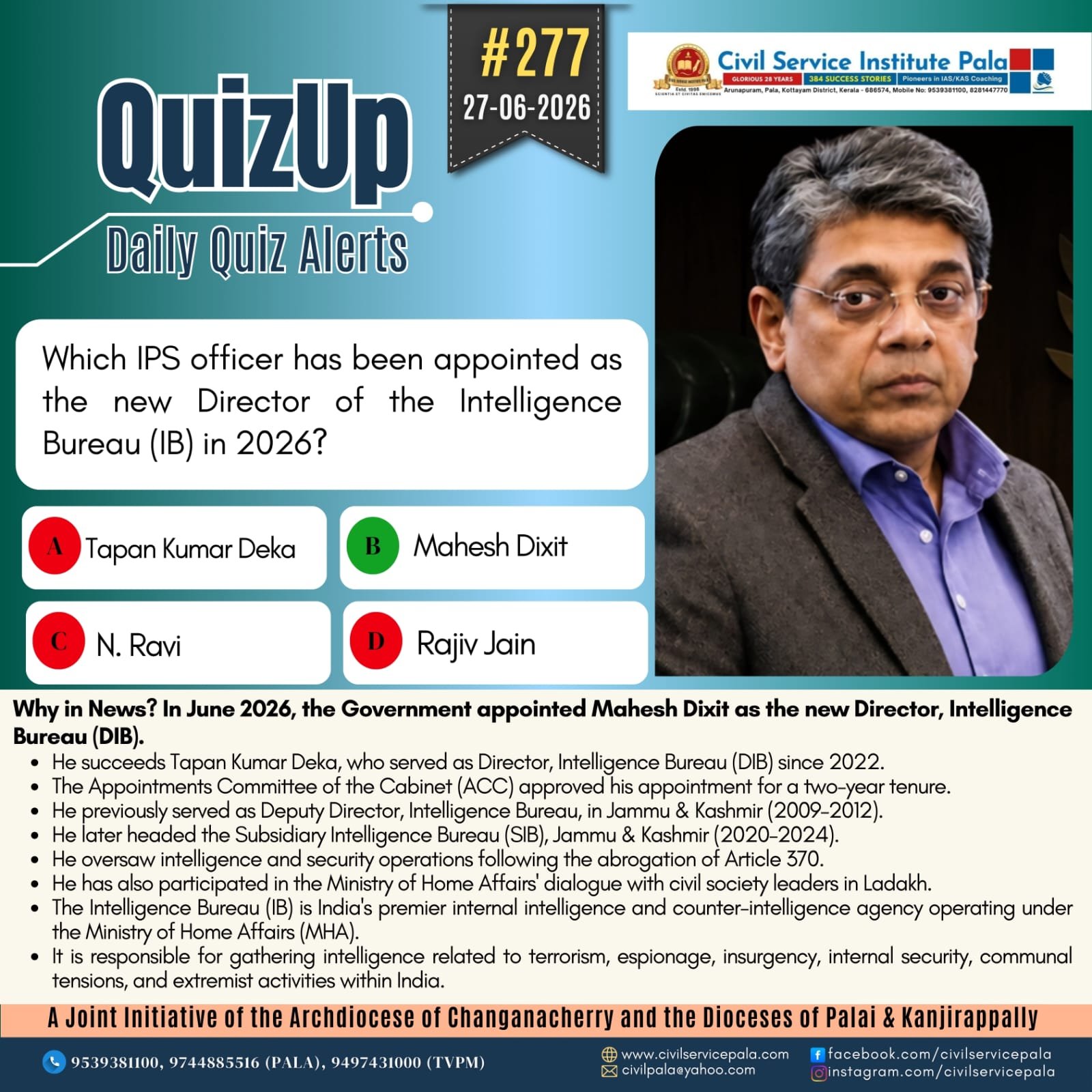
Mahesh Dixit as the new Director, Intelligence Bureau (DIB)
Appointment of the New Director of the Intelligence Bureau (IB)
Why in News?
• In June 2026, the Government appointed Mahesh Dixit as the new Director, Intelligence Bureau (DIB).
• Mahesh Dixit, a 1993-batch IPS officer of the Andhra Pradesh cadre, has been appointed as the Director, Intelligence Bureau (DIB).
• He succeeds Tapan Kumar Deka, who served as DIB from 2022.
• The Appointments Committee of the Cabinet (ACC) approved his appointment for a two-year tenure.
• He has also been granted a service extension beyond his scheduled retirement.
Mahesh Dixit: Profile
Career Highlights
• He belongs to the 1993 batch of the Indian Police Service (IPS) of the Andhra Pradesh cadre.
• He was a medical doctor by education before joining the IPS.
• He has extensive experience in intelligence operations, particularly in Jammu & Kashmir, Nagaland, and Bihar.
Major Assignments
• Served as Deputy Director, IB in Jammu & Kashmir (2009–2012).
• Served in Nagaland (2012–2015).
• Headed the Subsidiary Intelligence Bureau (SIB), Jammu & Kashmir (2020–2024).
• Oversaw intelligence and security operations following the abrogation of Article 370.
• Has also participated in the Home Ministry's dialogue with civil society leaders in Ladakh.
Intelligence Bureau (IB): History, Structure and Functions
Intelligence Bureau (IB)
• The Intelligence Bureau (IB) is India's premier internal intelligence and counter-intelligence agency operating under the Ministry of Home Affairs (MHA).
• It is responsible for gathering intelligence related to terrorism, espionage, insurgency, internal security, communal tensions and extremist activities within India.
• Unlike investigative agencies, the IB does not possess powers of arrest; it collects and disseminates intelligence for action by law-enforcement agencies.
Origin and Administrative Status
• The IB traces its origins to the Central Special Branch (1887) established during British rule.
• It evolved into the Department of Central Intelligence and later became the Intelligence Bureau in 1920.
• After Independence, it was retained as India's principal civil internal intelligence agency.
• The IB functions under the administrative control of the Ministry of Home Affairs (MHA).
• It does not have a dedicated statutory basis and operates through executive authority, making it one of India's major intelligence agencies without an Act of Parliament.
Leadership and Organisation
• The Bureau is headed by the Director, Intelligence Bureau (DIB), traditionally the senior-most serving IPS officer.
• The DIB reports directly to the Union Home Minister and briefs the Prime Minister on sensitive national security matters.
• The organisation functions through specialized divisions dealing with:
o Counter-terrorism
o Counter-intelligence
o Internal security
o Technical intelligence
o VIP security
• It maintains a nationwide network of Subsidiary Intelligence Bureaus (SIBs).
Major Functions of the Intelligence Bureau
Internal Intelligence
• Collects intelligence on:
o Terrorism
o Insurgency
o Espionage
o Communal violence
o Extremist and separatist activities.
Counter-Intelligence
• Detects and monitors activities of foreign intelligence agencies operating within India.
Intelligence Sharing
• Shares actionable intelligence with:
o State Police
o Central Armed Police Forces
o Union Government
• Serves as the nodal agency for intelligence sharing through the Multi-Agency Centre (MAC).
Security Vetting
• Conducts background verification and security clearance for sensitive government appointments.
Important Institutional Features
No Police Powers
• The IB cannot arrest or prosecute individuals.
• Operational action is taken by police or other investigative agencies based on IB intelligence inputs.
Multi-Agency Centre (MAC)
• Functions as India's principal platform for real-time sharing of terrorism-related intelligence among numerous Central and State agencies.
Legal Status
• The IB is exempt from the Right to Information (RTI) Act, 2005 under Section 24 and the Second Schedule.
• Its lack of a statutory charter has led to periodic debates on parliamentary oversight and accountability.
