



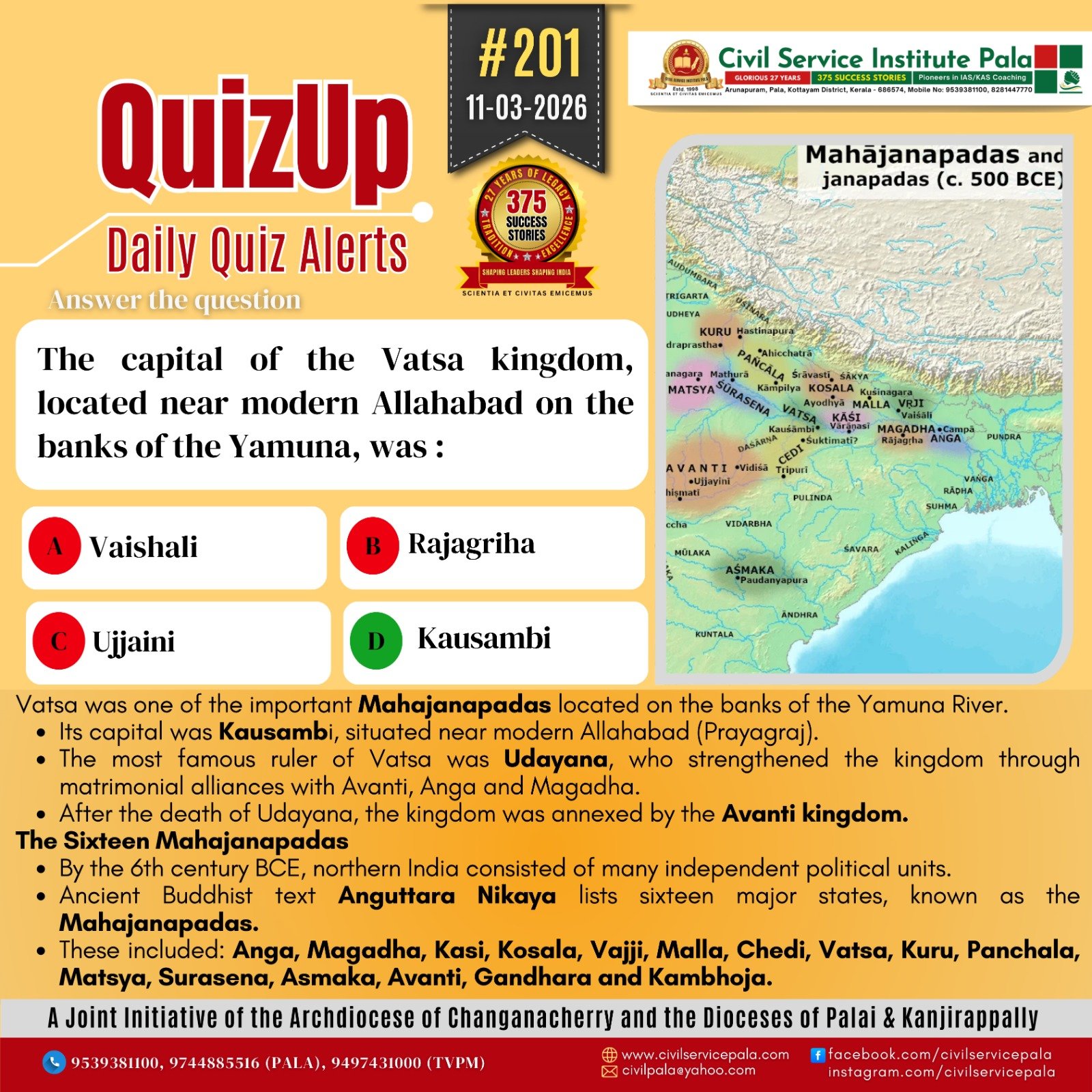
Mahajanapadas in Ancient India
Emergence of Early Kingdoms (6th Century BCE)
• By the 6th century BCE, northern India consisted of many independent political units.
• These states had two forms of governance: monarchies (ruled by kings) and republics (ruled by assemblies).
• Monarchies were mainly concentrated in the Gangetic plains, while republics were found in the Himalayan foothills and north-western India.
Nature of Republican States
• Some republics were organised around single tribes, such as the Sakyas, Licchavis and Mallas.
• Political authority rested in a Public Assembly, made up of tribal leaders or heads of families.
• Decisions were taken through majority voting, showing early forms of collective political decision-making.
The Sixteen Mahajanapadas
• Ancient Buddhist text Anguttara Nikaya lists sixteen major states, known as the Mahajanapadas.
• These included: Anga, Magadha, Kasi, Kosala, Vajji, Malla, Chedi, Vatsa, Kuru, Panchala, Matsya, Surasena, Asmaka, Avanti, Gandhara and Kambhoja.
• Jain texts also refer to the existence of these sixteen major political units.
• The Mahajanapadas represent the second stage of state formation in ancient India, after the early Vedic tribal states.
Political Transformation and Power Struggles
• Over time, weaker kingdoms were absorbed by stronger ones through conquest or submission.
• By the mid-6th century BCE, only four major kingdoms survived: Vatsa, Avanti, Kosala and Magadha.
• This consolidation of power eventually paved the way for large territorial empires in ancient India.
Vatsa Kingdom
• Vatsa was one of the important Mahajanapadas located on the banks of the Yamuna River.
• Its capital was Kausambi, situated near modern Allahabad (Prayagraj).
• The most famous ruler of Vatsa was Udayana, who strengthened the kingdom through matrimonial alliances with Avanti, Anga and Magadha.
• After the death of Udayana, the kingdom lost its independence and was annexed by the Avanti kingdom.
Avanti
• Avanti had its capital at Ujjain, and its powerful ruler Pradyota strengthened the kingdom through alliances and patronised Buddhism; later the kingdom was annexed by Magadha.
Kosala
• Kosala, with its capital at Ayodhya, was ruled by King Prasenajit, who strengthened ties with Magadha through matrimonial alliances, but the kingdom was eventually absorbed by Magadha after his death.