



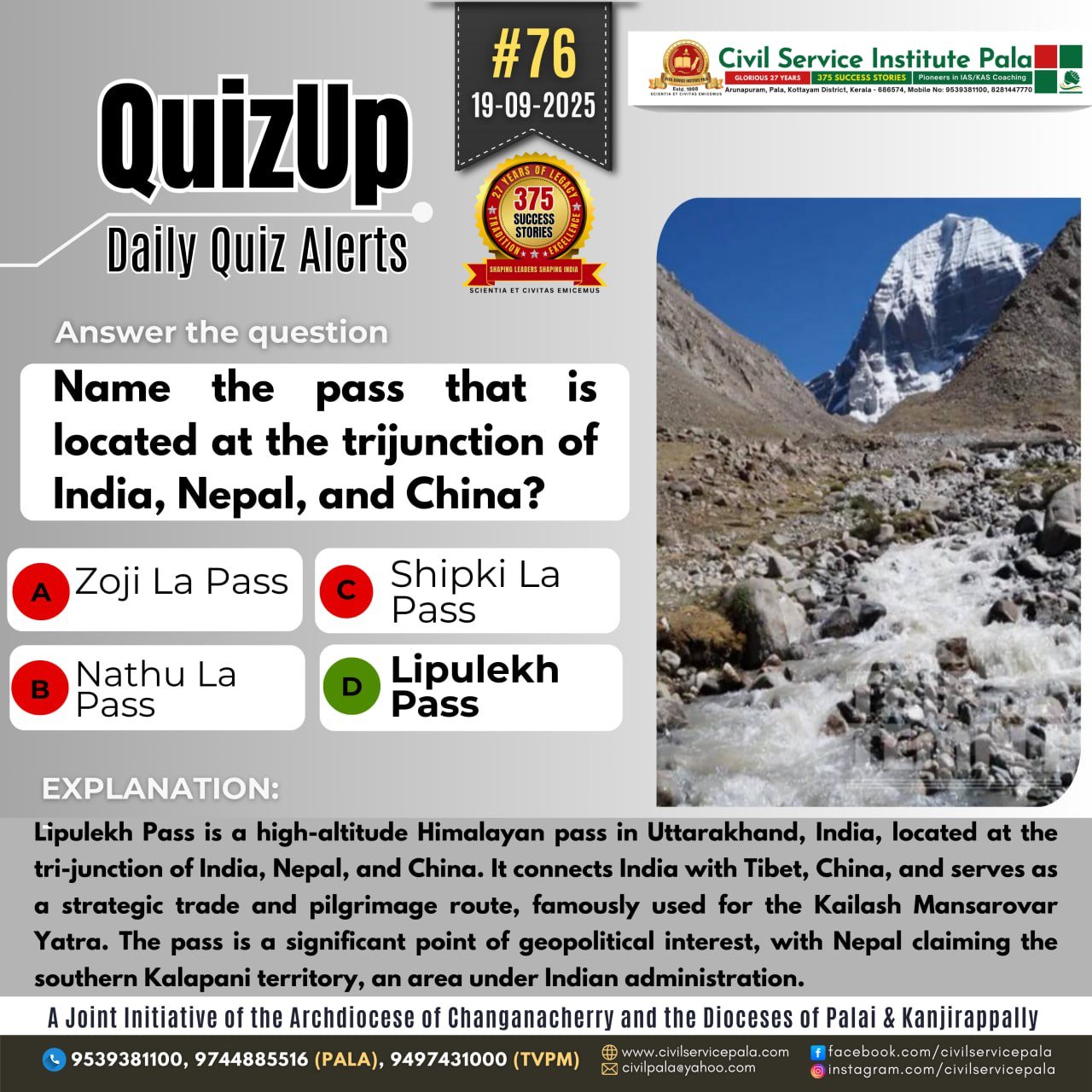
Lipulekh Pass
The Lipulekh Pass is a high-altitude mountain pass in the Himalayas, and it holds great strategic, economic, and cultural importance for India. Here’s a breakdown:
Location Lies at the trijunction of India, Nepal, and China (Tibet Autonomous Region). Altitude: around 5,000 meters. Located in Uttarakhand’s Pithoragarh district (India).
Strategic Importance India–China Border Security Provides India with a crucial entry point into the Tibet Autonomous Region. Important for the movement of troops and supplies along the India-China border. The region has witnessed border tensions, making the pass geopolitically sensitive. India–Nepal Relations The pass is part of the India–Nepal boundary dispute (Nepal claims Lipulekh, Kalapani, and Limpiyadhura as its territory). Strategic for bilateral diplomacy, since disputes here often affect wider India–Nepal ties. China Factor Close to China’s strategic road network in Tibet. Any infrastructure development in this pass region is seen with concern by both China and Nepal. India uses it as a surveillance and logistical point in the sensitive Himalayan frontier.
Economic & Trade Significance Serves as a trade route with Tibet/China (mainly for barter and local trade in limited goods). India and China have designated it as an official border trading point. Used for exchange of commodities like wool, salt, and daily-use items between border communities.
Cultural & Religious Importance Lipulekh Pass is a key route for the Kailash Mansarovar Yatra (a pilgrimage to Mount Kailash and Mansarovar Lake in Tibet). Thousands of Indian pilgrims cross this pass each year under a regulated arrangement with China.
Recent Developments In 2020, India inaugurated a new road to Lipulekh Pass, shortening travel time for pilgrims to Kailash Mansarovar. Nepal strongly protested, claiming the territory, which strained India–Nepal relations. The pass thus remains a flashpoint of strategic and diplomatic tensions.
