



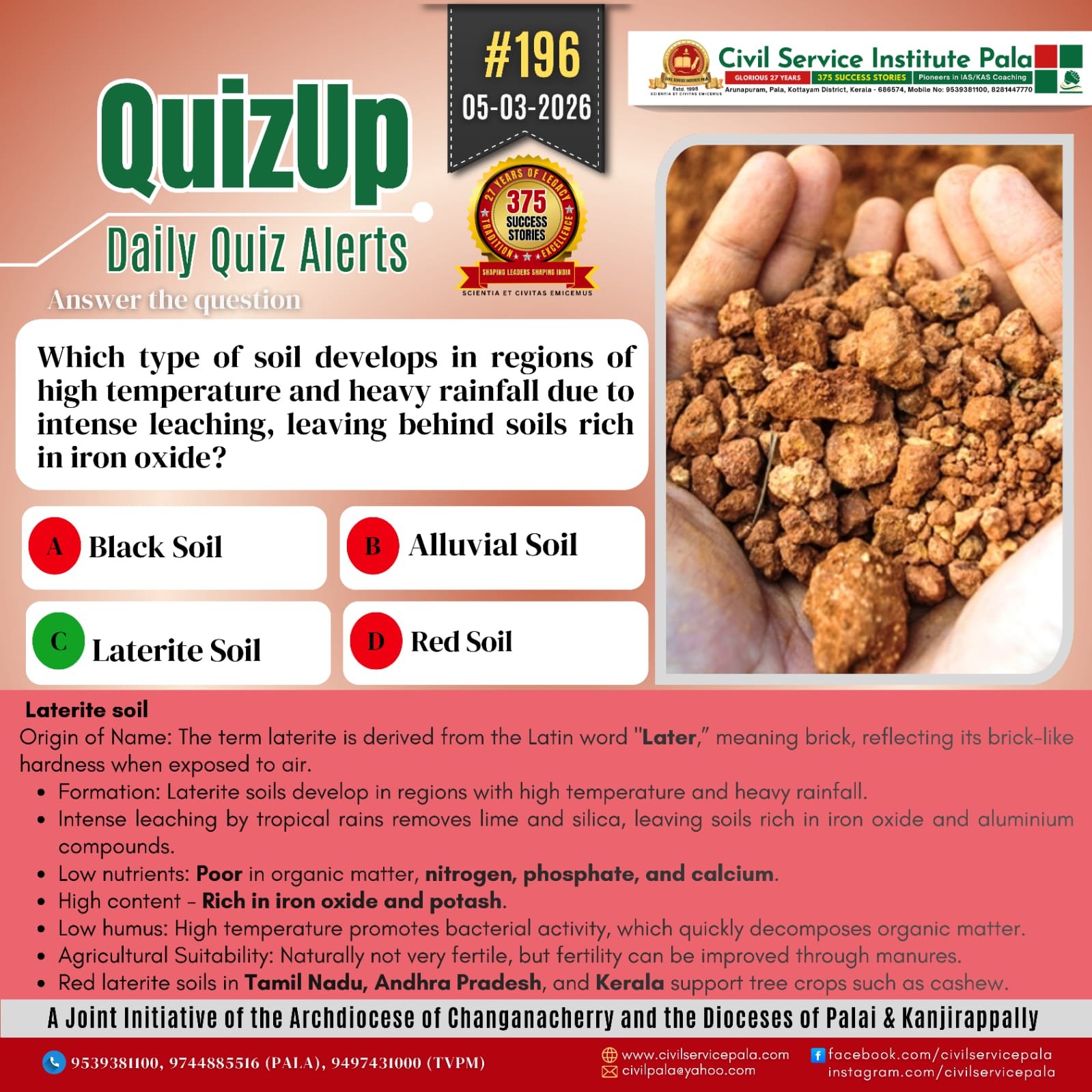
Laterite Soil
Origin of Name: The term laterite is derived from the Latin word "Later,” meaning brick, reflecting its brick-like hardness when exposed to air.
Formation: Laterite soils develop in regions with high temperature and heavy rainfall. Intense leaching by tropical rains removes lime and silica, leaving soils rich in iron oxide and aluminium compounds.
Soil Characteristics:
Low nutrients: Poor in organic matter, nitrogen, phosphate, and calcium.
High content - Rich in iron oxide and potash.
Low humus: High temperature promotes bacterial activity, which quickly decomposes organic matter.
* Agricultural Suitability: Naturally not very fertile, but fertility can be improved through manures and fertilizers. Red laterite soils in Tamil Nadu, Andhra Pradesh, and Kerala support tree crops such as cashew.
* Uses: Due to its hardness, laterite is widely cut into bricks and used in house construction.
* Distribution: Mainly found in higher areas of the Peninsular Plateau, especially in Karnataka, Kerala, Tamil Nadu, Madhya Pradesh, and the hilly regions of Odisha and Assam.
Major soil types of India
* Alluvial Soil: Formed by river deposition and widely found in the Indo-Gangetic plains, it is highly fertile and ideal for crops like rice, wheat and sugarcane.
* Black Soil (Regur): Derived from Deccan basalt lava, it has high moisture retention and is best suited for cotton cultivation
* Red Soil: Formed from weathering of crystalline rocks, it appears red due to iron oxide and is common in the eastern and southern Peninsular plateau.
* Laterite Soil: Develops under high rainfall and temperature with intense leaching, leaving soils rich in iron and aluminium.
* Arid Soil: Found in western Rajasthan and dry regions, it has high salt content and low organic matter.
* Forest/Mountain Soil: Occurs in hilly and mountainous regions and varies with altitude and vegetation cover.
