



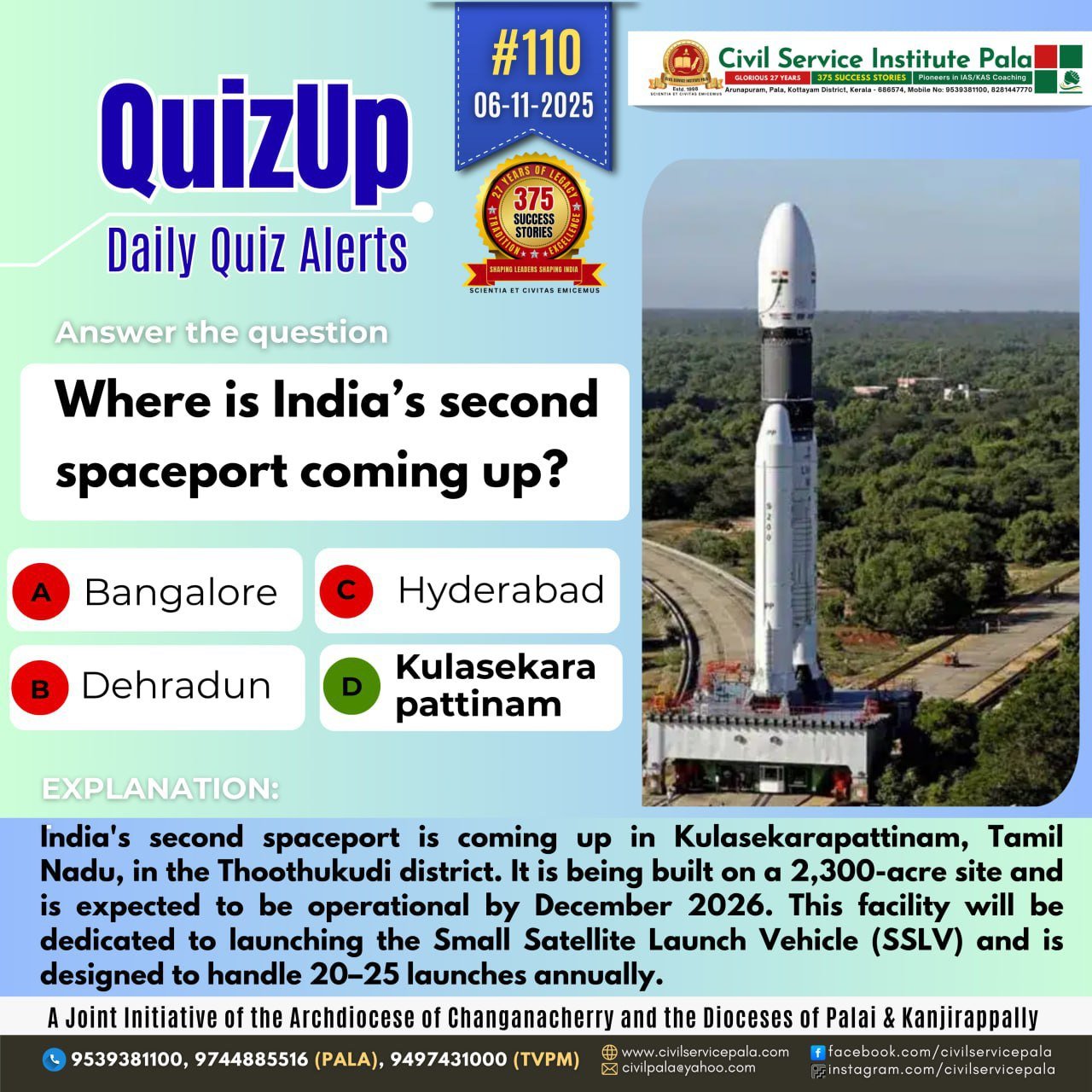
Kulasekarapattinam
Location: Coastal village of Kulasekarapattinam, in the Thoothukudi district (formerly Tuticorin) of Tamil Nadu. When: The foundation stone was laid on 28 February 2024 by Prime Minister Narendra Modi.
Target commissioning: The facility is intended to be operational in fiscal year 2026-27 (by end of 2026 or into 2027). Purpose & Focus The new spaceport is being developed specifically for small-satellite launches, especially using ISRO’s Small Satellite Launch Vehicle (SSLV) class of rockets. It is expected to complement the existing primary launch facility at Satish Dhawan Space Centre, SHAR (Sriharikota) in Andhra Pradesh, freeing that site for larger missions.
The site is also intended to support commercial, on-demand launches, including by non-government/private entities. Strategic & Technical Advantages Geographical advantage: Kulasekarapattinam offers a direct south-bound launch trajectory over the Indian Ocean without needing a “dog-leg” maneuver to avoid landmasses (as required at Sriharikota for some polar launches). This yields better payload capability and fuel efficiency.
Designed to handle rockets launching small satellites up to ~500 kg (in many references) into Low Earth Orbit (LEO) or sun-synchronous/polar orbits. The facility will include launch pad, rocket integration and stage-assembly facilities, mobile launch structure (in some descriptions), ground range and check-out facilities. Timeline & Current Status Land acquisition: The land-acquisition process has largely been completed (except for some minor adjustments, e.g., re-routing of the east-coast road) as of mid-2025. Construction: Major site development and technical facility construction are underway. First launch schedule: The aim is to have the first SSLV (or equivalent small-launcher) mission from this spaceport within ~24 months of start (i.e., some sources point to late 2026 or possibly 2027).
Significance Boost to India’s small-satellite launch market: With growing global demand for launching small satellites, this facility positions India to capture a share of that market. Private sector participation: By dedicating infrastructure to “on-demand” and small‐satellite launches, the spaceport helps liberalise access to space launch capabilities in India. Relieving existing launch site: The facility allows Sriharikota to focus on more complex and heavy-lift missions, while small-vehicle launches shift to Kulasekarapattinam.
Strategic autonomy and global competitiveness: Offers India enhanced launch flexibility and capacity, strengthening its role in global space infrastructure.
