



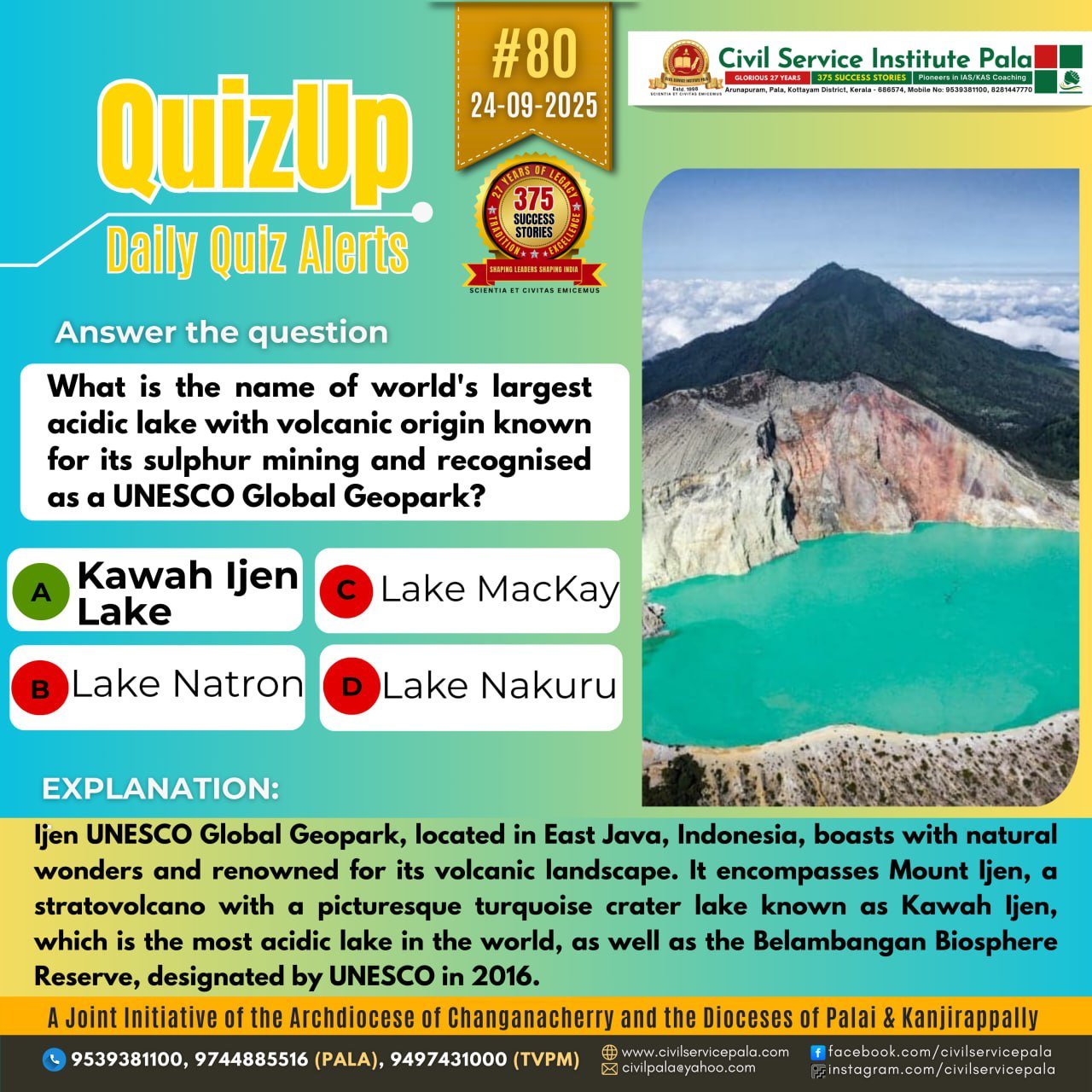
Kawah Ijen lake
Kawah Ijen lake, located in East Java, Indonesia, is the world's largest highly acidic crater lake. It lies within the caldera of the active Kawah Ijen volcano. The lake is approximately 200 meters deep with a volume of about 36 cubic hectometres, and it covers an area of roughly 0.41 square kilometers.
Its water is striking turquoise-blue due to extreme acidity combined with high concentrations of dissolved metals. The lake's acidity is extraordinarily intense, with pH values measured as low as 0.13 to below 0.3 in some parts. This level of acidity is comparable to or even stronger than car battery acid, making it highly corrosive—it can dissolve human skin and even clothes.
The acidity results from hydrothermal fluids charged with sulfuric and hydrochloric acids rising from a magma chamber beneath the volcano. Besides the lake's acidic nature, Kawah Ijen is known for its sulfur mining activity. Sulfur gases emitted from fumaroles around the lake surface ignite upon contact with oxygen, producing a rare and remarkable electric blue flame visible especially at night.
Despite the extreme environment, the lake supports a community of acidophilic microbes that survive in these harsh conditions. The site is also part of the UNESCO Global Geopark, attracting tourists who come to witness the blue flames and the unique acidic lake landscape.
