



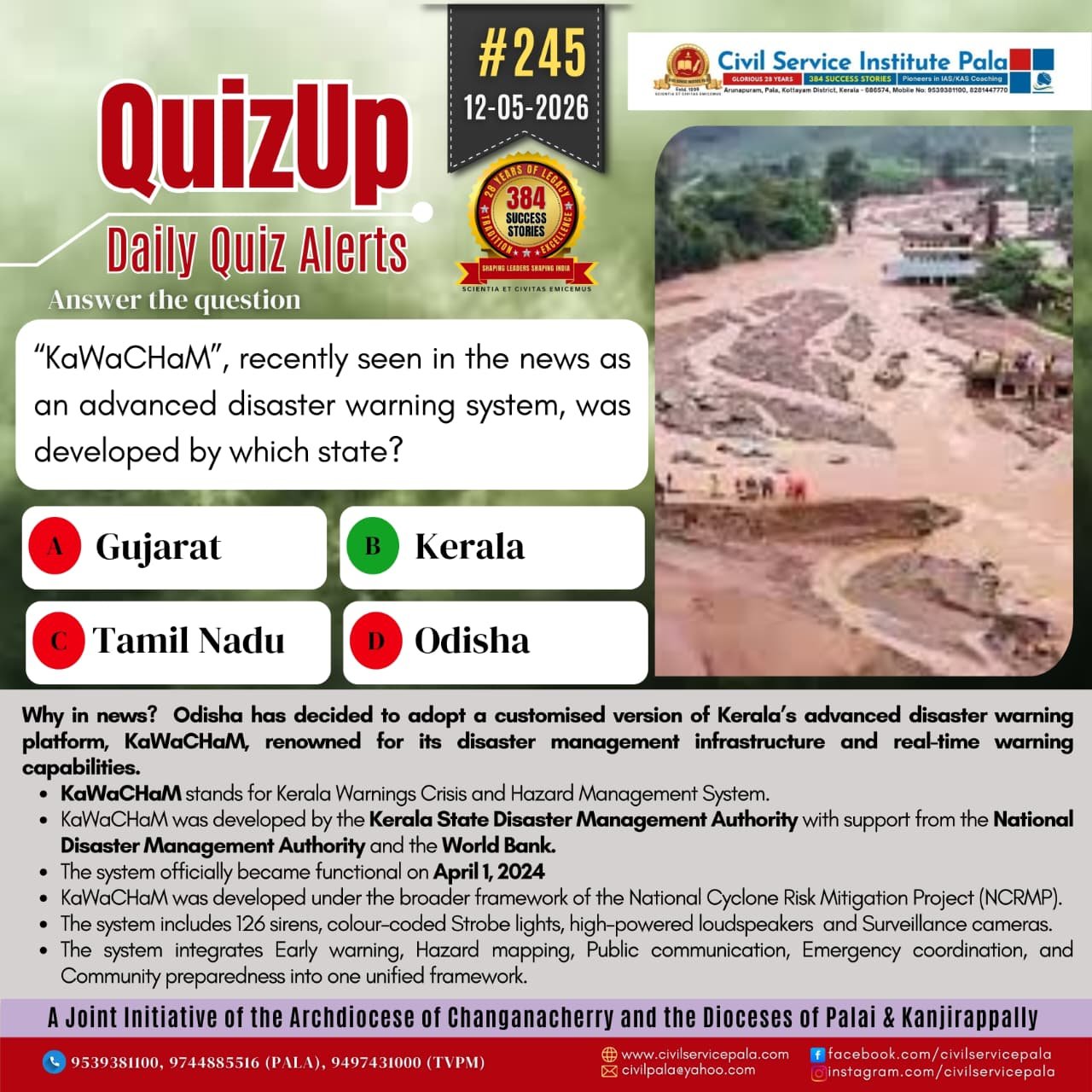
KaWaCHaM stands for Kerala Warnings Crisis and Hazard Management System
Why in News?
Odisha has decided to adopt a customised version of Kerala’s advanced disaster warning platform, KaWaCHaM, renowned for its disaster management infrastructure and real-time warning capabilities.
What is KaWaCHaM?
KaWaCHaM stands for Kerala Warnings Crisis and Hazard Management System. The term Kavacham in Malayalam means “shield,” symbolising protection against disasters and emergencies.
It is an advanced intelligent disaster management and early warning dissemination system developed by the Kerala State Disaster Management Authority with support from the National Disaster Management Authority and the World Bank.
The system officially became functional on April 1, 2024 and was formally inaugurated by the Chief Minister of Kerala on January 21, 2025.
KaWaCHaM has been designed as a cutting-edge, technology-driven platform that integrates real-time hazard monitoring, early warning dissemination, risk assessment, and coordinated emergency response into a single framework.
Why Kerala Needed KaWaCHaM
Kerala is highly vulnerable to hydro-meteorological and geological disasters due to its unique geography and climatic conditions.
The state has:
· A coastline of nearly 570 km
· High population density in coastal regions
· Heavy monsoon rainfall
· Landslide-prone hilly regions
· Flood-prone river basins
· Increasing exposure to climate change-induced extreme weather events
The devastating Kerala Floods(2018) and the deadly Wayanad Landslide(2024) exposed the urgent need for a more integrated and faster early warning system capable of protecting vulnerable populations. KaWaCHaM emerged as Kerala’s answer to this growing disaster vulnerability.
National Cyclone Risk Mitigation Project (NCRMP).
KaWaCHaM was developed under the broader framework of the National Cyclone Risk Mitigation Project (NCRMP).
The NCRMP was launched by the Central Government to reduce vulnerability to cyclones and other hydro-meteorological disasters in coastal states.
The project was implemented in phases:
NCRMP Phase I
Covered:
Odisha
Andhra Pradesh
NCRMP Phase II
Covered:
Goa
Gujarat
Karnataka
Kerala
Maharashtra
West Bengal
The NCRMP includes four major components:
Early Warning Dissemination Systems (EWDS)
Cyclone Risk Mitigation Infrastructure
Technical Assistance and Capacity Building
Implementation Support
Under Component A relating to Early Warning Dissemination Systems, Kerala developed KaWaCHaM.
Major Features of KaWaCHaM
KaWaCHaM integrates advanced technologies to create a highly responsive disaster warning ecosystem.
Collection of real-time data from geological and hydro-meteorological sensors across the state
Integration of weather information from agencies such as IMD, INCOIS, CWC, private agencies, and global weather models
Using a backend geodatabase consisting of nearly 280 data layers for hazard and vulnerability assessment
Rapid assessment of floods, cyclones, landslides, coastal threats, heavy rainfall, heat waves, and strong winds
One of its most important features is its last-mile warning dissemination capability.
The system includes 126 sirens, colour-coded Strobe lights, high-powered loudspeakers and Surveillance cameras.
These installations are placed on towers, schools, and government buildings across vulnerable areas.
The sirens can:
Broadcast alerts up to 1,200 metres
Deliver live public announcements
Issue colour-coded warnings using red, yellow, and orange strobe lights
The entire network can be centrally activated through:
State Emergency Operations Centre (SEOC)
District Emergency Operations Centres (EOCs)
Governance and Disaster Management Significance
· KaWaCHaM represents a major shift from reactive disaster response to proactive and technology-driven disaster governance.
· The system integrates Early warning, Hazard mapping, Public communication, Emergency coordination, and Community preparedness into one unified framework.
· This improves disaster preparedness, rescue efficiency, rehabilitation planning, public safety, and Inter-agency coordination.
The system is also linked with Kerala’s updated “Orange Book” of disaster management SOPs covering floods, cyclones, landslides, heatwaves, and pandemics.
Volunteer networks such as Samoohika Sannadhasena are also being trained under the project for preparedness, rescue, and rehabilitation support.
The system additionally focuses on inclusivity by incorporating audio alerts, disability-friendly communication, and Sign-language support.
Role During Emergencies
KaWaCHaM was actively used during:
The 2025 monsoon season for real-time siren-based alerts
Operation Abhyas, the nationwide civil defence mock drill conducted after rising tensions following the Pahalgam attack
All 14 districts of Kerala participated in the exercise using KaWaCHaM for emergency communication and civilian preparedness.
This demonstrated the system’s utility not only for natural disasters but also for broader emergency management situations.
