



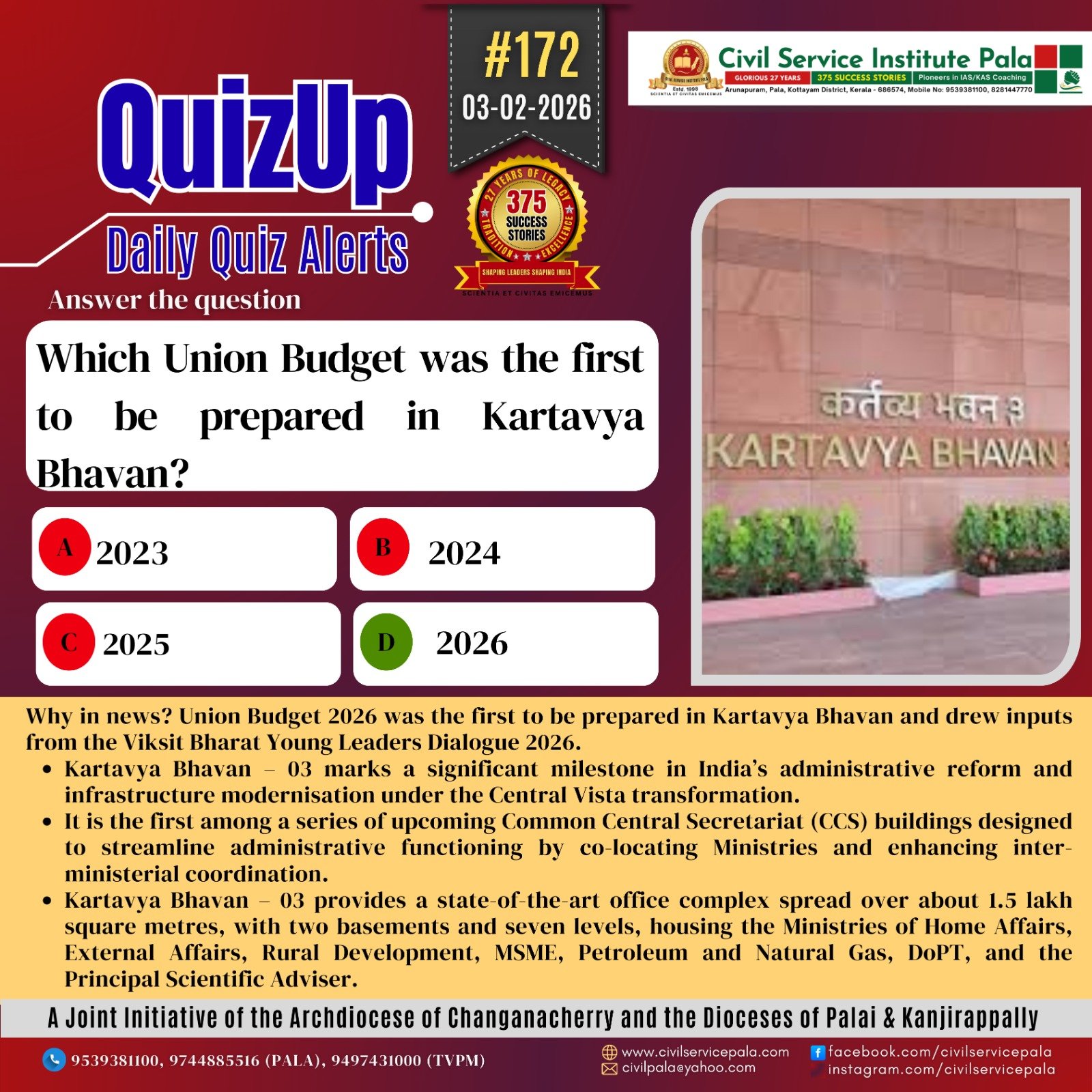
Kartavya Bhavan
Kartavya Bhavan – 03 marks a significant milestone in India’s administrative reform and infrastructure modernisation under the Central Vista transformation. Inaugurated by the Prime Minister at Kartavya Path on August 6,2025, the building reflects the vision of a modern, efficient, and citizen-centric governance ecosystem.
Administrative Integration : Kartavya Bhavan – 03 is the first among a series of upcoming Common Central Secretariat (CCS) buildings designed to streamline administrative functioning by co-locating Ministries and enhancing inter-ministerial coordination.
Legacy Constraints: For decades, key Ministries have operated from aging structures such as Shastri Bhawan, Krishi Bhawan, and Udyog Bhawan, built between the 1950s and 1970s, which are now structurally outdated, maintenance-heavy, and inefficient.
Modern Infrastructure : Kartavya Bhavan – 03 addresses these challenges by providing a state-of-the-art office complex spread over about 1.5 lakh square metres, with two basements and seven levels, housing the Ministries of Home Affairs, External Affairs, Rural Development, MSME, Petroleum and Natural Gas, DoPT, and the Principal Scientific Adviser.
Smart Governance : The building is designed to promote efficiency, collaboration, and agile governance, with IT-ready secure workspaces, ID-based access controls, integrated surveillance, and a centralized command system. It also sets a benchmark in sustainable governance infrastructure, targeting a GRIHA-4 rating. Key green features include double-glazed façades, rooftop solar panels generating over 5.34 lakh units of electricity annually, solar water heating meeting more than 25% of daily demand, advanced HVAC systems, rainwater harvesting, and zero-discharge wastewater treatment with reuse.
Energy Efficiency : Kartavya Bhavan – 03 is engineered to consume 30% less energy, supported by LED lighting, occupancy sensors, smart lifts, energy-management systems, and noise-reducing, heat-resistant glass. Sustainability is further reinforced through recycled construction and demolition waste, in-house solid waste management, lightweight partitions to reduce resource use, and electric vehicle charging infrastructure.
