



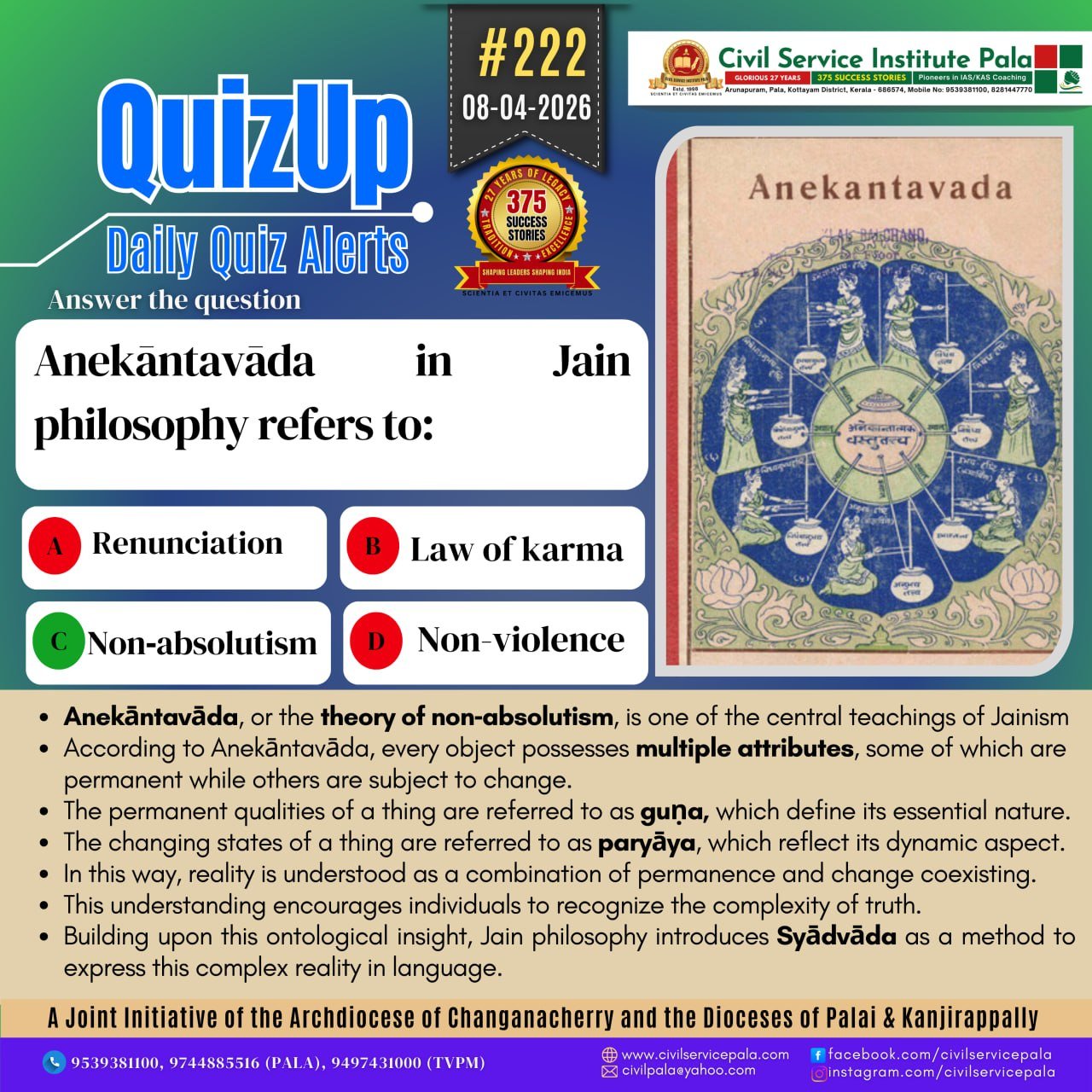
Jain Philosophy and Anekantavada
* Jain philosophy is rooted in the teachings of twenty-four Tīrthaṅkaras, who are regarded as spiritual guides that show the path to liberation.
* The first Tīrthaṅkara is traditionally considered to be Ṛṣabhadeva, while Pārśvanātha (23rd Tīrthaṅkara) and Mahāvīra (24th Tīrthaṅkara) are accepted as historical figures.
* The term “Jaina” is derived from the word Jina, meaning the conqueror, which signifies the conquest over passions such as anger, greed, and desire.
* Mahāvīra, the last Tīrthaṅkara, is called Jina because he attained supreme knowledge by overcoming all worldly attachments.
Literary sources
* The early teachings of Jainism were transmitted in Prakrit, which made them accessible to the common people.
* Over time, Sanskrit was adopted for more formal philosophical articulation and scholarly discourse.
* A systematic exposition of Jain philosophy is found in the Tattvārthādhigamasūtra written by Umāsvāti in the second century CE.
Core Philosophical Framework
* Jain philosophy presents a dualistic framework in which consciousness (jīva) and matter (ajīva) are treated as two independent and eternal realities.
* It rejects the idea of a supreme creator God and instead explains the universe as self-regulating and eternal in nature.
* The process of creation, preservation, and destruction is governed by the law of karma rather than divine intervention.
Concept of Karma and Liberation
* Karma in Jainism is conceived as a subtle material substance that binds the soul and determines its experiences across births.
* Liberation is achieved when the soul is freed from karmic bondage through right knowledge, right faith, and right conduct.
* This ethical orientation makes morality and self-discipline central to the Jain path of spiritual progress.
Nature and Limitations of Knowledge
* Within this broader framework, Jain philosophy develops a distinctive theory of knowledge that emphasizes the limitations of human perception.
* It argues that human knowledge is inherently partial because it is influenced by passions such as anger, ego, and attachment.
* As a result, any claim to absolute or complete knowledge from a single perspective is considered philosophically inadequate.
Doctrine of Anekāntavāda
* This insight leads to the doctrine of Anekāntavāda, which asserts that reality is multifaceted and cannot be fully captured from one viewpoint.
* According to Anekāntavāda, every object possesses multiple attributes, some of which are permanent while others are subject to change.
* The permanent qualities of a thing are referred to as guṇa, which define its essential nature.
* The changing states or modifications of a thing are referred to as paryāya, which reflect its dynamic aspect.
* Therefore, reality is understood as a combination of permanence and change, both of which coexist simultaneously.
* This understanding encourages individuals to recognize the complexity of truth and to avoid one-sided interpretations.
Doctrine of Syādvāda (Conditional Expression of Truth)
* Building upon this ontological insight, Jain philosophy introduces Syādvāda as a method to express this complex reality in language.
* Syādvāda holds that all statements are conditional and must be qualified by the term “syāt,” meaning “from a particular perspective.”
* It emphasizes that any proposition can only represent a partial truth depending on the standpoint from which it is made.
* This approach is further elaborated through the doctrine of sevenfold predication, which presents multiple possible ways of describing reality.
* The sevenfold scheme allows for statements that affirm, deny, or combine both affirmation and denial under different conditions.
Philosophical Significance
* In this way, Syādvāda provides a logical framework to articulate the many-sided nature of truth proposed by Anekāntavāda.
* While Anekāntavāda explains the nature of reality as complex and plural, Syādvāda explains how such reality should be described cautiously and conditionally.• Together, these doctrines form a coherent philosophical system that rejects absolutism and promotes epistemological humility.
* This framework ultimately fosters tolerance, open-mindedness, and respect for diverse perspectives in both philosophical inquiry and social interaction.
