



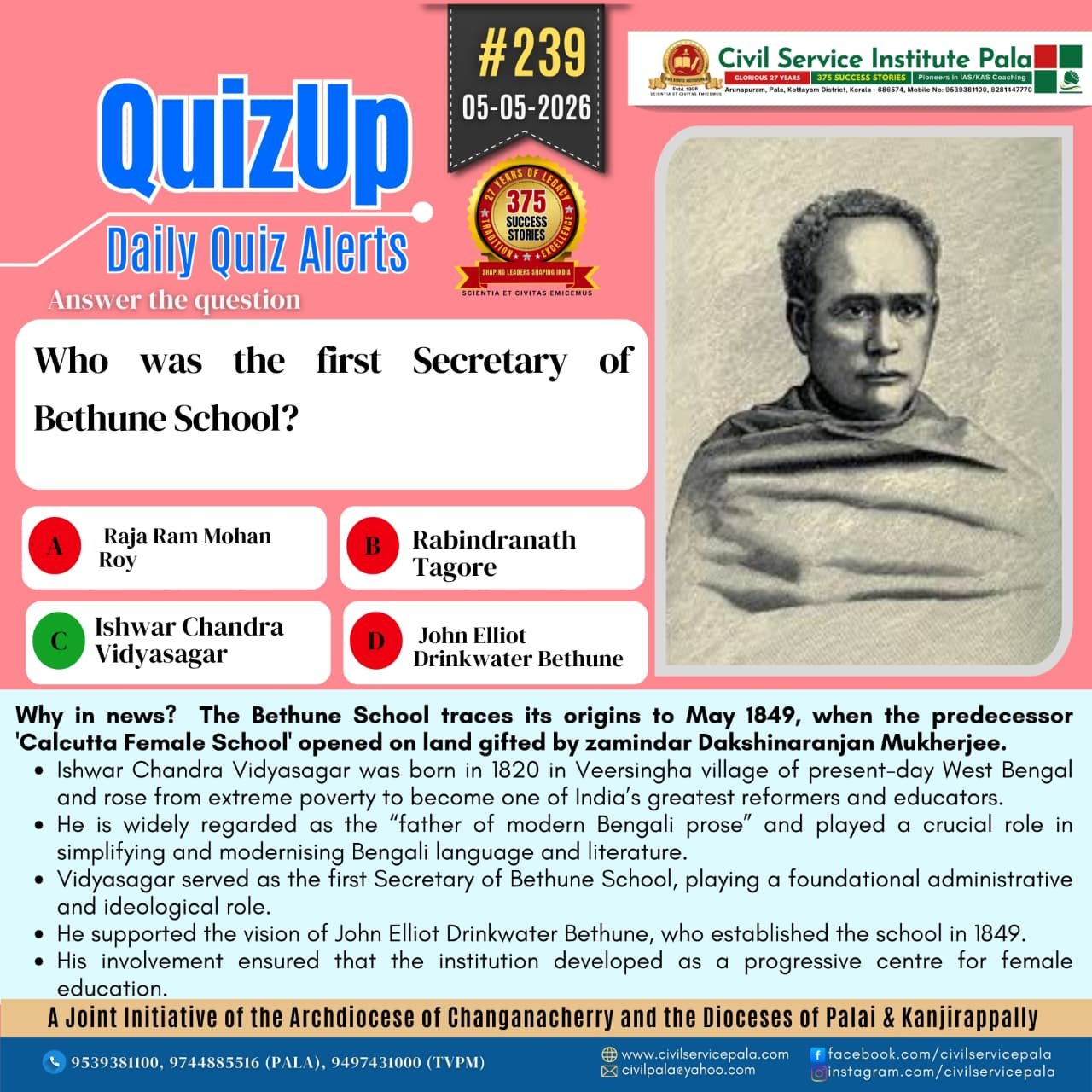
Ishwar Chandra Vidyasagar
Ishwar Chandra Vidyasagar
• Ishwar Chandra Vidyasagar was born in 1820 in Veersingha village of present-day West Bengal and rose from extreme poverty to become one of India’s greatest reformers and educators.
• He joined Fort William College in 1841 as the head of the Sanskrit department, marking the beginning of his influential academic career.
• He is widely regarded as the “father of modern Bengali prose” and played a crucial role in simplifying and modernising Bengali language and literature.
• Vidyasagar was a pioneering reformer who strongly advocated for widow remarriage, leading to its legalisation in 1856.
• He actively campaigned against child marriage and polygamy, highlighting the need for social justice and gender equality.
• He promoted inclusive education by opening institutions to lower caste students, breaking traditional caste barriers in education.
• His famous work Varna Parichay became a foundational text for Bengali language learning and mass literacy.
Vidyasagar and Bethune School
• Vidyasagar served as the first Secretary of Bethune School, playing a foundational administrative and ideological role.
• He supported the vision of John Elliot Drinkwater Bethune, who established the school in 1849 to promote women’s education in India.
• His involvement ensured that the institution developed as a progressive centre for female education and social reform.
• Vidyasagar believed that education was the key to women’s empowerment and social transformation.
• Through his association with Bethune School, he helped institutionalise formal education for girls, which was rare in 19th-century India.
• His reformist outlook influenced the school’s inclusive approach, making it accessible to women from diverse social and religious backgrounds.
Growth of Bethune School into Bethune College
• Bethune School, founded in 1849, evolved into Bethune College in 1879, becoming the first women’s college in India and Asia.
• The institution gained prominence for producing pioneers like Kadambini Bose (Ganguly) and Chandramukhi Bose, the first female graduates of the British Empire in 1883.
• The college received affiliation from the University of Calcutta in 1888 and became a hub of academic excellence and women’s intellectual activity.
• It also hosted important social and political discussions, including a major women’s meeting during the 1906 Indian National Congress session.
