



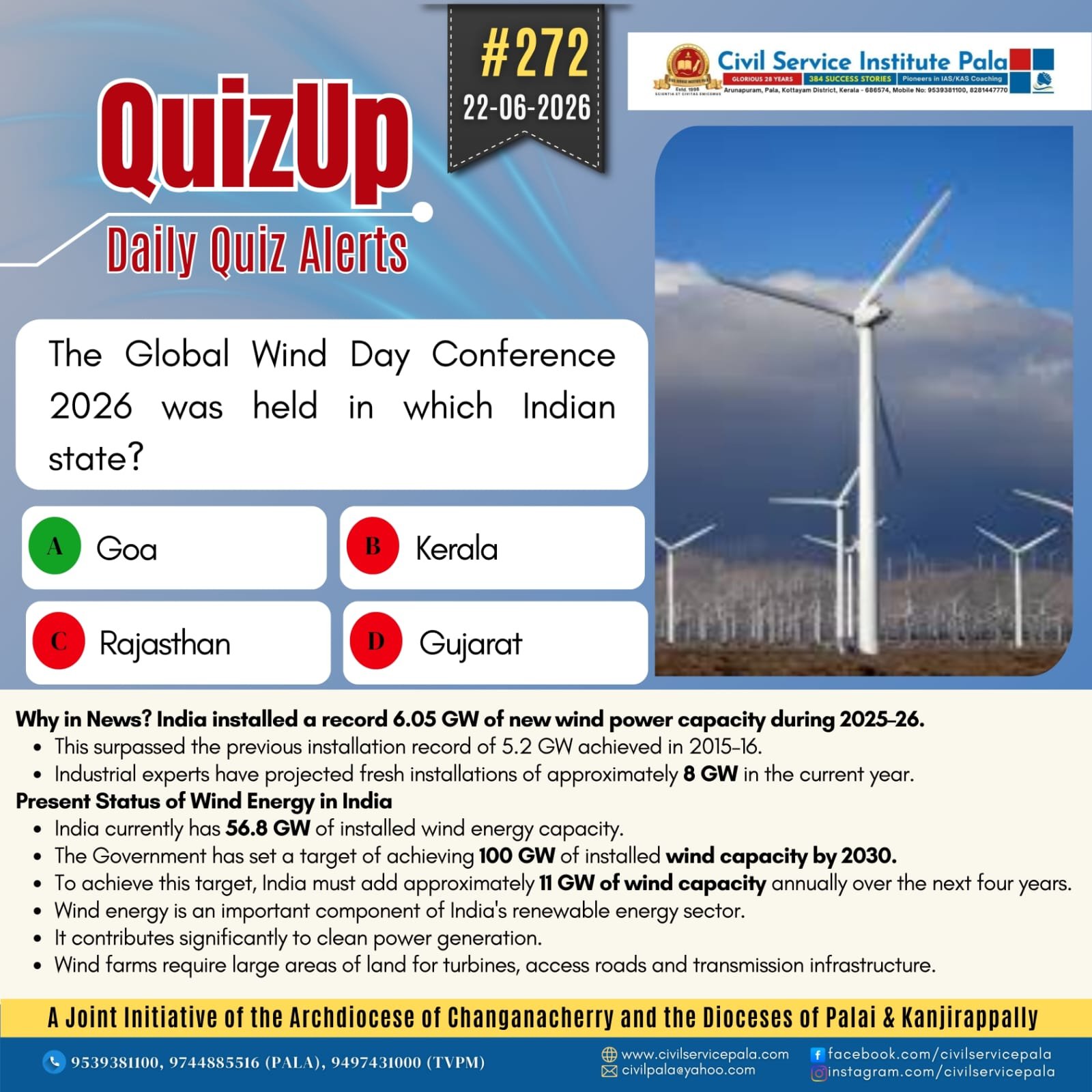
India’s Wind Energy Sector
India’s Wind Energy Sector
Why in News?
• India installed a record 6.05 GW of new wind power capacity during 2025–26.
• This surpassed the previous installation record of 5.2 GW achieved in 2015–16.
• The Indian Wind Turbine Manufacturers Association (IWTMA) has projected fresh installations of approximately 8 GW in the current year.
• Despite the record additions, the industry has expressed serious concerns regarding Right of Way (RoW) issues.
Present Status of Wind Energy in India
• Wind energy is an important component of India's renewable energy sector and contributes significantly to clean power generation.
• Wind farms require large areas of land for turbines, access roads, transmission infrastructure and transportation of equipment.
• Recent technological advancements have enabled wind projects to expand into regions that were previously considered unsuitable for wind energy generation.
• India currently has 56.8 GW of installed wind energy capacity.
• The Government has set a target of achieving 100 GW of installed wind capacity by 2030.
• To achieve this target, India must add approximately 11 GW of wind capacity annually over the next four years.
• Industry leaders have warned that achieving this target may become difficult unless existing bottlenecks are resolved.
Right of Way (RoW): The Major Challenge
What is RoW?
• Right of Way (RoW) refers to the legal right to use land belonging to another person or entity for a specific purpose, such as roads, transmission lines, pipelines, railways, or other infrastructure projects.
• RoW deals with obtaining access across land for the movement of equipment and development of project infrastructure.
• Wind projects require access for turbines, transmission lines, access roads, cranes and construction materials.
Why is the Problem Increasing?
• Wind projects are now spreading into a larger number of locations due to improvements in turbine technology.
• Developers increasingly interact with multiple landowners and local interest groups.
• Protests, compensation disputes and local opposition have increased project delays and costs.
• In several cases, disruptions occur after substantial investments have already been made in project construction.
• The growing size of wind turbines has worsened transportation challenges.
• Modern turbine blades now exceed 80 metres in length, making movement of equipment more difficult.
Impact on the Sector
• Project execution becomes slower and more expensive.
• Developers face repeated delays and additional compensation demands.
• Industry representatives have warned that persistent RoW issues could affect future capacity additions.
Andhra Pradesh Model
• Andhra Pradesh has adopted a land-leasing approach for renewable energy development.
• The State leases land from owners at approximately ₹30,000 per acre per year.
• The lease includes a 5% escalation every two years.
• Many landowners have opted to participate in the programme.
• The State is in the process of acquiring 1.5 lakh acres on a 25-year lease basis for renewable energy development.
• Officials have indicated that this model has helped avoid significant RoW issues.
Way Forward
• Resolution of Right of Way issues is essential for sustaining future wind energy growth.
• Better coordination between developers, local communities and State governments can help reduce project delays.
• Successful implementation of models such as land leasing may help facilitate future renewable energy expansion
