



India’s Historic Double Sculls Medal — Asian Games 2026
India’s Historic Double Sculls Medal — Asian Games 2026
Why in News?
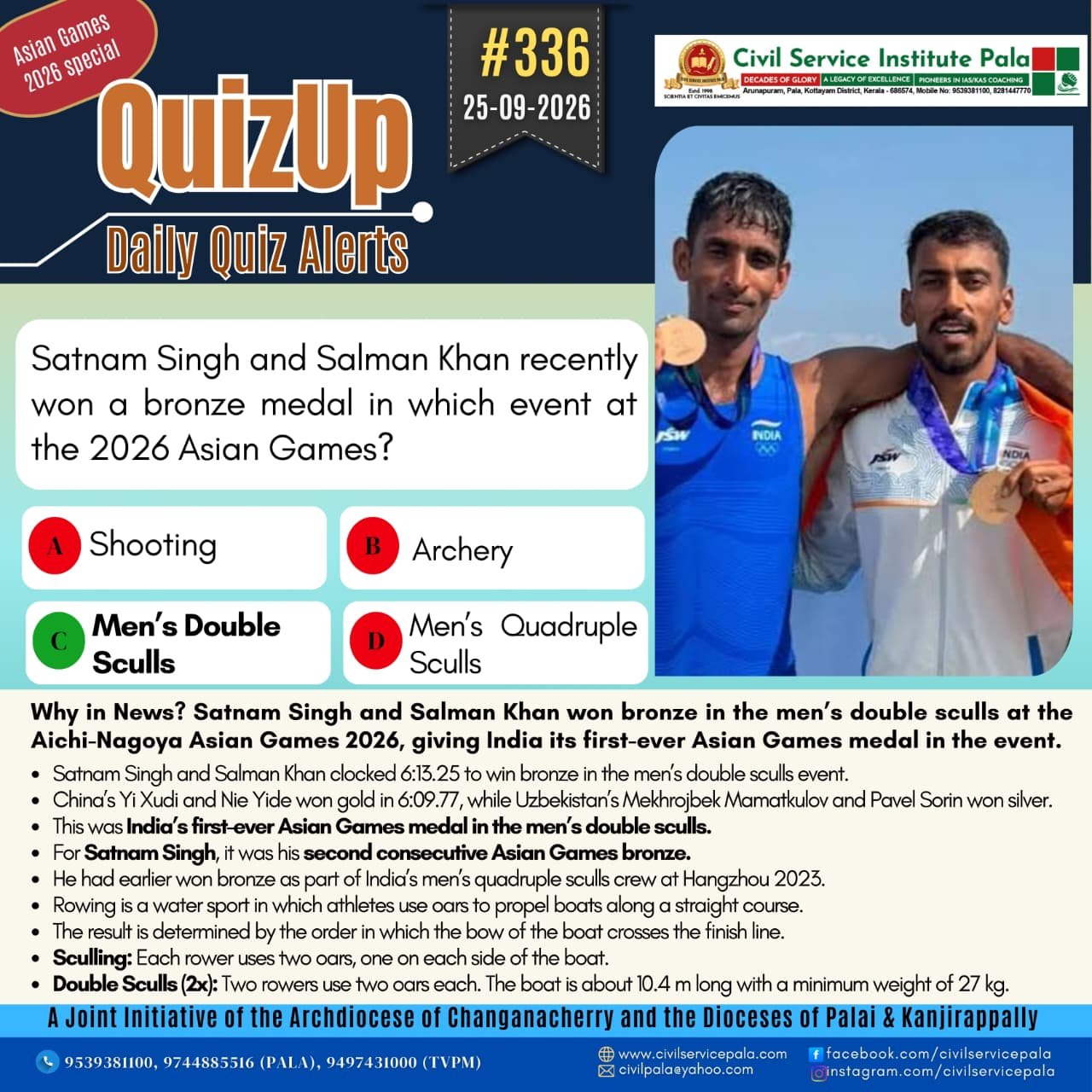
Satnam Singh and Salman Khan won bronze in the men’s double sculls at the Aichi-Nagoya Asian Games 2026, giving India its first-ever Asian Games medal in the event.
1. India’s Historic Double Sculls Medal
• Satnam Singh and Salman Khan clocked 6:13.25 to win bronze in the men’s double sculls (2x) at the Nagaragawa International Regatta Course.
• China’s Yi Xudi and Nie Yide won gold in 6:09.77, while Uzbekistan’s Mekhrojbek Mamatkulov and Pavel Sorin won silver in 6:10.49.
• The Indian pair were second at the 500 m, 1000 m and 1500 m marks, but the Uzbek pair overtook them in the final 500 m. India held on to secure bronze.
• This was India’s first-ever Asian Games medal in the men’s double sculls.
• For Satnam Singh, it was his second consecutive Asian Games bronze. He had earlier won bronze as part of India’s men’s quadruple sculls crew at Hangzhou 2023.
• Salman Khan won his maiden Asian Games medal.
India’s Rowing Record
• The bronze took India’s total to 29 Asian Games rowing medals.
• At Hangzhou 2023, India won five rowing medals — two silver and three bronze, equalling its best-ever rowing medal tally from Guangzhou 2010.
• India fielded a 22-member rowing contingent at Aichi-Nagoya 2026, comprising 17 men and five women, across eight events.
• Balraj Panwar came closest to another medal, finishing fourth in the men’s single sculls.
• Rohit and Ujjwal Kumar Singh finished fourth in the lightweight men’s double sculls.
• India’s men’s quadruple sculls crew finished fifth, while the women’s four finished sixth.
• Jaswinder Singh and Nitin Kumar won the men’s Pair Final B and finished seventh overall. Final B is a non-medal classification race.
• Ajay Tyagi reached the Final B of the lightweight men’s single sculls, while India’s men’s four crew was eliminated in the heats.
Understanding Rowing
Rowing is a water sport in which athletes use oars to propel boats along a straight course. The result is determined by the order in which the bow of the boat crosses the finish line.
There are two basic forms of rowing events:
• Sculling: Each rower uses two oars, one on each side of the boat.
• Sweep rowing: Each rower uses one oar, with rowers positioned on opposite sides of the boat.
Major Sculling Events
• Single Sculls (1x): One rower uses two oars. The boat is about 8.2 m long with a minimum weight of 14 kg.
• Double Sculls (2x): Two rowers use two oars each. The boat is about 10.4 m long with a minimum weight of 27 kg.
• Quadruple Sculls (4x): Four rowers use two oars each. The boat is about 13.4 m long with a minimum weight of 50 kg.
• Lightweight Double Sculls (2x): Two rowers compete under specified body-weight limits. For men, the maximum individual weight is 72.5 kg, while the average cannot exceed 70 kg. For women, the limits are 59 kg individually and 57 kg average.
Major Sweep-Rowing Events
• Pair (2-): Two rowers use one sweep oar each. The boat is about 10.4 m long and has a minimum weight of 27 kg.
• Four (4-): Four rowers use one sweep oar each. The boat is about 13.4 m long and has a minimum weight of 50 kg.
• Eight (8+): Eight rowers use sweep oars and are guided by a coxswain, who steers the boat using the rudder. The boat is about 19.9 m long and has a minimum weight of 96 kg.
