



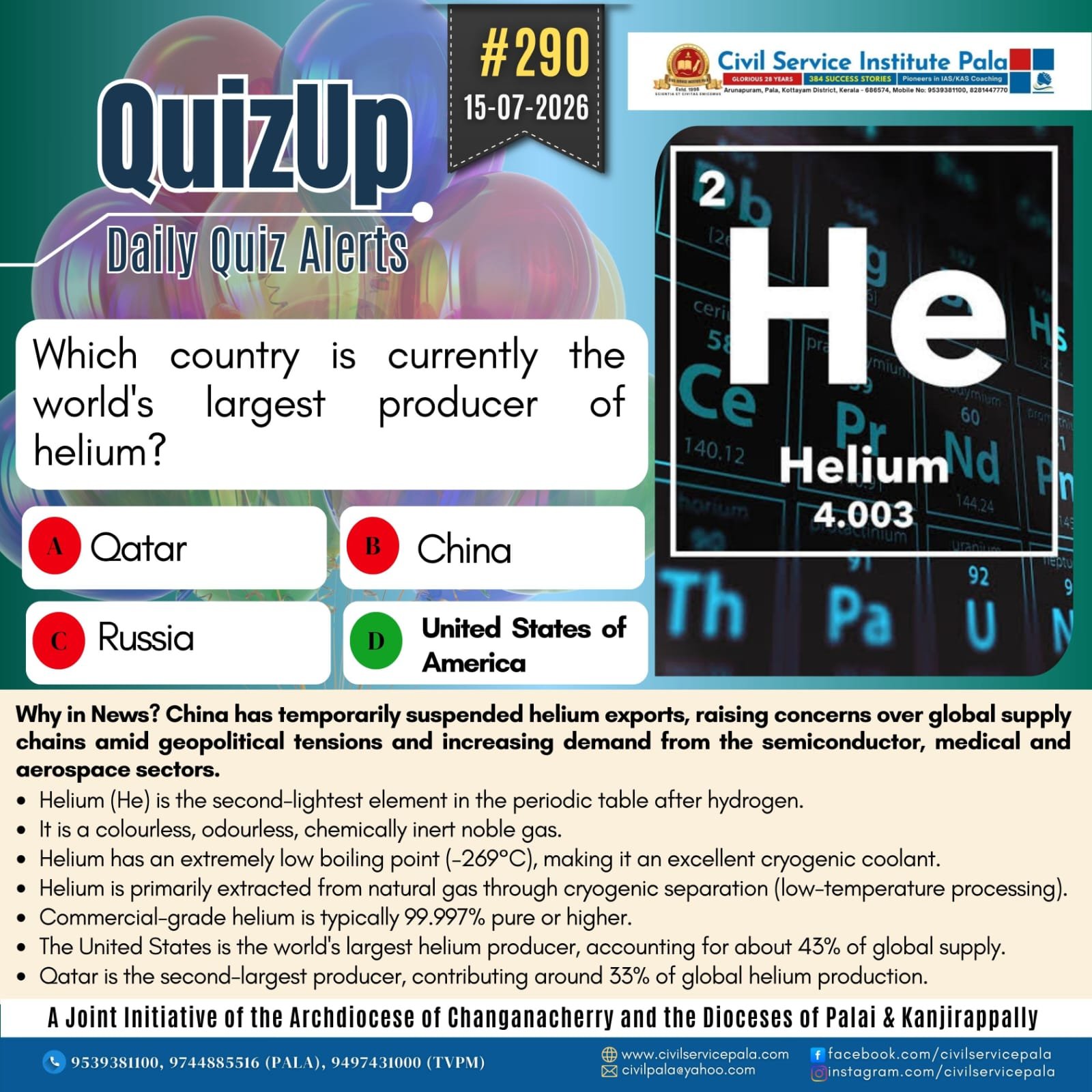
Helium: The Strategic Gas Behind Modern Technology
Helium: The Strategic Gas Behind Modern Technology
Why in News?
China has temporarily suspended helium exports, raising concerns over global supply chains as helium is a critical resource for the semiconductor, medical and aerospace industries.
What is Helium?
• Helium (He) is the second-lightest element after hydrogen.
• It is a colourless, odourless, chemically inert noble gas.
• Its extremely low boiling point (−269°C) makes it an excellent cryogenic coolant.
• Helium is a non-renewable resource, naturally formed by the radioactive decay of uranium and thorium and extracted from natural gas reservoirs through cryogenic separation.
Why is Helium Important?
Helium possess chemical inertness, very low boiling point, low density and tiny atomic size which makes it indispensable for:
• MRI scanners (cooling superconducting magnets)
• Semiconductor and quantum computing industries
• Rocket fuel pressurisation (ISRO, NASA, SpaceX)
• Optical fibre manufacturing
• Precision leak detection
• Scientific research and balloons
Major Helium Producers
• The United States is the world's largest helium producer, accounting for about 43% of global supply.
• Qatar is the second-largest producer, contributing around 33% of global helium production.
• Russia, Canada, and Algeria are also major helium-producing countries.
• China produces only about 1.6% of global helium but imports more than 80% of its domestic requirement, making it heavily dependent on international supplies.
Why Does China's Export Ban Matter?
The restriction comes amid:
• Russian export restrictions and geopolitical tensions in West Asia.
• Supply risks around the Strait of Hormuz, through which much of Qatar's helium exports pass.
• Rising domestic demand from China's semiconductor and medical sectors.
As a result, global helium prices have risen sharply, highlighting helium's growing importance as a strategic resource for advanced technologies, healthcare, defence and space programmes.
